
What is in this guide
Every article that answers this with a dollar figure has quietly guessed at your electricity tariff. Australian tariffs differ by state, by retailer, by plan and increasingly by time of day, so the same appliance genuinely costs different amounts in different houses.
What does not change is the calculation, and both numbers you need are already in your house.
The calculation
Cost = kilowatts × hours × cents per kilowatt hour
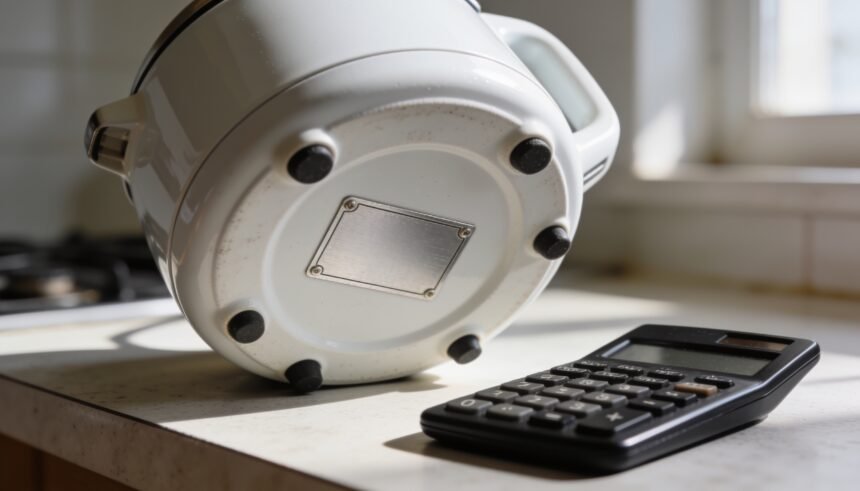
- Kilowatts comes off the appliance. There is a compliance plate or sticker on the back or underneath giving the rated power in watts. Divide by 1000 to get kilowatts. A 1500W air fryer is 1.5kW
- Hours is how long it actually runs, not how long it is switched on. Anything with a thermostat cycles, so a device rated at 2kW running for an hour uses less than 2kWh
- Cents per kilowatt hour is on your electricity bill, usually called the usage or consumption rate. If you are on a time of use plan there will be two or three rates and they matter here
So a 1.5kW air fryer running 20 minutes is 1.5 × 0.33 = about 0.5kWh. Multiply that by your own rate and you have your answer rather than somebody else’s.
Do it once for the three things you cook with most. It takes five minutes and it is the only version of this answer that is true for your house.
Why the air fryer usually wins against the oven
The saving is real and it is mostly not about power rating. It is about mass and time.
A full size oven has a large insulated cavity that has to be brought up to temperature before anything cooks, and that preheat is pure cost. An air fryer has a small cavity, a powerful fan and very little to heat, so it reaches temperature quickly and has less to keep warm.
An oven is typically rated higher than an air fryer as well, but the bigger factor is that the oven is on for longer to do the same job, and much of that time is spent heating air and steel rather than food.
The honest limits on that saving:
- It only applies when the air fryer can actually do the job. Cooking two batches because the basket is small erases most of it
- If the oven is already on, adding a second tray costs almost nothing. Cooking two things in the oven together beats running both appliances
- In winter, oven heat is not entirely wasted, because it heats the kitchen. In summer it is worse than wasted, because anything cooling the house then works against it
The slow cooker, which surprises people
A slow cooker draws very little power, usually in the low hundreds of watts, but it runs for eight hours. Low power for a long time and high power for a short time can land in a similar place, so the intuition that a slow cooker must be cheap because it is gentle does not automatically hold.
Where it genuinely wins is not electricity. It is the meat. A slow cooker exists to turn a cheap cut into a good dinner, and the difference between chuck steak and a premium cut across a week of family meals is far larger than any difference in running cost between appliances. Optimising the appliance and ignoring the ingredient is getting the small decision right and the big one wrong.
The microwave, which is the actual cheapest
For reheating, the microwave beats everything, because it puts energy into the food rather than into the air around it. It is the least fashionable appliance in the kitchen and the most efficient one.
The trade is texture. Anything that was crisp comes back soft. That is exactly the gap the air fryer fills for leftovers, and it is the one job where paying a little more to reheat is worth it.
Time of use tariffs change the answer
If you are on a time of use plan, when you cook may matter more than what you cook with.
Peak periods on Australian time of use plans commonly fall across the early evening, which is precisely when most households cook dinner. If that describes your plan, the cheapest change available is often not an appliance at all. It is cooking earlier, cooking in bulk on a weekend, or running the slow cooker through the cheaper daytime window.
Check your bill for whether you are on a flat rate or time of use before spending anything. Households frequently do not know which they are on.
Where the actual money is
In rough order of size, for a typical household:
- Heating and cooling, which dwarfs everything in the kitchen. Air conditioner running costs is where the real number is
- Hot water
- The fridge, because it never turns off. An old second fridge in the garage is frequently the single most expensive appliance in an Australian house
- The dryer
- Cooking appliances, well down the list
That ordering is not a reason to ignore this. It is a reason to do the five minute calculation, make the easy switch where it helps, and then go and look at the bigger items rather than feeling you have finished.
Buying, if you are buying
- Check the rated power on the compliance plate before you buy, not after
- Check the capacity against your household. A unit too small for your family costs more to run because you use it twice
- Energy rating labels apply to some appliance categories and not others. Where a star rating exists, the comparative energy consumption figure on the label is the number to compare, not the stars alone
The short version
Kilowatts times hours times your own rate. Get the kilowatts off the appliance, get the rate off your bill, and stop reading anyone’s guess including this one.
Which appliance suits which meal is a separate question, and a more useful one day to day: air fryer or slow cooker. And if the reason this came up is a bill that went up, the family budget is the place that actually moves.
The one-page family week
One printable page that holds the whole week: meals, school, activities and who is doing the pickup. Free, and we send one useful email a week.
One email a week. No spam, unsubscribe in a click.