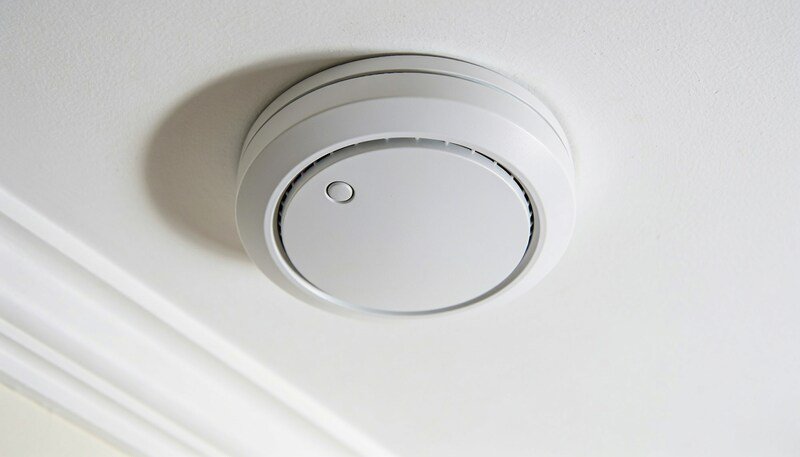
There is a date printed on the back or the side of every smoke alarm in your house. Most people have never looked at it.
Smoke alarms have a service life of ten years from the date of manufacture, not from the date somebody installed them. After that they should be replaced whether or not they still beep when you press the button, because the sensing element degrades over time and the test button only tests the battery and the sounder.
If you have lived in your house for more than a decade, or you bought it from someone who had, there is a reasonable chance the alarms in your ceiling are past it.
That is the part that applies everywhere in Australia. Almost everything else differs by state.
The check that takes five minutes
Do this tonight rather than at the next long weekend.
- Take the alarm off the ceiling and look at the back. There will be a manufacture date, sometimes as a full date, sometimes as a month and year stamp
- Ten years from that date is the replacement point. If it is close, replace it now rather than diarising it
- Press the test button on each one, every month. This confirms the battery and the horn, not the sensor
- Count them, and note where they are. Most houses have fewer than the current rules for new installations would require
- Write the replacement year on the alarm in marker while it is in your hand. Future you will not go looking for the stamp again
Photoelectric, and why it is the answer now
Two sensing technologies exist. Ionisation alarms respond faster to fast flaming fires; photoelectric alarms respond faster to smouldering smoky fires.
Australian fire authorities have moved firmly toward photoelectric alarms, on the basis that the smouldering fire is the one that most commonly kills people in home fires, typically at night, from furnishings and bedding, with smoke rather than flame as the hazard.
If you are replacing an alarm, replace it with a photoelectric one. In Queensland this is not a preference; it is the requirement.
Interconnected, which is the bigger change
Interconnected alarms all sound when any one of them detects smoke.
The reason matters more than the technology: a fire starting in a lounge room at two in the morning sets off the lounge room alarm, and a single alarm at the other end of a house with the bedroom doors closed may not wake the people it needs to wake. Interconnection means the alarm above the sleeping child sounds at the same moment.
Interconnection is either hardwired, which is an electrician’s job, or wireless, where alarms pair with each other. Wireless interconnected alarms with sealed ten-year batteries are the practical route for most existing homes and for renters in some circumstances.
Queensland: the 1 January 2027 deadline
Queensland has the most far-reaching requirement in the country and it arrives shortly.
By 1 January 2027, every private home in Queensland must have interconnected photoelectric smoke alarms, installed in every bedroom, in hallways connecting bedrooms with the rest of the house, and on every storey.
Rental properties and properties being sold or leased have been progressively subject to this already. The 2027 date is the one that catches owner-occupiers who have not had a transaction force the issue.
If you are in Queensland and have not done this, the Queensland Fire Department is the authority and its site sets out the exact requirements. It is not a small job in a large house and the deadline is months away rather than years.
What differs elsewhere
The shape is similar across the country and the specifics are not. Check your own state’s fire service or fair trading authority rather than assuming a national rule.
- Every state and territory requires working smoke alarms in homes. That part is universal
- Where they must be installed varies: all require them near sleeping areas and on each storey, and the requirement for an alarm inside every bedroom is not universal for existing homes
- Power source requirements vary. Some jurisdictions require mains-powered alarms or ten-year non-replaceable lithium batteries in rental properties. Tasmania, for example, requires rental alarms to be mains-powered or powered by a ten-year non-replaceable battery
- Rental testing and maintenance obligations vary. New South Wales requires annual landlord testing and cleaning. Victoria requires alarms to be operational at the start of a tenancy and tested annually under minimum rental standards. Queensland requires testing and cleaning within 30 days before the start or renewal of a tenancy and at least annually
- Interconnection requirements for existing homes are furthest advanced in Queensland
If you rent
Generally the landlord supplies, installs and maintains compliant alarms, and the tenant does not disable them and reports faults. The detail differs by state, and the lease may allocate routine testing to either party.
Practically:
- Ask for the alarm records at the start of a tenancy. In several states there is a formal testing obligation and therefore a record
- Test them yourself monthly anyway. It takes seconds and it is your household in the house
- Report a fault in writing, immediately. A non-working smoke alarm is generally an urgent repair, and urgent repairs have short defined timeframes. Rental repairs, urgent and non-urgent covers how that process works
- Never remove an alarm or take out its battery to stop nuisance alarms. It is both dangerous and, in most jurisdictions, a breach of the tenancy
- If it chirps, that is usually a flat battery or an expired unit, and it is a repair request rather than a DIY job in a rental
Nuisance alarms, without disabling anything
The alarm going off every time somebody makes toast is the reason people take batteries out, and taking the battery out is how people die.
Better options:
- Move the alarm, if it is too close to the kitchen or a bathroom door. There are minimum distances from cooking appliances, and an alarm installed too close is a common cause
- Use the hush button if it has one
- Clean it. Dust and insects inside the chamber cause false alarms. Vacuum the outside gently, following the manufacturer’s instructions
- Ventilate while cooking rather than removing the detection
- Replace an alarm that false-alarms repeatedly, particularly if it is old, because that is a symptom of a failing sensor
What else to do while you are up there
- A fire escape plan, practised once. Two ways out of every room, a meeting point outside, and somebody responsible for each child
- Check the alarms after a long absence, because a chirping alarm in an empty house is a flat battery by the time you return
- Know where the meter box and the water main are. Storm season: getting the house ready covers the rest of the annual household safety pass
- Batteries out of the old alarms go to a battery drop-off, not the bin. Never bin a battery covers why
Common questions
Does the test button prove it works? It proves the battery and the sounder work. It does not test the smoke sensor, which is why the ten-year replacement rule exists.
Can I install a hardwired alarm myself? No. Anything connected to mains wiring is licensed electrical work in every Australian state and territory.
Are wireless interconnected alarms as good? They are an accepted method of achieving interconnection, and in an existing home without ceiling access they are often the only practical one. Check what your state requires.
What about a holiday home or a granny flat? The requirements generally apply to any residential dwelling. Check your state.
Do I need one in the garage? Not usually, and heat alarms rather than smoke alarms are used in some spaces where smoke or fumes are normal.
The short version
Take one down tonight and read the date. If it is ten years old, replace it, and replace it with photoelectric.
If you are in Queensland, the interconnected requirement applies to every home from 1 January 2027 and that is very soon. Everywhere else, check your own state’s fire service, because the detail genuinely differs.
And never take the battery out to stop the beeping.
The one-page family week
One printable page that holds the whole week: meals, school, activities and who is doing the pickup. Free, and we send one useful email a week.
One email a week. No spam, unsubscribe in a click.