The rule is simple and the reason is not widely known, which is why the rule gets broken.
A battery in a kerbside bin gets crushed, in a truck or at a sorting facility. A crushed lithium battery can short, heat and ignite, and it does so inside a moving vehicle full of paper and plastic or inside a building full of the same. Waste truck and facility fires from batteries are a recognised and growing problem in Australia, and it is the reason every state environment authority now runs a version of the same campaign.
The good news is that the fix is free and the drop-off points are shops you are already in.
Where they go
B-cycle is Australia’s national battery stewardship scheme. Drop-off is free and there are collection points in many Aldi, Battery World, Bunnings, Officeworks and Woolworths stores, plus council transfer stations and libraries in a lot of areas.
To find the nearest one, search the B-cycle site by postcode, or check your council’s waste page. Service NSW also runs a battery recycling location finder for that state.
What B-cycle accepts:
- Standard household sizes: AA, AAA, AAAA, C, D, 9V, 6V lantern
- Button and coin batteries, the small round ones from remotes, watches, scales, hearing aids and toys
- Rechargeable batteries of all chemistries up to 5 kg
- Removable batteries from devices such as power tools, cameras and hearing aids
- E-micromobility batteries from e-bikes and e-scooters, at sites that accept them
What it does not cover: car and truck batteries, which go to a scrap metal dealer, an auto retailer or a transfer station, and are usually worth a small amount as scrap.
The one preparation step that matters
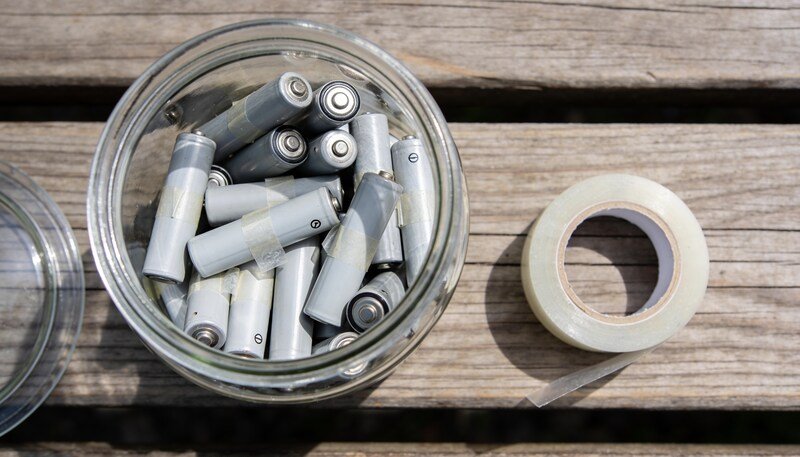
Tape over the terminals with clear sticky tape before you put batteries in the collection container.
This is the whole trick and it is mentioned almost nowhere prominently. A dead battery is not fully flat, and loose batteries touching each other in a bag or a drawer can short against one another and against coins and keys. Taping the ends removes that path.
For a 9V battery, tape the top where both terminals sit together. For AA and AAA, tape one end. For button batteries, tape across the flat face.
How to store them until the trip:
- A lidded jar or a small plastic container, not a loose drawer
- Somewhere cool, out of reach of children, and away from anything flammable
- Terminals taped as you go, rather than in a batch later, because the batch never happens
- Do not store them in the same container as coins, keys or foil
Button batteries are a different level of urgent
Worth its own section because the risk is not fire.
Swallowed button batteries cause severe internal burns very quickly, and Australia has mandatory safety and information standards covering secure battery compartments, packaging and warnings on consumer goods containing them.
Practically, in a household:
- Treat spent button batteries as dangerous, not as rubbish. They retain enough charge to cause injury
- Tape them and store them out of reach immediately, not on the bench “to deal with later”
- Check battery compartments on toys and remotes and replace anything where the cover no longer needs a tool or no longer closes securely. STEM toys by age covers what to check when buying
- If you suspect a child has swallowed one, it is an emergency. Call the Poisons Information Centre on 13 11 26 or 000. Do not wait for symptoms
E-waste is a separate route
Batteries and e-waste get conflated and they are different systems.
E-waste is anything with a plug, a battery or a circuit board: old phones, laptops, tablets, cables, chargers, printers, kettles, toasters, hair dryers, games consoles, TVs.
Where it goes:
- Council e-waste drop-off at transfer stations and recycling centres. In Victoria e-waste has been banned from kerbside bins since 2019, and other states have moved the same way
- Retailer take-back. Officeworks and some other retailers take a broad range of small e-waste, and several phone brands run their own take-back
- Televisions and computers are covered by a national recycling scheme, which is why those two are usually free to drop off
- Mobile phones have a dedicated national scheme run through phone retailers and Australia Post outlets
- Hard rubbish collections accept e-waste in many council areas, as a separate pile. Hard rubbish covers that
Before you hand over a phone, laptop or tablet: back it up, sign out of accounts, and factory reset it. Backing up family photos so you do not lose them is the step to do first, because a reset is final.
The drawer problem
Almost every Australian household has a drawer containing dead batteries, three unidentifiable chargers, a tangle of cables and at least one phone from 2016.
A workable clear-out:
- Batteries out first. Tape, jar, done
- Anything with a screen goes in a pile for reset-and-recycle
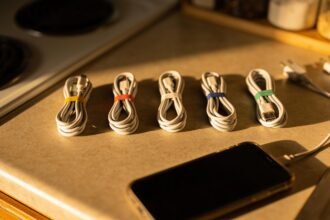
- Cables. Keep one spare of each connector you actually own a device for. The rest is e-waste
- Chargers you cannot identify are e-waste. If you cannot name the device, you will never use it
- Working devices with resale value: phone, tablet, laptop, console. Reset and sell or give away rather than recycle
- One trip. Batteries to the supermarket or hardware shop, e-waste to the council centre. Both can be a single Saturday errand
Common questions
Can I put batteries in the yellow recycling bin? No. They are a fire risk in the truck and at the facility, and they contaminate the load. What actually goes in the yellow bin has the rest of that list.
Are alkaline batteries actually recyclable? Yes. B-cycle accepts standard household alkaline batteries as well as rechargeables, and the materials are recovered.
What about a swollen or damaged lithium battery? Do not put it in a drawer or a bag with others. Keep it away from anything flammable, do not puncture it, and contact your council or the B-cycle site for advice on damaged batteries before transporting it.
What about vapes? Vapes contain lithium batteries and are accepted at many B-cycle drop-off points. They do not belong in any kerbside bin.
Does it cost anything? No. B-cycle drop-off is free, funded through a levy on batteries sold.
What about the batteries inside a device I am throwing out? If the battery is easily removable, take it out and put it in the battery stream. If it is built in, the whole device goes to e-waste, which handles it.
The short version
Never a kerbside bin. Tape the terminals as they die, keep them in a lidded jar out of reach, and drop them at the supermarket or hardware shop on a trip you were making anyway.
E-waste is the other pile and the other trip. Reset anything with a screen before it leaves the house.
The one-page family week
One printable page that holds the whole week: meals, school, activities and who is doing the pickup. Free, and we send one useful email a week.
One email a week. No spam, unsubscribe in a click.