
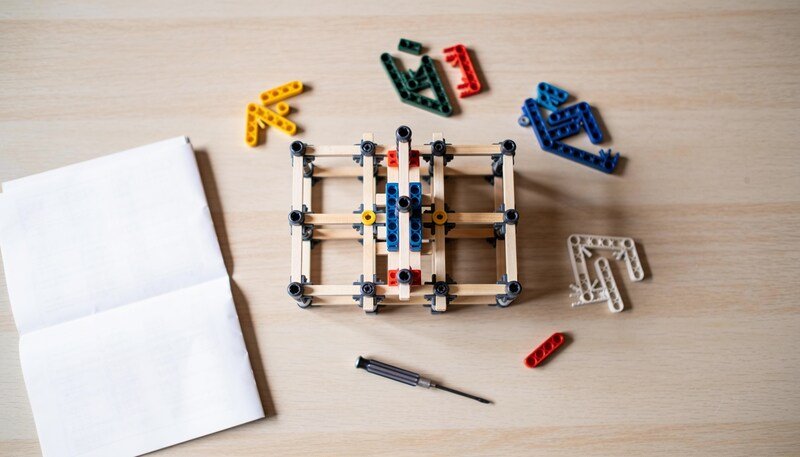
What is in this guide
The number on the box is a safety rating before it is a difficulty rating. “3+” mostly means no small parts. “8+” often means small parts exist, not that an eight-year-old can complete it.
That gap is why so many science kits are half-built on a shelf. The kit was age-appropriate to own and not age-appropriate to finish.
This guide compares published specifications and Australian retailer listings. No kit was built or used by us, and no claim is made here about educational outcomes.
The four questions that predict whether it gets finished
Ask these before the age bracket:
1. How much reading does it need? A kit with a twenty-page instruction booklet is a reading task first. For a child who reads reluctantly, that is the barrier, not the science. Picture-led instructions change who can do it alone.
2. What does it demand of small hands? Threading, screwing tiny screws, aligning circuit pieces, peeling stickers. Fine motor demand is the second most common abandonment point and it is never on the box.
3. Is it one build or many? A single-outcome kit is finished once and then it is an ornament. A construction system with many outcomes gets used for years. This is the biggest difference in value per dollar in the whole category.
4. Does it need an adult, and did you plan for that? Some of the best kits need an adult for the first hour. That is fine if you know, and it is a wasted purchase if you do not.
Roughly by age, with the caveat
These are the shapes that tend to work, not rules.
Three to five. Open-ended building, sorting, magnets, chunky pieces, cause and effect. No instructions. Nothing with small parts, and check the label. Kidstuff lists Bello Rainbow Puzzle Blocks at $49.99 on 13 September 2026 as an example of the open-ended end of this.
Six to eight. First guided builds with picture instructions. Simple circuits, simple mechanics, a kit that does one clear thing. Snap Circuits’ Bric Light Building Set was listed at $59.99 on 13 September 2026 and is the type example: pieces that clip rather than screw, and a visible result.
Nine to eleven. Multi-step kits, real mechanisms, an outcome that takes more than one sitting. 4M’s KidzLabs Mega Motor Science was $69.99 on 13 September 2026, in the range where a kit is genuinely a project.
Twelve and up. Kits where the interest has to come first. At this age a child who is not already interested will not be made interested by a box. 4M’s KidzLabs Mega 3-in-1 Robot Lab was $109.99 on 13 September 2026.
Across all ages, a large construction set earns its keep in a way a single-outcome kit does not. LEGO’s 10472 Animal Building Game was $119.99 on 13 September 2026, and that category is a system rather than a kit.
Safety, which in this category is specific
Two Australian mandatory standards matter here and both are worth knowing before buying.
Small parts. Toys for children under three are covered by a mandatory Australian safety standard addressing small parts and choking. The age label on a toy is in part a statement about this. Do not treat a 3+ label as conservative, and think about younger siblings in the house rather than only about the recipient.
Button batteries. Australia has mandatory standards for consumer goods containing button or coin batteries, covering secure battery compartments, packaging and warnings. Button batteries cause severe internal injuries very quickly when swallowed, and many electronic STEM kits contain them.
- Check the battery compartment is secured with a screw rather than a slide catch
- Store spare batteries out of reach, in their packaging
- If you suspect a child has swallowed one, it is an emergency. Call the Poisons Information Centre on 13 11 26 or 000
Magnets. High-powered small magnets are subject to their own Australian restrictions because two swallowed magnets can attract through the bowel wall. Buy magnetic construction sets from mainstream retailers rather than marketplaces.
The ACCC’s Product Safety Australia site is the authority on all three, and it also lists current recalls, which is worth a search on any brand you do not know.
What the listings do not tell you
- Completion time. Almost never published, and it is the number a parent most wants
- Whether adult help is needed, occasionally implied, rarely stated
- Reading level of the instructions
- Replacement part availability, which decides whether a lost piece ends the toy
- Whether batteries are included, sometimes stated and often not
Getting more out of what you buy
- Do the first build with them, then leave. The abandonment usually happens at step one
- Keep the box and the instructions, because loose pieces without instructions become landfill
- Rotate rather than accumulate. Toy rotation: how to make the same toys last applies to this category more than any other
- Pair a kit with the thing it is about. A circuits kit lands better in a week where something in the house has stopped working
- Free first. Free STEM activities using household items will tell you whether the interest is real before you spend $110 finding out
If what you actually want is help with schoolwork rather than a toy, a kit will not do it. Times tables that actually stick is a different problem with a different answer.
Before you buy
- Read the age as a safety floor, not a difficulty rating
- Judge reading level and fine motor demand honestly for this particular child
- Prefer a system with many outcomes over a kit with one
- Check the button battery compartment and the small parts label, including for younger siblings
- Decide whether you are committing an hour to the first build
Pick 2
Snap Circuitsu00ae Bric Light Building Set - STEM Kit
Snap Circuits
Pick 3
4M KidzLabs Mega Motor Science
4M
Pick 4
4M KidzLabs Mega 3 in 1 Robot Lab
4M
Pick 5
10472 Animal Building Game
LEGO
The one-page family week
One printable page that holds the whole week: meals, school, activities and who is doing the pickup. Free, and we send one useful email a week.
One email a week. No spam, unsubscribe in a click.