The thing that makes an activity educational is not the activity. It is one question, asked before you start.
“What do you think will happen?”
A child who has predicted an outcome is invested in finding out whether they were right, which is the whole of the scientific method in one sentence. A child who watches a demonstration has seen a trick. Same materials, entirely different experience.
Ask it, let them be wrong, and then ask why they think it happened. That is it.
Everything below uses things already in an ordinary Australian house.
Under five
Sink or float. A bowl of water and ten objects. Predict each one first. The value is entirely in the prediction.
Ice melting race. Two ice cubes, different places: sun and shade, salt and no salt, wrapped and bare. Which finishes first, and why. In an Australian summer this is a very fast experiment.
Colour mixing. Food colouring in water in clear cups. Predict what two colours make before mixing.
Ramps. A plank, a board, a book propped up. Roll different things down. Steeper, flatter, heavier, lighter.
Shadow tracing. Chalk around a shadow in the morning, again at midday, again in the afternoon. Genuinely surprising to a four year old and it is astronomy.
Sorting and patterns. Buttons, pasta, leaves, gum nuts. Sorting by property is the foundation of classification and children of this age love it.
Five to eight
Baking soda and vinegar. The standard, and worth doing properly: change the quantities, change the container shape, measure which combination produces the most, rather than doing it once for the noise.
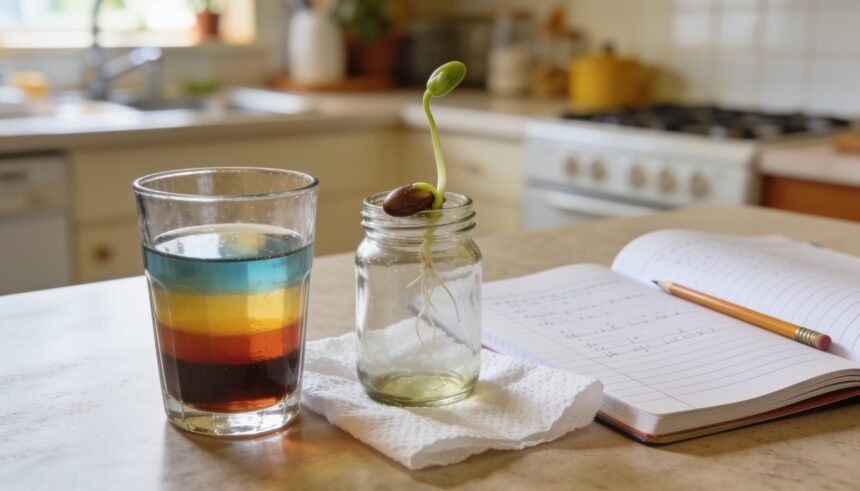
Grow a bean in a jar. A jar, damp paper towel, a dried bean from the pantry. Roots and shoot are visible through the glass. Takes a week and gives a daily reason to look.
Paper aeroplane trials. Three designs, three throws each, measure the distance, chart it. This is experimental design and children do not notice they are doing it.
Egg drop. Protect an egg using only what is in the house, then drop it from a fixed height. Iterate. Best done outside.
Water filtration. Muddy water, and layers of stones, sand and cloth in a cut bottle. Do not drink the result, and say so clearly.
Static electricity. A balloon and hair. Pick up paper scraps, bend a thin stream of water from a tap.
Density tower. Honey, dish soap, water, oil, poured carefully into a glass. Predict the order first.
Sundial. A stick in the ground and stones marking the shadow every hour. Australian summer sun makes this work properly.
Nine and up
Bridge building. Newspaper and tape only, spanning a fixed gap, tested with tins until it fails. Load-bearing structure, failure analysis and iteration.
Salt water density. Will an egg float in fresh water, salt water, and how much salt does it take. Measurable, repeatable, and the answer surprises adults.
Chromatography. A dot of washable marker near the bottom of a paper towel strip, the end in water. The colours separate. Works with several markers compared.
Coding without a computer. Write step-by-step instructions for another person to make a sandwich, and follow them literally. The failures are the lesson and it is genuinely funny.
Measure the house. Area of each room, cost per square metre, how much paint a wall needs. Applied maths with a real answer.
Reaction time. Drop a ruler between someone’s fingers and measure where they catch it. Compare people, compare tired versus alert, compare distracted versus focused. Repeatable and produces real data.
Turning an activity into science
Four steps, about a minute each, that lift any of the above.
Predict. Before anything happens.
Change one thing. More salt, steeper ramp, different shape, longer time. One variable at a time is the entire idea of a fair test and children grasp it quickly when it is framed as making it fair.
Measure something. A ruler, a timer, a count. Numbers turn an impression into evidence.
Ask why. Not to get the right answer. A wrong explanation that the child reasoned to is worth more than a correct one they were told, and the follow-up question is “how could we find out?”
This maps closely to how science is framed in the Australian Curriculum, which treats inquiry rather than demonstration as the point.
Safety, briefly
Supervise anything involving water, heat, height or small parts.
Do not mix household cleaning chemicals. Everything above uses food ingredients and ordinary materials deliberately. Never combine bleach with ammonia or with vinegar, which produces dangerous gases, and this is worth saying to older children directly.
Do not drink or taste experiment results, including the filtered water.
Eye protection for anything launched or dropped, and do the egg drop outside.
Australian heat and sun apply. Outdoor activities belong early or late, with hats and shade, and water-based activities should respect current water restrictions, which vary by region and season.
For a suspected poisoning, call the Poisons Information Centre on 13 11 26. In an emergency, call 000.
Making it stick
One a week beats six on a Saturday. A single activity with the four steps above does more than an afternoon of demonstrations.
Keep a book. A cheap exercise book where predictions and results get written down turns scattered activities into a record a child can look back at, and writing the prediction makes it real.
Let them repeat one. A child who wants to do the density tower four times is not being unimaginative, they are doing replication.
Follow the interest rather than the list. A child who is into bridges should build bridges for a month.
Next: backyard activities that cost nothing covers the outdoor half, toy rotation covers making existing kits get used, and getting a reluctant reader reading covers the non-fiction route into reading, which is where many of these children end up.
If a kit is going to be bought anyway, STEM toys by age covers what a child can actually finish alone.
The one-page family week
One printable page that holds the whole week: meals, school, activities and who is doing the pickup. Free, and we send one useful email a week.
One email a week. No spam, unsubscribe in a click.