What is in this guide
A child surrounded by forty toys will often play with none of them. The same child given eight will usually play with those eight, and for longer.
This is the whole premise of toy rotation, and the practical version is straightforward: most of the toys are stored, a small selection is available, and they swap over periodically. Nothing is thrown away, which is why it works in households that resist decluttering.
It is also a system that collapses easily, and the collapse is predictable. Both failure modes are at the end.
Setting it up in an hour
Step 1: Gather everything into one place. Every toy, from every room. This is the worst part and it takes twenty minutes.
Step 2: Remove the obvious. Broken items, pieces belonging to sets that no longer exist, and anything outgrown by years rather than months. Broken toys in particular should go rather than be stored, and a cracked or split toy has become a small-part hazard regardless of what its label says, as covered in age labels on toys.
Step 3: Set aside the permanent collection. Covered in the next section. These never rotate.
Step 4: Sort the rest into four groups, each containing a mix rather than a theme. Each group should have something to build with, something imaginative, something physical and something quiet. Four boxes of similar composition rotate better than four themed ones, because a week of only vehicles is a week of not much.
Step 5: Store three, put one out. Label the boxes so you know which one you are up to.
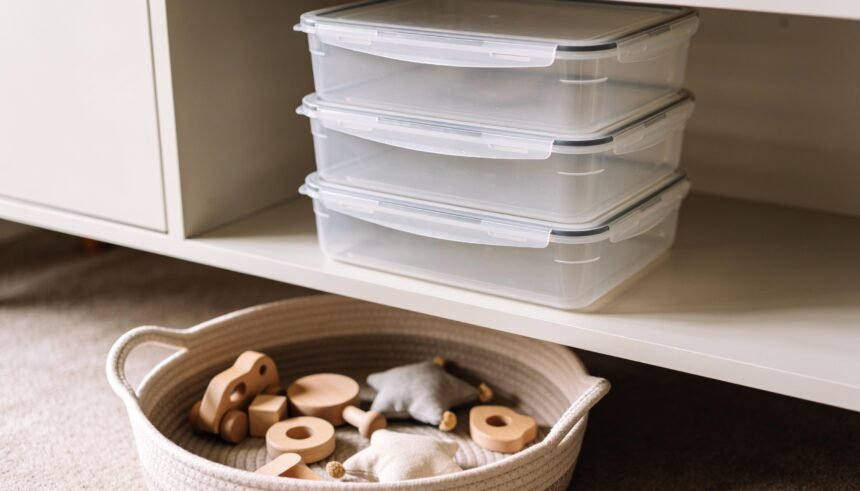
Step 6: Put the available set out visibly. On open shelves, in shallow baskets, or spread on a low surface. Toys in a deep toy box are invisible, and invisibility is most of the original problem. If a child cannot see it, they will not choose it.
What stays out permanently
Rotation fails when everything rotates, because some things are infrastructure rather than novelty.
The comfort item. Never, under any circumstances, in a box.
Construction sets. Blocks, magnetic tiles, Lego and similar are open-ended and get used continuously. Rotating them removes the most valuable thing in the house.
Art supplies. Paper, pencils, scissors, glue.
The current obsession. Whatever a child is deep in, whether that is dinosaurs, horses or a particular vehicle. Boxing an active obsession produces a genuinely upset child and no benefit.
Books. Rotate a portion if you like, and keep plenty accessible.
Outdoor equipment. Balls, bikes, sand toys. These live outside and are not part of the system. Backyard activities that cost nothing covers making better use of them.
When to swap
Every two to four weeks is the usual advice, and the better trigger is behaviour. When the child stops engaging with what is out, swap. That might be ten days or it might be six weeks, and watching for it works better than a calendar.
Swap when they are out of the room, not as an event. The reappearance is the effect, and a child who watches the boxes being swapped is being shown the trick.
Do not swap the whole set at once. Leave two or three items and change the rest. A complete change is disorienting; a partial change is a discovery.
The safety consideration nobody mentions
In a house with a younger sibling, the stored boxes are the risk. A box of a six year old’s small-part toys is fine on a high shelf and dangerous on the floor of a shared room.
Store rotation boxes out of reach and closed, not stacked in the corner of the playroom. Lidded tubs, high shelving or a cupboard.
Check the contents of a box before it comes out if a younger child has arrived since it went in. A set that was appropriate a year ago may not be appropriate for the household now.
Age labels on toys covers why the mixed-age household is the situation labelling does not solve.
Storing the boxes in an Australian house
Not the garage in summer without thinking about it. Australian garages get extremely hot, and heat damages plastics, batteries, glue and anything with adhesive. Anything with a battery in it should not be stored in a hot garage at all, and batteries are best removed from stored toys regardless.
Not the shed, for the same reason plus moisture.
Under beds, on top of wardrobes, in a hall cupboard or on high shelving are the realistic options in most Australian homes.
Clear tubs beat cardboard, because you can see the contents and because cardboard does not survive a humid summer or a silverfish.
The two mistakes that kill it
1. Making the system too complicated. Elaborate schemes with themed boxes, a schedule, an inventory and a spreadsheet do not survive a busy term. Four unlabelled tubs and a rough sense of which one was last out is a system that runs for years. The failure is almost always sophistication, not neglect.
2. Not removing anything. Rotation is not a substitute for reducing. A household with four hundred toys rotating through boxes still has four hundred toys, and the boxes become permanent storage for things nobody will ever want again. Every swap is a chance to remove a few items that clearly have no future.
A third, smaller one: not telling the other adults in the house. A partner or grandparent who finds the boxes and puts everything back out has ended the system without knowing it existed.
Where the removed toys go
Keep the genuinely sentimental, which is a much smaller number than it first appears.
Pass on what is intact and safe. Check Product Safety Australia for recalls before passing something on, as covered in toy safety standards in Australia.
Charity shops take toys in good condition, though policies differ on soft toys and on anything with missing pieces, so check with the shop rather than leaving a bag at the door.
Broken toys are rubbish, not donations. Passing on something broken moves the disposal problem rather than solving it.
The post-Christmas window is the right time to do this, while the new arrivals make the case obvious and before the school year starts.
Next: age labels on toys covers the mixed-age storage question, toy safety standards in Australia covers checking before passing on, and backyard activities that cost nothing covers the toys that never go in a box.
The one-page family week
One printable page that holds the whole week: meals, school, activities and who is doing the pickup. Free, and we send one useful email a week.
One email a week. No spam, unsubscribe in a click.