
What is in this guide
Almost every household has made a chore chart. Almost none are still using the one they made.
They fail in week three, and they fail for the same four reasons every time. Design around those and a chart lasts a school term, which is about as long as any household system should be expected to run before it needs a refresh.
The four reasons charts fail
1. Too many jobs. A chart with six jobs per child looks thorough on Sunday and is overwhelming by Wednesday. Three jobs per child is plenty and one is a perfectly reasonable place to start.
2. It requires an adult to run it. If a parent has to check the chart, mark the chart and remind everyone about the chart, the chart is a second job for the parent. It has to be readable and markable by the child without help, which means it must match their reading level.
3. The reward drifts. Charts that promise a large reward at the end of a month collapse, because a month is too far away for a seven year old and because the reward inflates each time.
4. Nobody looks at it. A chart in a bedroom, inside a cupboard, or on a fridge behind three layers of paper is not part of the day. Position is more important than design.
The minimum viable chart
Build this first. Add to it only if it is still working in a month.
One row per child. Three columns of jobs. Seven columns of days. That is the whole thing.
Use pictures for pre-readers, drawn badly by you or by them. A child who drew the picture of the job engages with it more than one who was given a printed icon.
Make marking it satisfying and physical. A tick, a sticker, a magnet moved, a peg turned over, a whiteboard marker. The physical act is most of the motivation for younger children, and a tick box beats a digital equivalent for under-tens by a wide margin.
Put it where the day happens. The kitchen, at child height. Not the bedroom, where nobody goes in the morning, and not at adult eye level.
Keep the jobs the same every day at the start. Variable jobs are harder to internalise, and the aim is to make the job automatic rather than to teach flexibility.
What goes on it
Use age-appropriate chores from 2 to 16 to pick the jobs, and apply two filters.
Only jobs they can do without help. A job needing an adult is not a chore, it is a shared activity, and it will not survive a busy morning.
Only jobs that have a clear finish. “Tidy your room” has no defined end and produces argument. “Put the washing in the basket” is finished when the floor is clear.
Include at least one job that visibly serves the household, not just their own things. Feeding a pet, setting the table, bringing in the bin. This is the difference between a routine and a contribution and children notice it.
Rewards, and whether to use them
Charts work with or without rewards. What does not work is an inconsistent or inflating reward.
Three approaches that hold up:
No reward, just the chart. The tick is the reward. Works better than adults expect, particularly with younger children who like the completed row.
A small, immediate, non-material reward. Choosing the music, picking the weekend activity, staying up fifteen minutes on Friday. Immediate beats large.
Pocket money attached to specific extra jobs, with basic household contribution unpaid. Covered in teaching kids about money by age.
What to avoid: escalating material rewards, rewards contingent on a whole week being perfect, and taking rewards away as punishment. The last one converts the chart from something the child wants to engage with into something used against them, which ends it.
A reward chart is not the same thing as a chore chart and the research position on reward charts generally is more mixed than the template sites suggest. Reward charts: when they help and when they backfire goes into it.
Making it survive
Review it monthly, with the child. What is working, what is annoying, what should change. A chart the child helped adjust gets used.
Expect school holidays to break it, and plan to restart at the beginning of term rather than treating the lapse as failure. This is the single most common point of abandonment in an Australian family year, because two weeks is long enough to lose a habit.
Let a missed day be a missed day. A chart with three gaps in it is a working chart. A household that responds to gaps by escalating ends the system.
Change the jobs each term, not each week. Children outgrow jobs and a stale chart is ignored.
The two-household version
Where children move between households, the chart needs to work in both or it will work in neither.
The simplest approach is the same chart, same jobs, in both houses, which requires the adults to agree on the jobs. Where that is not possible, a separate chart in each house with its own jobs is better than one chart that only exists in one place.
What does not work is a chart at one house that the child is expected to remember at the other.
Teenagers
Charts mostly stop working around eleven or twelve, and pushing them past that produces resentment.
What replaces them is a shared list rather than a chart, in whatever the household already uses: a whiteboard, a shared note, the family calendar from the school-year calendar setup. The jobs are agreed rather than allocated, and the ownership is real.
The principle that carries over is the same one: a job with a clear finish, that belongs to the person, that they do not have to be reminded about.
Starting today
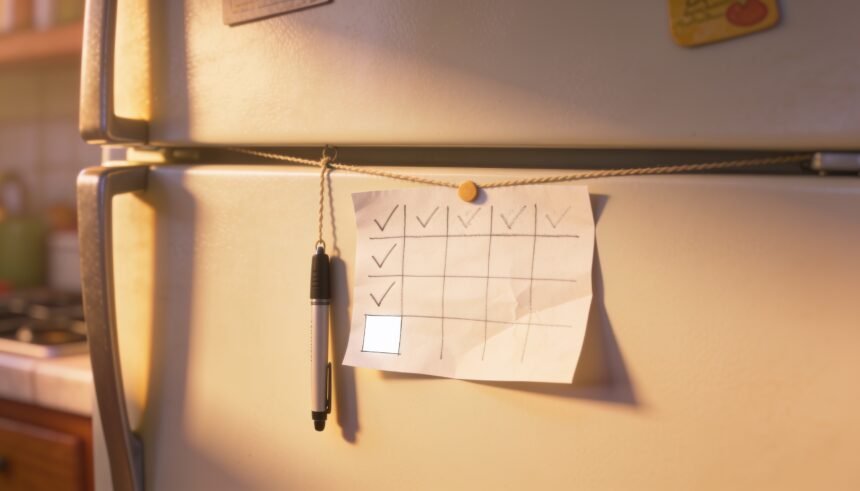
Pick one job per child. Write it on a piece of paper. Stick it on the fridge at their height. Put a pen next to it.
That is a working chore chart and it will outlast any laminated colour-coded version, because the thing that makes a chart work is that it is used, not that it is good.
Next: age-appropriate chores from 2 to 16 covers what to put on it, getting kids to bed without the two-hour battle covers the other daily routine, and the school-year calendar setup covers the household system a teenager joins instead.
The one-page family week
One printable page that holds the whole week: meals, school, activities and who is doing the pickup. Free, and we send one useful email a week.
One email a week. No spam, unsubscribe in a click.