What is in this guide
Two things decide whether chores work in a household, and neither of them is the list.
The first is standards. A four year old will not set a table correctly. If the adult follows behind and fixes it, the child learns that their contribution does not count, and within a fortnight they stop. Accepting a badly set table for a year is the price of a twelve year old who sets it properly.
The second is timing. Small children want to help and are bad at it. Older children are good at it and do not want to. The window where those overlap is roughly ages three to seven, and a household that uses it has a substantially easier time than one that starts at eleven.
With those two in mind, here is what is realistic at each stage.
Ages 2 to 3: helping, badly
Toddlers genuinely want to participate and it takes longer with them than without. That is the investment.
Put toys in a basket. Put clothes in the washing basket. Carry their plate to the bench. Wipe a spill with a cloth. Put books on a shelf. Feed a pet with an adult, from a pre-measured container.
What the adult gives up: speed and accuracy. Every one of these is faster done alone, and doing it alone is exactly how it never gets learned.
Ages 4 to 5: real jobs, supervised
Preschoolers can complete a simple task with a visible beginning and end.
Set the table. Match socks. Put away their own clothes into a low drawer. Water plants. Make their bed to a low standard. Clear their plate. Help unpack shopping. Tidy their room with a specific instruction, meaning “put the blocks in the box” rather than “tidy your room”.
What the adult gives up: the specific instruction is not optional. “Tidy your room” is meaningless to a four year old and produces nothing but a stalemate.
Safety at this age: no knives, no heat, no chemicals, no stairs while carrying. Anything in the kitchen is with an adult present.
Ages 6 to 8: routines
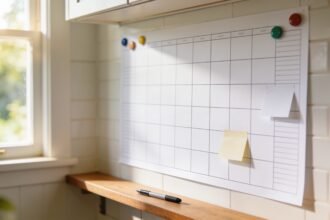
This is where a chore becomes a routine rather than an event, and where a chart genuinely helps. Chore charts that kids actually use covers making one that survives.
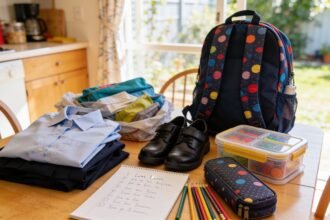
Make their bed. Get dressed and pack their own bag. Feed a pet on a schedule. Set and clear the table. Load a dishwasher. Fold simple washing. Take out the bin. Wipe benches and tables. Sweep. Water the garden. Bring in washing. Sort recycling.
What the adult gives up: reminding. The point of a routine is that it is triggered by the time of day rather than by a parent’s voice, and the transition is the hard part.
Safety: cooking involvement stays supervised. Nothing with a blade, heat or chemicals unsupervised.
Ages 9 to 12: independence
This is the age with the biggest gap between what children can do and what they are asked to do.
Operate the washing machine. Hang and fold a full load. Vacuum. Clean a bathroom sink and mirror. Prepare simple food including breakfast and a packed lunch. Cook a basic meal with an adult nearby. Change their own sheets. Mow with supervision, subject to the point below. Wash the car. Walk a dog, if it is safe for that child with that dog. Look after a younger sibling briefly, in the house, with an adult present.
What the adult gives up: ownership. A job at this age should belong to the child, including the deciding when, not be a task handed out each time.
Safety: cleaning products need a conversation about labels and about never mixing them. Powered garden equipment including mowers, whipper snippers and blowers carries real injury risk, and readiness varies with the child and the machine rather than with an age. Australian state work health and safety and consumer safety bodies publish guidance on domestic equipment, and the manufacturer’s instructions are the first reference.
Ages 13 to 16: contribution
Teenagers should be contributing to the household rather than doing tasks for it, and the distinction matters to them.
Cook a full meal for the family, on a regular night. Do the shopping from a list. Full laundry from basket to wardrobe. Clean a bathroom properly. Look after younger siblings. Manage their own schedule, sport gear and school equipment. Yard work. Take responsibility for a pet entirely.
The single highest value one is cooking one family dinner a week. It is a real contribution, it is a life skill they will need within a few years, and it changes how a teenager sees the work involved in feeding a household.
What the adult gives up: the assumption that a teenager will do it the way you would. They will not, and the meal will still be dinner.
Why starting at eleven is harder
If chores were not part of the household earlier, introducing them to a child who has never had them is a negotiation rather than a routine, and it arrives at the same time as adolescence.
It is still worth doing. Two things make it work.
Start with something that is obviously theirs, such as their own laundry or their own room, rather than a job that benefits everyone else. The fairness argument is much harder to counter.
Attach it to the household rather than to a reward. “This is what living here involves” is a more durable frame than a payment, particularly with a teenager who can calculate whether the payment is worth it.
Paid or unpaid
A genuine disagreement with reasonable positions on both sides.
The common Australian compromise is that basic household contribution is unpaid because everyone lives there, and specific extra jobs can be paid. That separates the citizenship argument from the earning one and gives a route to pocket money that is not automatic.
Whatever you choose, be consistent, because inconsistency is what produces negotiation at every single task. Teaching kids about money by age covers the earning side.
Making any of it stick
One job per child at a time. Households that introduce six jobs at once end with none.
Attach it to an existing anchor. After dinner, before school, Saturday morning. A job with no trigger does not happen.
Do not redo it in front of them. The single most common way chores die.
Say what specifically was done well, rather than general praise. “The table is set and everyone has a fork” lands better than “good job”.
Expect it to take three weeks before it is a habit, and expect it to lapse in school holidays and need restarting.
Next: chore charts that kids actually use covers the system, getting kids to bed without the two-hour battle covers the other end of the day, and teaching kids about money by age covers whether to pay.
The one-page family week
One printable page that holds the whole week: meals, school, activities and who is doing the pickup. Free, and we send one useful email a week.
One email a week. No spam, unsubscribe in a click.