Run an indoor scavenger hunt in your lounge room by reading out clues about objects already in view, then letting children point to their answers. Start with colours, shapes and familiar uses; you need no hidden treasure, printed list, new supplies or prizes to make a complete game.
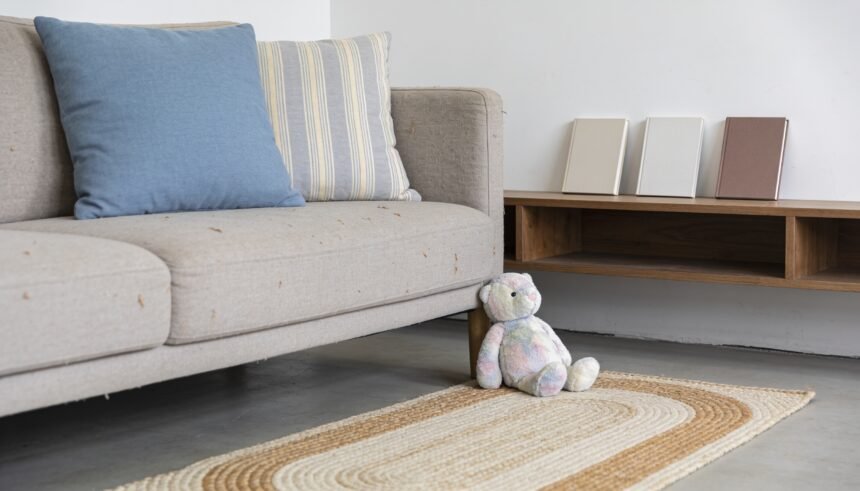
The simplest version leaves everything where it belongs. A cushion stays on the sofa, a book stays on its shelf and the rug can count as an answer without being moved. That makes the hunt workable in a small shared room, including when somebody else is sitting there.
Set the room boundary before the first clue
Tell everyone that the hunt stays in the lounge room and that finding means pointing or describing. Cupboards, drawers and other rooms are outside the game. Keep climbing, moving furniture and reaching behind the television out of the rules too.
Look around before you begin. Choose clues with at least one obvious answer visible from where the children will play. You do not need to tidy the entire room, but leave clear space for anyone who wants to walk between answers. If the floor is crowded, run the hunt from the sofa instead.
Use ordinary room features such as cushions, upholstery, books, a rug or a toy already out. Leave breakable ornaments, cords, controls and anything an adult has put out of reach out of your clue choices. A pet resting nearby is not an item to fetch or disturb.
Agree on the finish: three clues for a first attempt, or the full list below if everyone wants more. Those numbers are suggested game structures, not promises about how long children will stay interested.
Read these clues aloud, one at a time
Check each clue against your own room and skip any that have no suitable answer. Give children time to look before offering a hint. They can answer without reading, writing or holding a device.
| Say this | An answer might be | If nobody spots it |
|---|---|---|
| Find something soft. | A cushion or the sofa upholstery | Name the area to look in. |
| Find something with corners. | A book cover or the rug | Ask them to look for a rectangle. |
| Find something with a pattern. | Striped fabric or a patterned cushion | Describe a pattern you can see. |
| Find something you can read. | A book already on a low shelf | Point towards the books. |
| Find two things that are the same colour. | A toy and part of the rug | Choose a colour visible in two places. |
| Find something people sit on. | The sofa or a chair | Accept the place they are sitting. |
| Find something round in a picture or pattern. | A circle on a book cover or fabric | Narrow the search to one surface. |
| Find something that belongs somewhere else. | A shoe or school bag left in the room | Skip this if nothing fits. |
Accept more than the answer you had in mind. A rug and a cushion can both be soft. If a child identifies a circle inside a pattern, that counts as something round even though the whole object is rectangular. Ask them to show you what they mean before deciding a clue has gone wrong.
For the final clue, finding is enough. Returning a misplaced item can happen after the game, with help if needed, rather than opening the hunt into the whole house.
Change the clues to match the children playing
For a child who prefers a direct instruction, say, “Point to a blue thing”, rather than asking for two objects with a shared feature. Name one thing at a time and let them answer with a gesture. You can also demonstrate the first clue yourself, then invite them to choose the next answer.
If even that feels too involved today, rainy day activities for under-fives offers other starting points. There is no need to finish a hunt that nobody wants to play.
For children who want a harder version, ask for a combination: something soft and patterned, or something rectangular that is used for reading. Another option is to find two different answers to the same clue. This changes the challenge without adding objects or preparation.
With mixed-age siblings, let everyone answer the same clue in their own way. One child might point to the cushion while another explains why a different object fits. Take turns giving the first answer if one person keeps calling out before anyone else has looked. Avoid making the youngest child’s clue a task the older sibling completes for them.
Keep a small room hunt cooperative
A race is optional, and this version works without one. The group can find an answer together, then move to the next clue. Nobody needs a separate pile of objects, and two children can choose the same cushion without competing to own it.
If you want a score, count solved clues for the whole group. Settle the rules before starting: pointing counts, an explanation counts and different sensible answers count. Do not add a stopwatch unless the players actually want a timed round.
For a child playing with an adult, swap roles after a few clues. The child chooses something in view and gives a clue while the adult guesses. If making up a clue is difficult, offer a beginning such as “Find something that is…” and let them supply the colour or texture.
When several children want different activities, indoor activities for primary school kids provides a broader choice. Keep the hunt in its agreed space rather than spreading it across somebody else’s game.
Make a second round without hiding anything
Ask the players to invent one clue each about something still visible. Start with an object’s use: something that holds stories, something that makes a seat softer or something you put on your feet. The clue-giver should have an answer in mind before speaking.
For another variation, choose one existing book and look for clues in its illustrations. Find a circle, two matching colours or something used in a house. This keeps the game seated and contained without needing a new printable sheet.
You can also make a memory round. Everyone looks at a few familiar objects, then turns away while an adult asks, “What colour was the cushion?” Nothing needs to disappear, and nobody needs to rummage under furniture to solve the question. Keep it as a separate variation so the rules of the original hunt remain clear.
Finish before the room becomes a collection pile
After the agreed final clue, let each player name their favourite answer or give one last clue. If someone collected objects despite the pointing rule, return those few items together. There should be no clue cards to gather, furniture to rebuild or reward bags to prepare.
For the next activity, games for a long wet afternoon covers cards, board games and spoken options. If you want another activity using existing materials, free rainy day ideas without screens includes paper puzzles and pretend play.
To begin now, choose three clues from the table that have clear answers in your room. Explain that pointing counts, read the first clue aloud and let the children show you what they find.
How we checked this
Reviewed on 10 October 2026. This is an editorial activity plan using visible household objects. The clues and adaptations are suggestions, with no hands-on testing, developmental benefit or guaranteed play duration claimed. Published link eligibility and package metadata were checked against local records.
The one-page family week
One printable page that holds the whole week: meals, school, activities and who is doing the pickup. Free, and we send one useful email a week.
One email a week. No spam, unsubscribe in a click.