One game rarely carries a whole wet afternoon. The afternoons that work have three or four ready to go, grouped by how much energy is left in the room: a card game to start, a board game for the middle stretch, and something that needs no setup at all for the last tired hour.
Start with cards, because nobody has to find anything
A standard deck covers more ground than most people give it credit for. Snap needs nothing explained twice: deal the deck evenly, turn cards face up into the centre one at a time, and the first to call “snap” on a matching pair takes the pile. It works from about four years old with help turning cards, and gets faster and funnier as reflexes improve.
Memory (Concentration) suits a quieter stretch. Spread the whole deck face down in rows, and players take turns flipping two cards to find a pair, keeping any match and going again. A smaller grid of twelve to sixteen cards works better for younger players than the full fifty-two.
Go Fish is the one to pull out for mixed ages sitting around a table. Deal five to seven cards each, and players ask a named player for a specific rank, going to the pool with a “go fish” if the other person does not have it. It teaches turn-taking without much reading or maths, which makes it workable for a five-year-old sitting with a ten-year-old.
Move to a board game once everyone is settled
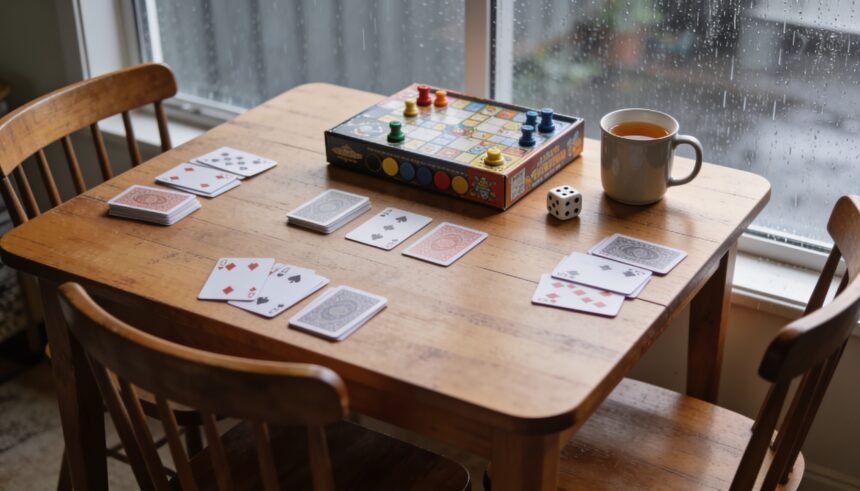
The indoor activity list for primary kids mentions board games in passing. The practical version is choosing one that matches the room’s patience level right now, not the one that has sat unopened the longest.
A game that depends on a single die roll and moving a token suits a short attention span and a toddler who wants to be included, even without reading the rules properly. A game with a few decisions each turn, strategy and a points tally, holds older children and adults for longer and is worth saving for when the afternoon is at its calmest, usually straight after lunch rather than right before dinner.
If the box is missing a die or a card, improvise rather than abandoning the game: a phone timer can replace a sand timer, a folded paper marker can stand in for a missing piece, and a coin flip can replace a die for a simple yes-or-no decision.
Keep a no-prop game in reserve for the flat part of the afternoon
By mid-afternoon, energy for setup usually drops before interest in playing does. This is where word and guessing games earn their place: I Spy, twenty questions, and a simple story-building game where each person adds one sentence to a tale that started with someone else’s line.
These need nothing beyond the room you are already sitting in, which matches exactly what low-cost play guidance recommends for indoor time: games built from what is already in the house rather than anything bought for the occasion. They also travel well to a car trip or a waiting room, since the only equipment is attention.
Adjust for the ages actually in the room
For a mix of primary-aged and younger children, let the youngest hold the cards or roll the die even if an older sibling reads the rules aloud. Being included matters more than following every rule correctly at that age. If the age gap makes a shared game frustrating for everyone, the rainy-day ideas for under-fives cover separate activities that run alongside, rather than instead of, the older kids’ game.
For a group that keeps arguing over whose turn it is, write the turn order on a scrap of paper once and point to it rather than relitigating it. For a child who struggles with losing, choose cooperative options such as Go Fish’s gentler win condition, or agree before starting that the game ends at a set time rather than when someone wins.
When nobody can agree on a game
Write three or four options on separate scraps of paper and draw one, rather than spending the next ten minutes negotiating. If even that stalls, default to the simplest option in the room: a deck of cards and Snap rarely draws an objection.
If games themselves have lost their appeal for the day, the weekend activities that need no plan and baking and cooking for a wet weekend cover a change of pace, and indoor obstacle courses and movement games is the better pick if the problem is too much energy rather than too little.
Start now: pick one card game, one board game and one no-prop game before the afternoon starts to drag, so there is always a next option on hand.
How we checked this
Reviewed on 3 October 2026. F1 is a reused verified finding from Raising Children Network’s low-cost play guidance, originally retrieved 2026-10-02 for UW0716 and still current here. The specific game rules, round structures and age adjustments are standard public-domain instructions and original editorial suggestions, not sourced findings.
The one-page family week
One printable page that holds the whole week: meals, school, activities and who is doing the pickup. Free, and we send one useful email a week.
One email a week. No spam, unsubscribe in a click.