What is in this guide
Most of the fur on your floor was on the dog an hour ago, and a meaningful share of it was removable before it fell.
Which is why the highest value intervention in this whole subject is not a better vacuum. It is ten minutes a day spent upstream.
Reduce the volume first
Brush the dog outside, daily. Not weekly. Daily, for a few minutes, outside, where the fur stays.
For a heavily shedding or double-coated dog this single habit removes a large proportion of what would otherwise end up on your floors, and it is the difference between cleaning constantly and cleaning normally.
Use the right kind of tool for the coat. A short-coated dog, a double-coated dog and a long-coated dog each need something different, and using the wrong one either does nothing or damages the coat. Ask your groomer or vet what suits your dog’s coat, which is a thirty-second question and saves buying the wrong thing.
Do not shave a double-coated dog to reduce shedding. The undercoat provides insulation in both directions and shaving can affect regrowth and sun protection. This comes up every Australian summer and it is worth knowing before the clippers come out. Discuss any coat clipping with a vet or an experienced groomer.
Bathe appropriately for the coat, and not excessively, since over-bathing affects skin and coat condition. A loosened coat during a heavy shed does come out more easily after a bath and a thorough dry and brush.
Feed and health matter. Coat condition reflects health, and a sudden increase in shedding, bald patches, itching or skin changes is a veterinary question, not a cleaning one.
Contain where the dog sleeps. A washable bed cover and a blanket on the sofa spot catches a large share of what does come off. Washing two covers weekly is far less work than washing a house.
Then the surfaces
The technique differs by surface far more than people expect.
Hard floors, which is most Australian houses
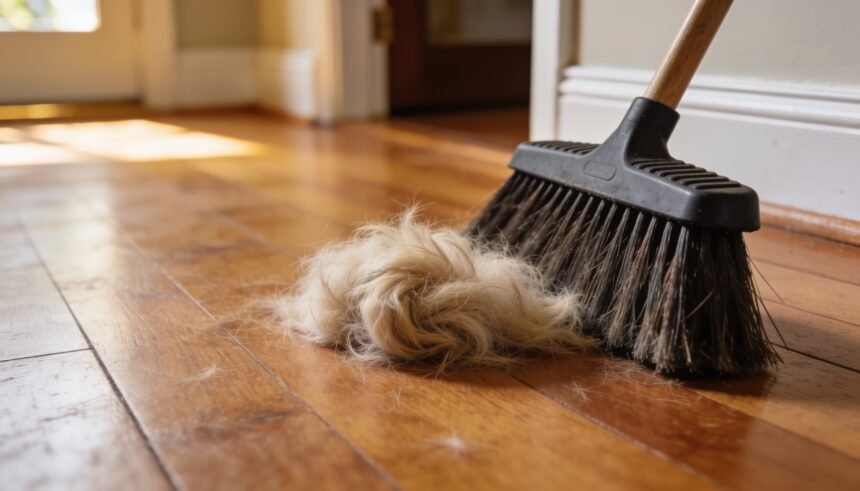
Do not sweep with a stiff broom. It pushes fur into the air and it settles again somewhere else.
A rubber broom or a rubber-edged squeegee is the best tool for fur on hard floors, and almost nobody owns one. The rubber creates static drag that gathers fur into a clump instead of dispersing it. It works on tile, timber and vinyl and it costs very little.
A damp microfibre mop picks up what is left. Damp rather than wet, and rinse it often.
A robot vacuum earns its keep here, not because it cleans better but because it runs daily, and daily removal is what stops the build-up. This is a category rather than a recommendation and nothing is named, though what to look for in a robot vacuum covers the specifications that matter in a house with a shedding dog.
Vacuum along the skirting boards and into corners, where fur accumulates in drifts and where most people never go.
Carpet and rugs
Vacuum slowly, in two directions. Speed is the most common error. Fur works into the pile and one fast pass takes the surface layer only.
A rubber glove, dampened, dragged across the carpet gathers embedded fur that a vacuum will not lift. Tedious and genuinely effective on a small area such as a rug or a stair.
A squeegee works on low-pile carpet for the same reason it works on floors.
Upholstery and fabric
A damp rubber glove or a damp sponge, wiped in one direction. This outperforms almost every purpose-made tool and costs nothing.
Lint rollers are for clothes, and using them on a sofa is expensive and slow.
Wash covers regularly rather than cleaning the fabric repeatedly.
Clothes
Fur on clothes comes off in the dryer more easily than in the wash. A short tumble on air before washing removes a lot of it into the lint filter. Clean the filter afterwards, since a clogged filter is a fire risk and a dryer efficiency problem.
A damp hand wiped down a garment works when you are already at the front door.
Car
Rubber glove, or a squeegee, on the seats. Same principle.
A washable seat cover is the actual answer if the dog travels regularly.
The routine that keeps up
Daily: brush the dog outside. Run the robot vacuum if you have one, or do the one room that matters most.
Twice weekly: rubber broom or vacuum through the main living areas and along the skirting boards.
Weekly: wash the dog bed cover and the blanket from the sofa spot. This is the highest value wash in the house.
Seasonally: during a heavy coat blow, daily brushing is not optional and everything above happens more often. In most of Australia this is compressed rather than spread across a long spring.
What does not work
Sweeping with a bristle broom. Redistributes rather than removes.
Dry dusting. Moves fur into the air, where it lands on everything else.
Waiting until the weekend. Fur compounds, and a week of accumulation on carpet is embedded rather than sitting on top.
Fabric softener sheets rubbed on furniture, which is a common suggestion and leaves residue on the surfaces a dog lies on.
Air fresheners for smell, which mask rather than remove. For odour specifically, getting pet smell out of carpet and enzyme cleaners: why ordinary cleaner does not work cover it properly, and the tray side is in litter tray smell.
Cleaning products, briefly
Never mix cleaning products, and in particular never combine bleach with ammonia or with acidic cleaners, which produces dangerous gases.
Store all cleaning products out of reach of pets and children.
Check that any floor product is suitable for your floor type, since some strip finishes from timber.
No product is named in this article, because the tools that work best here are a rubber broom, a squeegee, a rubber glove and a washing machine, none of which needs a brand.
Next: nail trimming without the drama covers the other half of at-home grooming, litter tray smell covers the cat side of household odour, and mould in Australian bathrooms covers the other persistent household cleaning problem.
When the machine itself is the problem, vacuums for pet hair covers the three places hair actually defeats a vacuum.
The one-page family week
One printable page that holds the whole week: meals, school, activities and who is doing the pickup. Free, and we send one useful email a week.
One email a week. No spam, unsubscribe in a click.