What is in this guide
Mould grows where relative humidity sits above about 50 per cent for long enough. Cleaning it off removes the colony but not the condition, which is why it is back within weeks. The fix is two jobs: get the moisture out faster after every shower, and remove the surfaces that hold water. Everything else is maintenance.
Australian bathrooms are particularly prone to it because outdoor humidity in Brisbane, Sydney and Melbourne is already high, so indoor air has less capacity to dry out on its own.
Why it keeps coming back
A hot shower releases litres of water vapour into a small room. If it has no escape route, it condenses on the coldest surfaces it can find: the ceiling, the window reveal, the grout, the silicone at the base of the shower screen. Those surfaces then stay damp for hours.
Mould does not need dirt. It needs moisture and a surface. That is why a spotlessly clean bathroom still grows it, and why bleaching the ceiling every three months feels like a losing battle. It is a losing battle, because it is treating the wrong thing.
Removing what is already there
Do this first so you can see whether the prevention is working.
On grout and silicone. A bathroom mould spray with a bleach base is effective on porous grout. Apply, leave it for the time on the label rather than wiping immediately, then rinse. Ventilate the room while you do it and afterwards.
On painted ceilings and walls. Bleach kills surface mould but does not always remove the staining, and on a ceiling it can lift paint. Work gently, in sections, with the fan running.
On silicone that stays black. If it has grown into the silicone rather than sitting on it, cleaning will not recover it. It needs to be cut out and replaced. That is an afternoon job, not a specialist one, and it is the most common permanent fix in an older bathroom.
Never mix cleaning products. Bleach and ammonia-based cleaners together produce a genuinely dangerous gas. Use one product, rinse, and move on.
Stopping it, which is the actual job
Run the fan for long enough
This is the single change with the biggest effect. An exhaust fan run for the length of the shower does almost nothing, because the steam is still in the room when you switch it off. The guidance is consistently 15 to 20 minutes after the shower ends.
Most people do not do this because nobody is standing there to switch it off. Three ways round it:
- A timer switch, which runs the fan on for a set period after the light goes off. This is the standard fix and an electrician job in most cases.
- A humidity-sensing fan, which runs until the room is dry and switches itself off.
- A note on the door and a household rule, which works for about a fortnight.
Check the fan actually vents outside
A surprising number of Australian bathroom fans vent into the roof cavity rather than through the roof or an eave. That moves the moisture problem rather than solving it, and it creates a second one above the ceiling.
Rough test: hold a single sheet of toilet paper against the running fan. If it does not hold, the fan is not moving meaningful air, either because it is blocked, undersized, or venting into a dead space.
Open the window, every time
Free, and it works. Cross-ventilation while the fan runs clears steam faster than the fan alone. In a bathroom with no window, the fan has to do all of it, which is why run time matters more in those rooms.
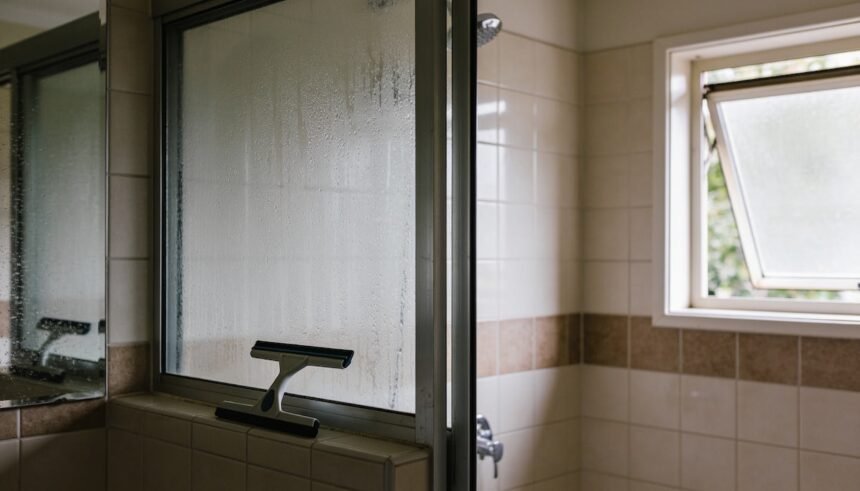
Squeegee the screen and walls
Thirty seconds after the last shower of the day. It removes a genuinely large proportion of the water that would otherwise evaporate back into the room. This is the highest-effort-to-reward item on the list and the one people abandon first, so treat it as optional and do the fan properly instead.
Reseal the grout
Unsealed grout absorbs water and holds it. Resealing every 12 to 18 months keeps it shedding water instead. It is a cheap product and a slow, boring afternoon.
If you rent
Some of this is not yours to fix. A fan that does not work, a fan that vents into the roof, an exhaust fan that was never installed, or a bathroom with no ventilation at all are maintenance issues.
Put the request in writing, describe the problem in terms of the building rather than the cleaning, and keep dated photographs. “The exhaust fan does not clear steam and mould is recurring on the ceiling” gets a different response from “the bathroom is mouldy”.
Tenancy rules differ by state. Check your own state tenancy authority for what counts as a repair obligation rather than relying on a general statement.
The maintenance version
Once it is under control:
- Fan on before the shower, off 20 minutes after. Ideally automatically.
- Window open during and after where there is one.
- Squeegee the screen after the last shower.
- Wipe the silicone line at the base of the screen weekly.
- Reseal grout every 12 to 18 months.
- Look at the ceiling once a month. Catching a few spots is a five-minute job. Catching a ceiling is not.
What does not work
Ventilating only in summer. Winter is worse, not better. The house is closed up, the air is colder, and cold air holds less moisture before it condenses.
A dehumidifier instead of ventilation. It helps in a damp house generally, but in a bathroom the moisture arrives in a burst and needs to leave. Extraction beats dehumidification for that.
Leaving the door closed to contain it. It contains the moisture too. Open the door after the last shower so the room can dry.
Next: heating a sealed-up house in winter creates exactly this problem, which is why the winter heating guide covers ventilation alongside cost.
The one-page family week
One printable page that holds the whole week: meals, school, activities and who is doing the pickup. Free, and we send one useful email a week.
One email a week. No spam, unsubscribe in a click.