What is in this guide
Ordinary cleaner does not work on this, and there is a reason.
Pet urine is organic. A general purpose cleaner lifts the visible mark and masks the smell with fragrance, and the compounds causing the odour stay in the fibres, the backing and the underlay. A week later the mark is gone and the smell is not.
Enzyme cleaners work differently. They contain enzymes that break down the organic material itself rather than covering it. That is the whole distinction and it is why one works and the other does not.
The method, in order
1. Get the liquid out first, if it is fresh. Blot with towels or paper, pressing down hard, standing on it if necessary. Do not rub, which spreads it through the fibres and pushes it deeper.
2. Find the full extent. Urine spreads much further under the surface than the visible mark suggests, and treating only what you can see leaves most of it. Feel for the damp edge, which is usually well outside the stain.
3. Apply the enzyme cleaner generously. More than feels reasonable. It has to reach as far as the urine did, which means through the carpet, into the backing and into the underlay if it got there.
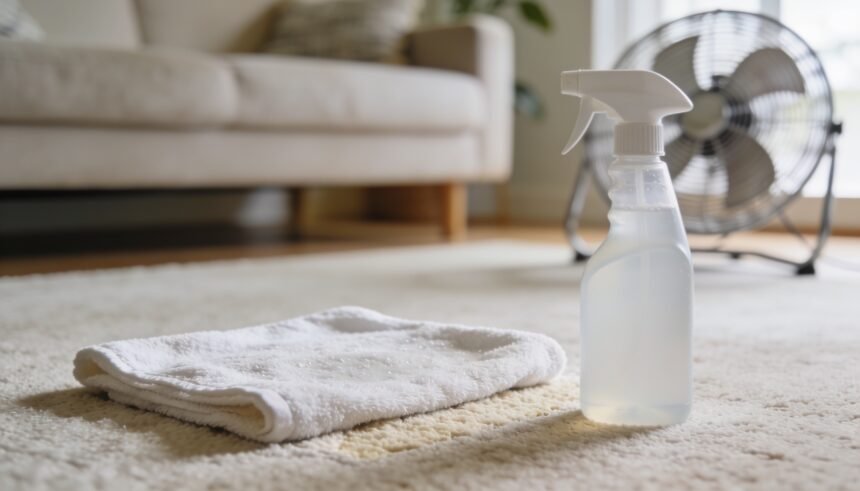
4. Leave it wet, and slow the drying. This is the step people skip and it is the one that matters most. Enzymes need time and moisture to work. Covering the area with a damp towel or plastic to stop it drying too fast, and leaving it for as long as the product specifies, is the difference between a fix and a repeat.
Follow the product’s own instructions, which are the authority on dwell time, dilution and suitability.
5. Blot up the excess, then dry thoroughly. Airflow and ventilation, and a fan if you have one.
6. Repeat if you can still smell it. Old or repeated soiling frequently needs a second or third treatment, and that is normal rather than a sign the product failed.
7. Test on a hidden area first, particularly on wool, which is common in Australian carpets and can be damaged by the wrong product.
Why it comes back in warm weather
A very common experience and it has a cause.
Residual compounds that were not fully broken down become more volatile as temperature and humidity rise. So a spot treated in July can smell again in February even though nothing new has happened.
If it returns with the heat, the original treatment did not reach everything. Repeat it, more generously, and consider whether it reached the underlay.
The underlay problem
This is where most persistent cases live.
Urine soaks through the carpet and into the underlay, and the underlay is absorbent, hidden and not reached by any surface treatment. A carpet cleaned perfectly can sit on saturated underlay and smell indefinitely.
Signs it has reached the underlay: the smell returns after every clean, it is stronger in warm weather, or a large volume soaked in and was not dealt with immediately.
The honest position: for a badly affected area, replacing the underlay in that section is frequently the only complete answer, and no amount of surface cleaning will substitute for it. A professional carpet cleaner can assess this and will tell you whether the underlay is the problem.
Steam cleaning without an enzyme treatment can make it worse, because heat can set the proteins. Enzyme treatment first, and tell the cleaner what you are dealing with.
What not to do
Never mix cleaning products. Do not combine bleach with ammonia or with acidic cleaners, which produces dangerous gases.
Never use an ammonia-based cleaner on pet urine. Ammonia smells like urine to an animal and can mark the spot as a toilet, which is the opposite of what you want. This is the same principle as in litter tray smell: fixing it properly.
Do not use a fragranced product as the solution. It masks and it deters nothing.
Do not rub.
Do not ignore the cause. If a house-trained animal has started toileting indoors, that is a veterinary matter first. Why is my cat not using the litter tray covers the cat version, and the same principle applies to a dog: a sudden change in toileting warrants a vet visit before it is treated as a cleaning or behaviour problem.
Safety while you are doing it
Ventilate the room.
Keep pets and children out of the area while it is wet and until it has dried, following the product’s directions.
Wear gloves, and follow the label.
Store products out of reach.
Finding what you cannot see
A UV torch shows dried urine on carpet in a darkened room, which is genuinely useful when you can smell something and cannot locate it. It is also frequently alarming, so be prepared to find more than you expected.
Check the edges of rooms, behind furniture and in corners, which is where animals go when they are avoiding an obvious spot.
Renting
Most Australian families rent at some point and pet odour is a bond issue.
Deal with anything immediately and properly, because the difference between a same-day treatment and a discovered-at-the-end-of-tenancy one is the difference between nothing and a replacement claim.
Keep receipts for any professional cleaning.
Check your lease for what is required at the end of a tenancy, and your state’s tenancy authority publishes guidance on what can and cannot be required.
Preventing the next one
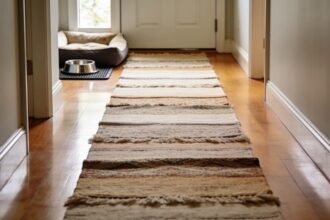
A washable mat or rug in the spot the animal uses is far easier to deal with than carpet.
Deal with the cause, whether that is a litter tray issue, a toileting problem needing a vet, or an older pet needing more frequent access outside.
Clean up the day it happens. Almost every difficult case in this article began as an easy one that was left.
Next: dog fur, floors and a clean house covers the other half of a pet household, litter tray smell: fixing it properly covers the cat side, and why is my cat not using the litter tray covers the underlying cause.
The one-page family week
One printable page that holds the whole week: meals, school, activities and who is doing the pickup. Free, and we send one useful email a week.
One email a week. No spam, unsubscribe in a click.