What is in this guide
- 1. Name the job before picking up a bottle
- 2. Read the exclusions as closely as the suitable surfaces
- 3. Read the whole sequence of directions
- 4. Establish what is inside this particular pack
- 5. Ask what each front label claim actually covers
- 6. Compare the quantity after checking suitability
- 7. Resolve missing information before checkout
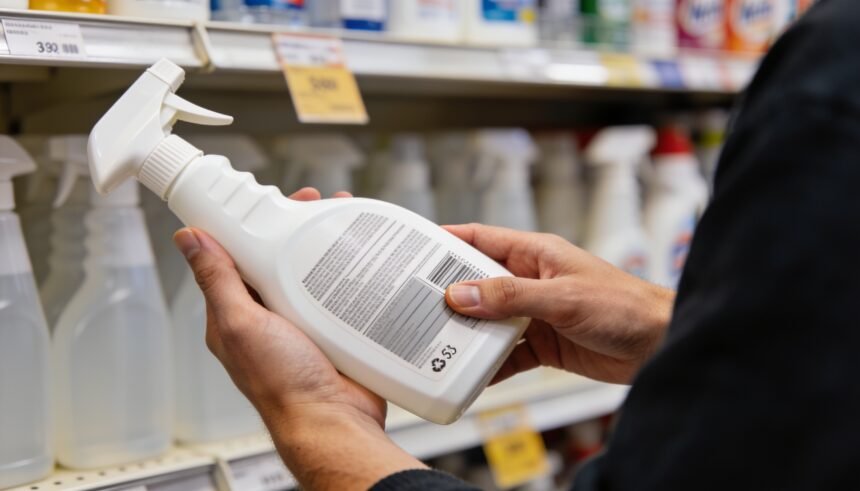
Start with the surfaces and directions on the back of the bottle, then check the claims on the front. Reading a cleaning product label before you buy should answer three questions: does it suit the job, can you follow its instructions, and is this the pack you actually need?
1. Name the job before picking up a bottle
Write down what you want to clean and what it is made from. “Kitchen” is too broad to be a useful shopping note. “Fingerprints on the laminate cupboard doors” gives you a surface and a problem to check against the label.
Look for that intended use in the product description. If you are buying for several jobs, check each one rather than letting a broad product name stand in for the details. Leave the bottle on the shelf if the main task you need it for is unclear.
This is also a chance to check whether something already in the cupboard covers the job. If your shopping list contains a separate spray for each room, deciding whether you need a different cleaner for every room can help you review the list before buying more.
2. Read the exclusions as closely as the suitable surfaces
CHOICE’s surface-cleaner buying guide notes that cleaners can exclude particular surfaces. Read both the positive list and wording such as “not suitable for” or “do not use on”. A broad name on the front does not settle every surface question.
Match the exact description where possible. If your care paperwork describes a finish or coating, keep that wording in your shopping note. Do not silently drop a qualifier such as “sealed” when comparing your surface with the label.
For a rental, you might need to ask the property manager what a benchtop is made from. For furniture or an appliance, look up its care instructions. If you cannot establish the material or the product’s suitability, make that an unanswered question rather than a reason to guess.
3. Read the whole sequence of directions
Work through the directions from application to the final step. Look for whether the product is used as supplied or prepared first, how it is applied, and any stated waiting, wiping, rinsing or drying requirements. Where the label gives different methods for different jobs, identify the one relevant to your purchase.
You are checking the work involved before paying. A product with a method you cannot reasonably fit into your routine may be a poor choice even if its advertised purpose sounds right.
For example, if your aim is a quick cupboard-door clean before leaving for work, compare the complete labelled method with the time you have. Do not choose a bottle on the assumption that you can skip a step. Equally, do not borrow the instructions from a similar-looking product you have used before.
Read any warnings, precautions and storage directions during this pass. If an instruction is unclear, ask the manufacturer before buying. The point is to choose a product whose requirements you understand, not to work out a substitute method in the supermarket aisle.
4. Establish what is inside this particular pack
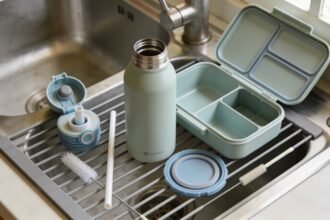
Check the full product name, variant, contents and pack format. For a refill, find out whether it is ready to use or needs preparation, and which container or dispenser the manufacturer specifies. Do not assume that every pack called a refill works the same way.
Look at what you already own. If the purchase depends on a compatible bottle, put that requirement beside the refill on your list. A pack that cannot be used with your existing setup needs a different buying decision from a straightforward replacement.
For the wider question of committing to a system, read what to check before buying cleaning kits and refills. Here, the immediate task is simply to establish what this pack contains and what else its instructions require.
5. Ask what each front label claim actually covers
Take one claim at a time and find its explanation. Does it describe the liquid, the bottle, one ingredient or the complete product? Follow any asterisk to its qualification before treating it as a reason to choose that pack.
The ACCC warns that broad environmental terms and visual presentation can create misleading impressions. Look for a specific, supported statement rather than relying on a leaf illustration or general green wording. If the claim concerns packaging, keep it separate from your judgement about the cleaner’s performance.
A useful question is: “What would I be able to check?” Look for the named material, the part of the pack covered, a stated comparison or an explanation of any conditions. If a certification is a deciding factor, check what the named scheme covers rather than assuming it endorses every feature of the product.
You do not have to resolve every marketing claim to buy a cleaner. You can leave an unclear claim out of your decision and compare the information that is actually available.
6. Compare the quantity after checking suitability
Once two options meet your requirements, compare their pack quantities and prices. The ACCC explains that unit prices show the cost of a standard quantity. Read the unit as well as the number so that the comparison uses matching amounts.
Keep preparation instructions alongside that comparison. A bottle of concentrate and a ready-to-use spray need more thought than comparing the volume printed on their fronts. Avoid inventing a dilution or assuming that equal volumes provide equal numbers of cleaning jobs.
Use the separate guide to comparing unit prices for household basics for the calculation. Then check the total you will pay today and whether the pack fits your available storage. Price belongs after suitability in this reading sequence because an unsuitable product does not become useful through a lower price.
7. Resolve missing information before checkout
For an online order, open the label photographs as well as the description. Check that the name, variant and size match your selection. If the back panel is unreadable, look for the exact product on the manufacturer’s site or request a clearer label image.
Make a short note for your final choice: intended job, matching surface, important exclusion, required steps and pack format. If one of those fields remains uncertain, pause that purchase. On your next shop, use this note to read one candidate bottle from front to back before it goes in the trolley.
How we checked this: Reviewed CHOICE surface-cleaner guidance and ACCC environmental-claim and unit-pricing guidance on 30 September 2026. The reading sequence is an editorial method. No products were tested or ranked, and no current prices or savings are claimed.
The one-page family week
One printable page that holds the whole week: meals, school, activities and who is doing the pickup. Free, and we send one useful email a week.
One email a week. No spam, unsubscribe in a click.