No. Cleaning products are marketed by room, but they are formulated for a type of grime on a type of surface. A kitchen bench and a bathroom vanity that are both laminate with everyday grease and fingerprints on them can be cleaned with the same product, and the label on most general sprays already says so.
Where a room does need something specific, it is because of the soil or the surface in it, not because of the room itself. Once you sort the cupboard by job rather than by room, the shelf gets a lot shorter.
This is an editorial comparison of how products are labelled and what they are designed to do. Nothing here was tested by us, and no cleaning performance claim is made about any product.
Why the aisle is organised by room
Supermarket cleaning aisles group products as kitchen, bathroom, floor, glass and toilet because that is how people shop and because it sells more bottles. A household that buys one product per room owns six or seven, plus the specialty items, and replaces them at different rates.
The chemistry underneath is simpler. Almost every household cleaner is doing one of a small number of jobs:
- Lifting greasy or oily soil, which is what detergents and general degreasers do
- Dissolving mineral deposits, which is what acidic descalers and most bathroom sprays do
- Killing or removing mould and stains, which is what chlorine-based and oxygen-based bleaches do
- Breaking down organic matter, which is what enzyme cleaners do
- Scouring, which is what abrasive creams and powders do
A “kitchen” spray is usually a mild degreaser. A “bathroom” spray is usually a mild acid to deal with soap scum and hard water marks. A “glass” cleaner is a fast-evaporating solvent so it does not streak. The room names are labels on the front. The job is on the back, in the directions.
Sort the cupboard by job instead
Read the directions panel on each bottle you own and note two things: what soil it says it removes, and which surfaces it says it is safe on. You will usually find that several bottles are close to interchangeable and that one or two are doing a job nothing else can.
For most Australian houses that leaves a working list of about five products:
- One general surface spray for benches, tables, painted surfaces and most sealed floors
- One bathroom or descaling product for soap scum, tap scale and hard water marks, which a general spray does poorly
- One toilet cleaner, because the bowl is a different soil and a different surface again
- One abrasive cream or powder for the small number of things that need scrubbing
- One specialty product if your house has a recurring problem, such as mould, pet accidents or an oven
Add microfibre cloths and a mop, and that is a complete cupboard. The four products most houses actually need come to the same list from the direction of refill kits, and the cost comparison there is worth reading before buying any system.
The jobs that genuinely need a specific product
There are real exceptions, and they are worth being honest about, because “one product for everything” is as much a marketing claim as “one product per room”.
Bathroom mould is a moisture problem first and a product problem second. A general spray removes the visible mark but not the growth, and the fix involves ventilation as much as chemistry. Mould in Australian bathrooms covers what actually works.
Pet urine on carpet, rugs or grout is organic matter that soaks in. Ordinary surface cleaners deal with what is on top and leave the source behind, which is why the smell returns. That is the job enzyme cleaners exist for.
Ovens and rangehood filters carry baked-on, polymerised grease that a bench spray will not shift. This is one of the few places where a purpose-made product or a long soak in hot water and dishwashing detergent is the practical answer.
Natural stone benches and floors are the other direction. Marble, limestone and travertine are damaged by acidic cleaners, which rules out most bathroom sprays and vinegar on those surfaces. Stone suppliers and manufacturers specify a neutral cleaner for that reason, and the surface, not the room, is what decides it.
Glass and mirrors do not strictly need a dedicated product. A general spray works if it is wiped fully dry with a clean cloth, but a glass cleaner streaks less and is cheap enough that many households keep one.
Where the room-by-room approach costs you
Beyond the money, buying per room creates three problems.
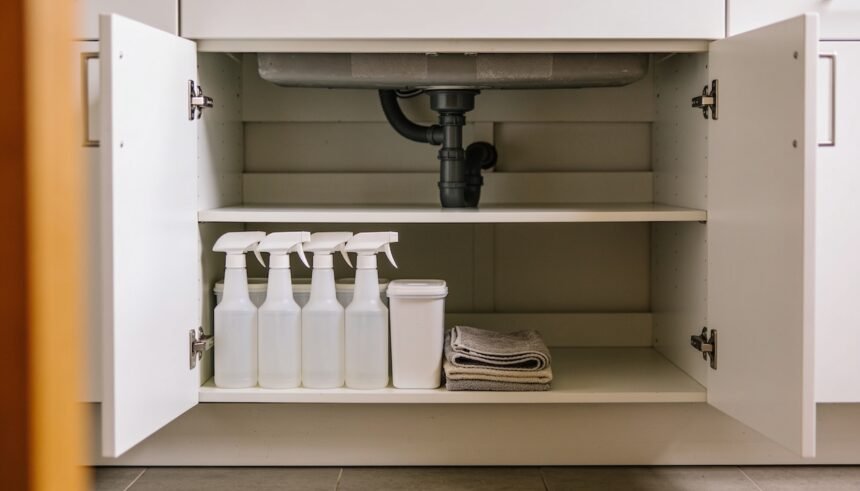
- Products go off or go unused. Half-full bottles under every sink are the normal result, and they still need to be stored away from children
- Storage multiplies. Each bathroom and the kitchen end up with its own stash, instead of one caddy that moves with you
- More bottles means more chances to mix them. This is the one that matters, and it gets its own section
If you rent, the end-of-tenancy standard is where a lot of specialty buying happens. The end of lease cleaning list is shorter than the aisle suggests and is worth checking before stocking up.
Fewer products, same safety rules
Consolidating the cupboard makes the safety rules more important rather than less, because one bottle now travels to rooms where a different product is also in use.
Never mix cleaning products. Chlorine bleach mixed with an acidic product, which includes many bathroom sprays, toilet cleaners and vinegar, releases chlorine gas. Bleach mixed with ammonia-based products releases toxic chloramine vapours. Using one product and then another on the same surface without rinsing in between can do this too.
- Ventilate the room you are cleaning
- Keep every product in its original labelled container, out of reach of children. Decanting into a plain spray bottle is the habit that turns a simplified cupboard into a hazard
- Use the dilution and contact time on the label rather than estimating stronger or longer
- Check the surfaces panel before using a product somewhere new
- The Poisons Information Centre is 13 11 26, anywhere in Australia, 24 hours a day
The short answer, again
You need a different cleaner for every type of job and surface in your house, not for every room. For most Australian households that is a general spray, a bathroom descaler, a toilet cleaner, an abrasive and one specialty product for whatever your house does repeatedly. Everything else on the shelf is a variation on one of those five, sold with a room’s name on the front.
The one-page family week
One printable page that holds the whole week: meals, school, activities and who is doing the pickup. Free, and we send one useful email a week.
One email a week. No spam, unsubscribe in a click.