What is in this guide
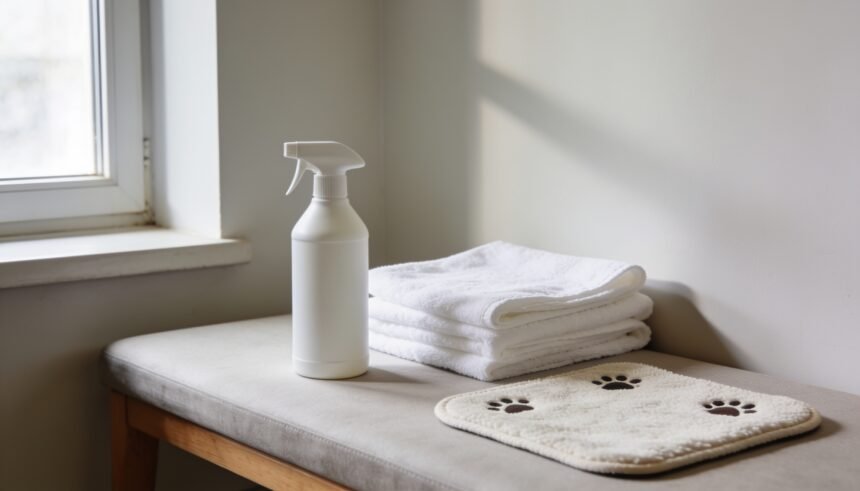
An enzyme cleaner formulated for pet urine targets organic residue that an ordinary wipe-down may leave behind. Ordinary cleaners are not useless, but a disappearing mark or a fresh smell does not establish that the urine has been removed; the formulation, surface and application method matter. [S1, S3]
Why can a clean-looking patch still smell?
Removing the visible mess and removing the remaining urine are different checks. Australian manufacturer urineFREE describes urine reaching beneath carpet and needing further treatment even when the surface does not show the full problem. Its instructions also separate urine treatment from later carpet shampooing. [S4]
That makes the title a shorthand, not a rule that every ordinary cleaner fails. The American Cleaning Institute says products both with and without enzymes can clean effectively. The useful question is whether your cleaner is formulated for this particular residue and whether its directions suit the affected material. [S1]
If the usual spray has left a persistent urine smell, check those two things before repeating the same clean.
What do enzymes change?
Enzymes help break larger stain material into smaller pieces that are easier to remove. They have specific targets: an enzyme suited to one type of soil is not automatically suited to every other type. The American Cleaning Institute’s enzyme factsheet describes this as selective cutting of stain material. [S2]
For the household, the practical distinction is between changing the residue and simply judging the patch by appearance. Look for a stated pet-urine use, rather than assuming that any bottle containing enzymes is interchangeable. [S1, S2]
The word “enzyme” is a useful clue, not a complete set of instructions. It does not tell you the dilution, suitable surfaces, contact time or finishing steps. Those belong to the individual formulation. [S1, S3, S5]
How should you use an enzyme cleaner for pet urine?
1. Match the bottle to the mess and material
Read the urine-removal claim and surface list together. Check the item’s care instructions as well. A direction for carpet is not permission to treat every furnishing in the house. If compatibility is unclear, ask the cleaner or furnishing manufacturer before applying it. [S1, S3]
2. Test a hidden patch
Follow the label’s colourfastness test before treating the visible area. This is part of the preparation, not something to do after applying the cleaner across the stain. Keep the test specific to the material you intend to clean. [S1, S4]
3. Blot fresh liquid first
The Australian instructions checked begin with absorbing excess urine using paper towels. Prepare the patch that way where your product directs it, then follow its application instructions. Do not substitute a remembered routine from a different bottle. [S4]
4. Follow the full treatment sequence
Read beyond “spray on”. Check how much to apply, how long to leave it, and whether the next step is blotting, air drying or removing residue. The directions checked differ: one formulation specifies a wait followed by blotting, while another uses an air-drying sequence. [S3, S5]
Do not automatically cover every treated patch overnight. Covering appears in some instructions for old deposits; it is not a universal step for every product or surface. Follow the bottle’s precautions and access restrictions throughout. [S3, S5]
What if the smell remains?
Check the completed process before deciding the cleaner cannot work: was it suitable for urine, did treatment reach the affected area, and were the drying and finishing steps completed? Manufacturer guidance allows for repeat treatment of some old deposits, but does not establish that every stain will disappear in one application. [S3, S4]
For a carpet problem extending beyond a surface patch, see getting pet smell out of carpet. This guide’s next step is simpler: read the urine claim, material restrictions and complete application sequence on the bottle before treating the spot again.
How we checked this
Checked on 21 September 2026 against cleaning-industry explanations and manufacturer directions, including Australian guidance. This is an editorial comparison of mechanisms and instructions. No products or household surfaces were tested, and no brand is ranked or recommended.
The one-page family week
One printable page that holds the whole week: meals, school, activities and who is doing the pickup. Free, and we send one useful email a week.
One email a week. No spam, unsubscribe in a click.