What is in this guide
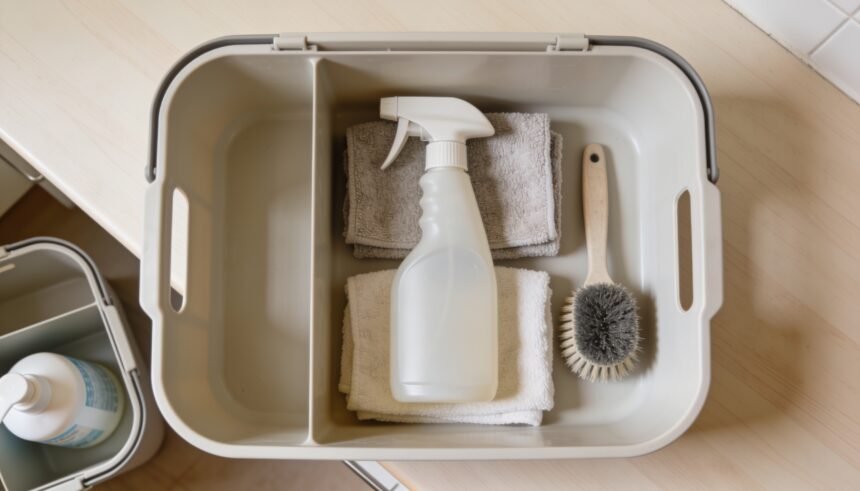
A caddy should hold only what gets picked up and put down in the same ten minutes, kept where the daily clean actually happens. Everything else, concentrates, backups and anything a child could reach, belongs in a cupboard, not the caddy. Mixing the two is the single most common reason a caddy stops getting used: it gets heavy, it gets left wherever it was last used, and the system quietly reverts to bottles scattered under every sink in the house.
What actually belongs in the caddy
Keep it to what is used nearly every day: a general surface spray, a cloth or two, and whichever single bathroom product the household reaches for most. That is close to the full list. A caddy carrying six products and three spare bottles is not a caddy any more, it is a box, and boxes get put down and left.
If a different cleaner for every room is not actually needed, which for most households it is not, the caddy gets lighter and the question of what to carry gets easier to answer on its own.
Where it should live
The caddy belongs wherever the daily reset happens, not under whichever sink is nearest when it was last used. For most households that is the kitchen, since that is where the fastest and most frequent wipe-downs happen. A caddy that has to be fetched from another room before it can be used adds a step that gets skipped on a tired evening, which is the same failure point covered in a cleaning routine for households with no time to clean.
A second, smaller caddy for the bathroom is worth having if the household showers and cleans at different times of day to the kitchen reset. Beyond two, a caddy per room stops saving time and starts duplicating bottles that then all need replacing at once.
How many caddies does a house need
One for daily jobs, in the room where they happen most. A second only if a genuinely separate daily task, usually the bathroom, happens on its own schedule. A third caddy for a multi-storey house is reasonable if carrying one up and down stairs every day is the actual barrier. Beyond that, extra caddies are a sign that supplies need sorting into the caddy and cupboard categories properly, not that more caddies are needed.
Keeping it safe with kids and pets in the house
The caddy itself should carry nothing a toddler cannot be near unsupervised for a moment, which rules out concentrates and anything with a child-resistant cap designed to stay closed. Anything stronger goes in the cupboard, stored at least 1.5 metres up, ideally in a locked or child-resistant cupboard, separate from food and from anything a pet could knock down. This matches general Australian poisoning-prevention guidance for households with children, and it applies the same way whether the house is rented or owned.
Labelling and avoiding the unlabelled bottle problem
Never decant a concentrate or a strong cleaner into an unlabelled bottle to make it lighter or easier to carry. Every product stays in its original container with the label intact, because that label is what tells anyone in the house, including a babysitter or a visiting relative, what is actually in the bottle and what to do if it is swallowed or splashed.
Reading the label before it goes in the caddy
A product earns a spot in the daily caddy based on what the label says it is for, not on packaging or marketing. Reading a cleaning product label before you buy covers what the label is required to disclose and how to tell a genuine multi-surface product from one that is marketed as one.
Cleaning the caddy itself
A caddy that sits under a sink picks up its own grime, usually from drips down the outside of bottles. Wipe it out every few weeks with whatever general spray already lives in it. A caddy that is visibly dirty is one that stops feeling worth grabbing, which undoes the entire point of keeping it somewhere convenient.
Small homes and rentals
In a smaller home or a rental with limited cupboard space, the caddy can be the only storage that exists day to day, with the cupboard reduced to a single shelf or a lockable box on a high shelf for anything stronger. The standard does not change with the size of the house. What changes is how little extra storage there is to get wrong, which makes the caddy and cupboard split more useful in a small home, not less. End of lease cleaning and flyscreens, windows and window tracks both cover jobs that need their own gear temporarily, which is a case for borrowing or buying for that job alone rather than adding it to the everyday caddy.
Start this week
Empty every bottle currently under every sink onto the kitchen bench. Sort into three piles: used most days, used occasionally, and anything that should have gone out months ago. The first pile becomes the caddy. The second goes on a labelled shelf. The third gets disposed of according to council guidance rather than poured down the sink.
The one-page family week
One printable page that holds the whole week: meals, school, activities and who is doing the pickup. Free, and we send one useful email a week.
One email a week. No spam, unsubscribe in a click.