What is in this guide
The routine that works is smaller than the one most households try first. A short daily reset, done at the same time every day, plus one rotating task that takes ten to fifteen minutes, covers almost everything a lived-in house needs. The deep jobs, the ones that take an hour or more, get taken out of the weekly routine entirely and scheduled on their own.
The usual approach fails for a specific reason: it bundles a week’s worth of cleaning into one block of time, and that block only exists if nothing else claims it. One missed Saturday and the house is now two weeks behind, which is exactly the point most people give up and decide the whole system does not work for them.
Why the weekend clean keeps getting skipped
A full clean needs an uninterrupted stretch, and a household with kids, shift work or both rarely has one on a reliable day. Sport, visitors, a sick kid, a double shift, any one of these and the weekend clean does not happen.
The bigger problem is what happens next. A skipped week does not just delay the job, it makes the next attempt bigger, because nothing was done in between. A routine that gets harder every time it is missed will eventually stop being attempted at all. The fix is not a better schedule for the same big job. It is a smaller job that does not depend on a specific day going to plan.
The daily reset, ten to fifteen minutes
This is the part that holds the house at a livable standard, done every day regardless of what else is happening.
- Kitchen bench cleared and wiped down
- Sink empty, dishes in the dishwasher or washed
- One load of laundry started, even if it is not finished or folded
- A fast floor pass in the kitchen and the main living space, broom or a stick vacuum rather than a full vacuum and mop
- Surfaces cleared before bed, so the house resets overnight instead of accumulating
Fifteen minutes, same order, ideally the same time of day so it becomes automatic rather than a decision made fresh every evening. The order matters more than it looks like it should, because a reset that starts with the hardest job gets skipped on a tired night. Start with the bench, because it is fast and visible, and momentum carries the rest.
One rotating task a day
Spread the slower jobs across the week instead of grouping them into one session. A rough version:
- Monday: bathroom surfaces and toilet
- Tuesday: vacuum or mop the floors properly
- Wednesday: dusting and skirting boards
- Thursday: bins out, recycling checked
- Friday: bedlinen or towels, whichever is due
- Weekend: one slightly longer job, thirty minutes, not a full day
Ten to fifteen minutes a day for the rotating task, on top of the daily reset. The specific order matters less than having one, because a fixed rotation removes the daily decision about what needs doing, which is often the actual barrier rather than the cleaning itself.
What this routine deliberately leaves out
Some jobs do not belong in a weekly rotation because they are infrequent, slower, or only relevant at certain points in the year, and folding them in is what made the old schedule too heavy to sustain.
Window tracks, flyscreens and the oven interior fall into this category. Flyscreens, windows and window tracks covers one of these properly, including the order that avoids doing the glass twice. These get their own slot once or twice a year, not a weekly line.
Moving out of a rental is its own standard entirely, well beyond what a routine needs to maintain week to week. End of lease cleaning sets out what that actually requires, separate from ordinary upkeep.
Keep the cleaning kit small enough to grab
A routine that takes longer to set up than to do will not survive a tired week. A caddy with the few products a house actually needs, kept where the daily reset happens rather than under a different sink in a different room, removes a step that otherwise causes the whole thing to be skipped. Sorting the cleaning cupboard by job rather than by room cuts most households down to about five products, and cleaning kits and refill systems is worth checking before buying a bundled system to simplify this further.
Sharing it without becoming the reminder
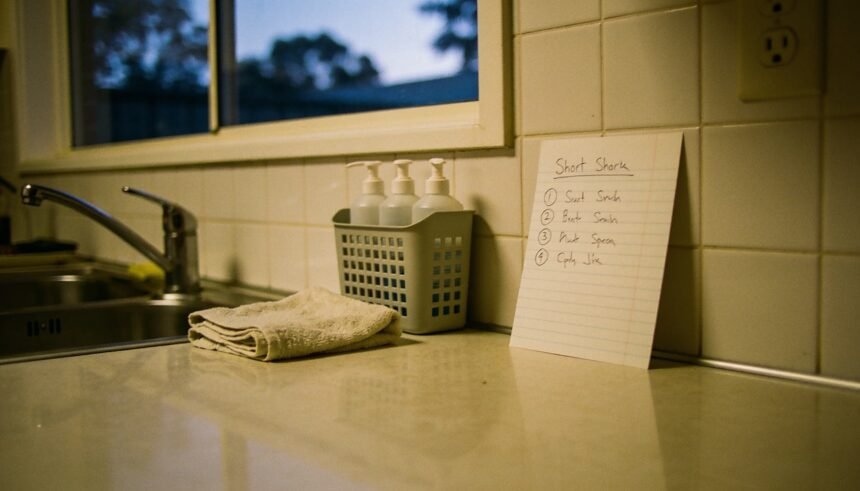
A routine that only one adult tracks in their head is not a household routine, it is one person’s extra job. Writing the week’s rotation on a card where everyone sees it, the same principle behind a chore chart that actually gets used, means a child or a partner can see what today’s task is without being told.
When the routine breaks
Some weeks it will not happen, and the response matters more than the routine itself. Drop to the smallest possible version: dishes done, one load of laundry, bins out on the right night. Skip the rotating task entirely rather than trying to catch up on two days’ worth at once. Resume the normal rotation the following week rather than doubling up to compensate. A routine that demands catch-up is a routine that eventually gets abandoned the same way the full weekend clean did.
Starting this week
Pick the daily reset time, the fifteen minutes that happens regardless of the day. Write this week’s five rotating tasks on a card near the kettle or the calendar. That is the whole system, and it survives a bad week precisely because there is so little to fall out of.
The one-page family week
One printable page that holds the whole week: meals, school, activities and who is doing the pickup. Free, and we send one useful email a week.
One email a week. No spam, unsubscribe in a click.