What is in this guide
Most households are not actually fighting a lazy child. They are fighting a room with no obvious place for anything to go back to, and a habit that was never built in the first place. Fix the system before you fix the child, and the daily argument mostly disappears on its own.
This is editorial guidance drawn from common parenting and behaviour management approaches used across Australian families. No household, child or result described here has been tested by us.
Why “clean up” does not work as an instruction
“Clean up your mess” asks a child to do three separate jobs at once: notice what is out of place, decide where each thing belongs, and physically move it there. For a young child, the first two steps are the hard ones, not the third. Adults skip past this because they do all three automatically and without noticing.
A second problem is timing. Most mess accumulates across a whole afternoon, and the instruction usually arrives as one big job at the end of it, after the child has moved on mentally to dinner, a show or bed. A job that size, requested at that moment, reads as a punishment rather than a task, and it is resisted the same way.
The setup that actually changes it
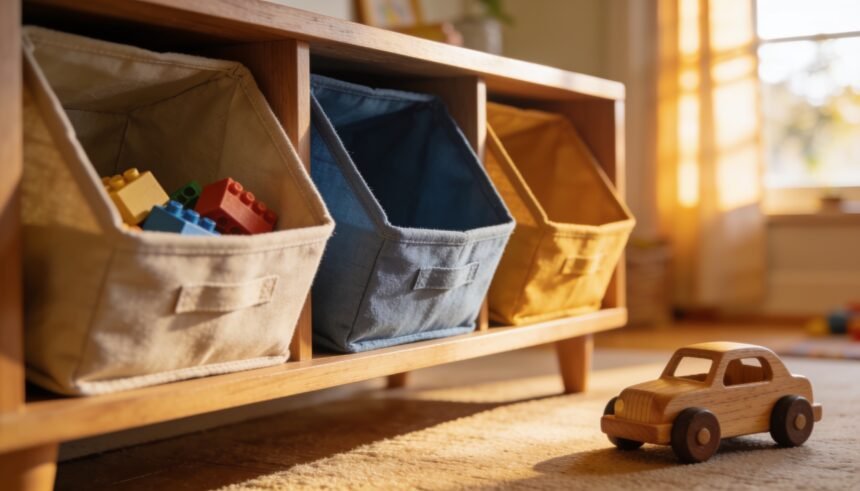
Every object needs one obvious home, and that home needs to be as easy as the floor. A toy box with no categories inside is barely better than the floor, because it still requires a decision. Open bins by type, labelled with a picture for a child who cannot read yet, remove the decision entirely. Decluttering kids' toys without the tears covers getting the volume down to a point where this is possible, and it is worth doing that first. A room with three times more toys than fit the available storage cannot be kept tidy by any amount of good behaviour.
Clean up in small amounts, often, rather than once at the end. One activity, put away before the next one starts, is a two-minute job a small child can actually complete. A whole day’s mess at 6pm is not.
Narrate what you are doing instead of only directing. “I’m putting the blue cars in the blue bin” said while you do it teaches the system faster than an instruction said from across the room. This matters most in the first few weeks of a new storage setup.
Name what was done well, specifically. “The blocks are all in the box and the floor is clear” lands. “Good job” does not, because it gives no information about what to repeat.
What this looks like by age
Two to four: Expect to do most of the physical work alongside them for a long time. Their job is sorting into the right bin with you, not independent tidying. One bin, one type of toy, is the realistic unit at this age.
Five to seven: This is the age a short, specific instruction starts to work on its own, such as “trains in the train box”, rather than a general one. Children this age can finish a job with a visible end point but will genuinely forget an instruction given more than a few minutes earlier.
Eight and up: A child this age can manage the full loop, noticing, deciding and moving, provided the storage system still makes the decision easy. If a child this age still cannot do it, the more common cause is a storage system that has become cluttered or outgrown rather than a behaviour problem. Age-appropriate chores from 2 to 16 and chore charts that kids actually use cover building this into a wider routine once the daily habit is solid, and meal, chore and activity tracking in one place covers keeping it visible alongside everything else running in the household.
When it still does not work
If the storage system is simple, the amount of mess is reasonable for the room, and a child still will not put things away after several weeks of a consistent routine, it is worth checking a few other things before assuming it is defiance. Overtiredness and a day with too many transitions already behind it make this specific task much harder for a lot of children, and so does a room that is still objectively too full despite a tidy-up attempt. For a small number of children, ongoing difficulty with multi-step tasks and sequencing is worth raising with a GP or school if it is consistent across settings, not only at home.
It is also worth lowering the standard before assuming the system has failed. A box of mismatched toys shoved in roughly the right bin is a win for a six year old. Perfecting it yourself afterwards teaches that the attempt did not count, which is the single fastest way to end the habit.
Next step
Get the storage system right before anything else. Decluttering kids' toys without the tears and a cleaning routine for households that have no time to clean are the two pieces worth reading next, because a tidy habit sits on top of both.
The one-page family week
One printable page that holds the whole week: meals, school, activities and who is doing the pickup. Free, and we send one useful email a week.
One email a week. No spam, unsubscribe in a click.