What is in this guide
To protect the texture of cooked meals, freeze the main cooked component and leave delicate finishes for serving day. Use well-sealed freezer packaging, divide the batch into portions you will actually use and accept that some foods will soften: packing can limit damage, but cannot make every meal taste freshly cooked.
The useful question is what needs to be ready when dinner comes around. A complete meal in one container is convenient. A prepared sauce with pasta still to cook asks for more evening work, but gives you control over the pasta’s final texture. Choose the arrangement before making a large batch.
Decide what should go into each portion
Write the dinner as three parts: the main cooked component, the accompaniment and the finish. For tomato pasta, that might be sauce, pasta and grated cheese. For bean bowls, it might be the bean mixture, rice and fresh salad. Then decide which parts you want ready from the freezer.
This is a preparation plan, rather than a rule that every ingredient must be packed separately. If you need a dinner that can be served with very little extra cooking, choose a recipe designed for that purpose. If you can manage one saucepan on the night, freezing the sauce alone may suit you better.
For broader recipe selection, start with meals chosen for freezing and reheating. Here, the job is to change how you prepare and pack the dinner you have chosen.
Understand which texture changes you can prevent
University of Minnesota Extension explains that freezing can rupture the cell walls of fruit and vegetables, leaving them softer after thawing. That means a cooked vegetable component should not be expected to regain the bite of a fresh salad.
The National Center for Home Food Preservation also identifies milk sauces that may separate and casserole crumb toppings that become soggy. Its warning about mushy cooked pasta applies to pasta frozen alone; it does not establish that every pasta bake fails.
Use these limits to decide what matters in your dinner. If the appeal is a crisp topping, plan to add that topping later. If the dish is meant to be soft and spoonable, a change in vegetable firmness may matter less. No container can promise to preserve every original texture.
Leave soup additions and crisp finishes for later
For soup, UGA Extension recommends adding milk or cream, pasta and delicate final additions after thawing and reheating. Use that as a component plan: prepare the soup base, then record the remaining ingredients as part of the dinner job.
The following are editorial meal plans based on that separation approach. They are not tested recipes or guarantees for every version of these dishes.
| Dinner | Prepare for the freezer | Keep as a serving-day job |
|---|---|---|
| Tomato pasta | The cooked tomato sauce | Cook pasta and add the chosen cheese |
| Vegetable noodle soup | The soup base without noodles or cream | Prepare noodles and follow the recipe’s final additions |
| Bean bowls | The cooked bean mixture | Prepare the accompaniment and fresh salad |
| A casserole with crumbs | Follow a freezer-suitable recipe for its main mixture | Add the crumb topping as that recipe directs |
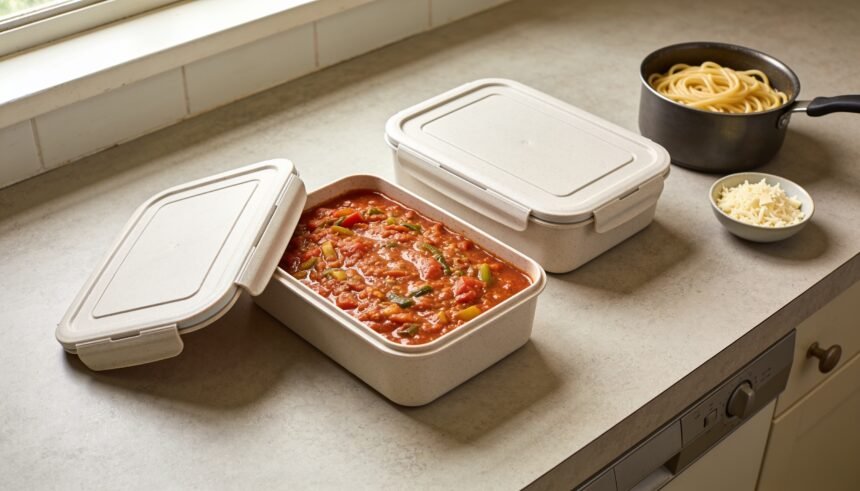
For an adaptable starting component, one sauce base with three different dinner finishes shows how to assign the extra jobs. Keep the finishing plan modest. A frozen base that needs several missing ingredients and a shopping trip is unlikely to help on a busy evening.
Pack for the meal you will actually serve
Choose freezer-suitable packaging that resists moisture loss, with a lid or seal that closes properly. UGA Extension recommends moisture-vapour-resistant materials for freezer packing. Check the container’s own instructions for freezer use, expansion space and any later heating method.
University of Minnesota Extension describes freezer burn as surface moisture loss that leaves dry, tough areas. A loose lid is therefore a packaging problem worth fixing before committing more dinner portions to it. Do not assume an ordinary takeaway tub is suitable for repeated freezing and heating simply because it has survived once.
Allocate portions by the occasion: one lunch, dinner for two or the household’s usual shared meal. If the number eating varies, smaller meal allocations give you more choices than one large container. This is an organisation suggestion, not a prescribed safe portion size.
Prepare matching labels before filling the containers. Include the dish, preparation date, amount and unfinished jobs. A label such as “tomato sauce, two dinner portions, cook pasta separately” tells the next person what dinner still needs. Put a matching note on the meal plan so the missing components are bought or set aside.
Make room before cooking a large batch
The National Center for Home Food Preservation warns that overloading a freezer with unfrozen food slows freezing and may reduce quality. Check the space and your appliance’s freezing-capacity instructions before choosing the batch size.
If the available space only fits two portions, make those two portions. Avoid cooking six dinners and then discovering that the containers cannot sit properly or the door will not close. A smaller planned batch is easier to accommodate than an oversized one requiring last-minute decisions.
Use a freezer organisation and labelling system to give the portions an identifiable place. The layout should help you find the meal and its preparation note without opening several similar containers.
For cooling, storage, thawing and reheating, follow Food Standards Australia New Zealand’s consumer food safety guidance and the recipe’s applicable instructions. Texture advice does not establish whether an individual meal has been handled safely, and this guide does not assign storage durations.
Try one portion before repeating the batch
For an unfamiliar recipe, freeze one planned portion before filling the freezer with it. When you prepare it for dinner using appropriate handling guidance, note what you like and what needs changing. Judge the result against the meal you want to eat, rather than expecting it to match the original pan exactly.
Keep the note specific. “Leave noodles out next time” gives you an action. “Did not freeze well” does not tell you whether the issue was the recipe, a delicate ingredient or the packaging. If the texture is acceptable but dinner still takes too much work, simplify the accompaniment or choose a different meal for that night.
These are household preference checks, not food-safety tests. They also avoid turning one disappointing portion into a freezer full of the same dinner.
Choose one upcoming dinner in your weekly family meal plan. Write what you will freeze and what you will add later, then check that both the freezer space and serving-day ingredients are available before cooking.
The one-page family week
One printable page that holds the whole week: meals, school, activities and who is doing the pickup. Free, and we send one useful email a week.
One email a week. No spam, unsubscribe in a click.