What is in this guide
Make a rotating family dinner menu usable by giving it a start date, complete dinner entries and permission to change a night without rewriting the cycle. Run a short trial before adding more meals, then use the dinners that were skipped to decide what needs changing.
A menu can look finished while leaving the evening’s work undecided. “Chicken” does not tell the person cooking which recipe to use, what goes beside it or whether anything needs preparing beforehand. The useful version gives that person enough information to start dinner without asking the planner to explain it.
Start with a menu small enough to try
If you already have a rotation written down, use its first two weeks as a trial. If you have only a collection of dinner ideas, choose a small set of familiar meals first. The four-week dinner rotation template covers building the longer cycle; this guide covers getting those choices into use.
Two weeks is a suggested starting point, not a proven ideal length. A household with changing shifts might prefer one roster cycle. Pick a period you can actually observe, including both easy evenings and nights when somebody arrives home late.
Use meals you are willing to cook again. Keep unfamiliar recipes outside the repeating menu until you have made them and decided whether they belong there. Otherwise, your trial becomes a series of cooking experiments rather than a check of the menu itself.
Give the cycle a clear starting point
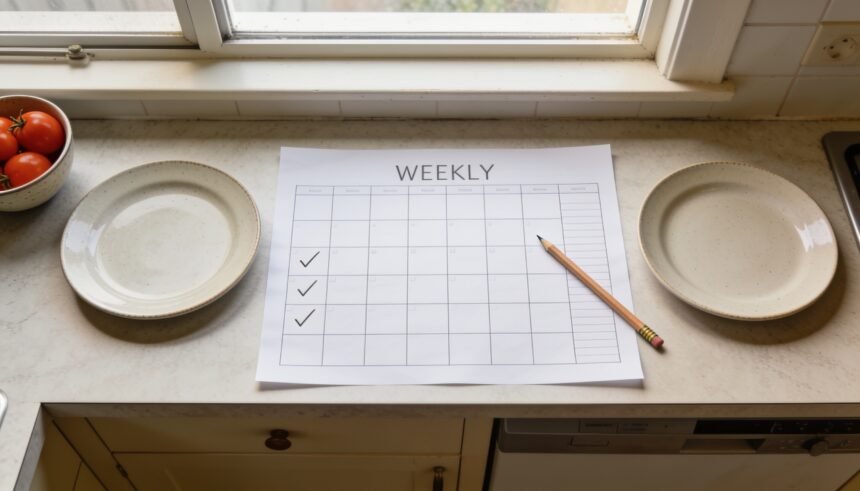
Write “Week A starts on Monday” and the date somewhere everyone using the plan can find it. In a shared note, put the current week at the top. On paper, mark the current row with a plain tick. Avoid displaying several versions with no indication of which one applies.
Choose how the cycle advances after a disrupted week. One workable rule is to move to the next week on the usual day, even if some dinners were missed. That prevents one changed evening from leaving the whole menu permanently behind.
Before the first shop, check the coming week’s commitments. A school concert, late shift or sport fixture can make a normally convenient dinner awkward. Move that dinner now, while the plan and shopping list are still being prepared. The rotation supplies the starting choices; the calendar decides whether they fit this particular week.
Write each dinner as a complete handover
Use the same short format for every entry: meal, accompaniment, recipe location, preparation job and person cooking. You do not need a detailed recipe on the calendar, but the route to it should be obvious.
For example, an illustrative entry might read: “Bean tacos with cabbage and yoghurt; recipe in shared recipes; slice cabbage at dinner time; Sam cooking.” Another could be: “Tomato pasta with peas; usual sauce recipe; pasta and peas still to cook; Alex cooking.”
Include the less exciting jobs. Washing a saucepan, checking whether there is rice or collecting an ingredient can affect whether the dinner is practical. If a meal needs work earlier in the day, assign that job separately instead of assuming the evening cook will somehow have done it.
For households sharing the task, a meal plan two adults can both update covers ownership and editing. In a single-adult household, the same notes can serve as reminders rather than handovers. Keep them brief enough that updating the plan does not become another large job.
Connect this week’s menu to this week’s shop
A repeating dinner list still needs a current stock check. Mark ingredients already available and add the missing ones for the dinners you actually intend to cook. Check accompaniments too: the sauce may be ready, but dinner still needs its pasta, vegetables or other chosen sides.
Keep a reusable ingredient list if it helps, but treat it as a checklist rather than an automatic order. Remove ingredients for any meal you have swapped out. Adjust amounts when fewer people will be home, using the quantities from your usual recipe and household needs.
The shopping-list system built from a meal plan covers the detailed list workflow. For this trial, the important check is simpler: can each planned dinner be made from what is available or included in the coming shop?
Agree on a small set of substitutions
Write one acceptable alternative beside the nights most likely to change. For a late arrival, that might be a familiar quick meal whose ingredients you normally keep. For a dinner the household has tired of, it might be another known recipe using the same main ingredient.
The alternative must fit your household’s actual dietary requirements and equipment. It should also be something the assigned cook can prepare. A substitute that requires a new recipe, another shop and an appliance you do not have is another planning task.
| What changes | Suggested response | What to record |
|---|---|---|
| The cook gets home late | Use the agreed quick alternative | Original meal and reason for the swap |
| Fewer people are eating | Adjust the chosen recipe or swap dinners | Ingredient quantities still needed |
| A meal feels repetitive | Replace that occurrence with another familiar dinner | Whether the original stays elsewhere in the cycle |
| Plans change after shopping | Check which bought ingredients still have a planned use | Any shopping-list adjustment for next time |
These are planning examples, not instructions to keep food for any particular length of time. Do not move a dinner to a later date without checking the relevant ingredients’ handling instructions and date labels.
Review what happened when the menu repeats
Beside each dinner, write “cooked”, “changed” or “skipped”, with a short reason when useful. “Late shift” and “nobody wanted this again” point to different changes. Avoid a complicated scorecard: the note only needs to explain what prevented that entry from being used.
When you reach the end of the trial, sort the entries into keep, change and remove. Keep meals that fitted the night. Change the day, preparation note or accompaniment when the dinner was welcome but awkward to organise. Remove a meal if nobody wants it in the next cycle.
If the same dinner keeps moving, stop carrying it forward as unfinished business. Give it a suitable place or take it out. If the entire plan was abandoned, why meal planning fails in week two provides the broader diagnosis; adding more menu choices may not address the problem.
Review again when the household timetable changes, such as a new school term, sporting season or work roster. Change individual meals when weather or preferences make them unappealing. You do not need two complete seasonal menus unless that arrangement suits your household.
Choose the start date now. Before shopping, complete the first week’s dinner entries and agree on the alternative for its hardest night. Leave space beside each meal for the note that will guide the next repeat.
The one-page family week
One printable page that holds the whole week: meals, school, activities and who is doing the pickup. Free, and we send one useful email a week.
One email a week. No spam, unsubscribe in a click.