What is in this guide
- 1. Set out seven dates and the people eating
- 2. Count what is available, then reserve breakfast and lunch
- 3. Choose meals that need few additions
- 4. Give each ingredient one job at a time
- 5. Move whole allocations when the week changes
- 6. Combine the gaps into one shopping list
- When the pantry cannot cover the week
Build a one week family meal plan by listing the ingredients available for dinner, assigning them to seven evenings and buying only the gaps. Record quantities as you go: the rice, beans or cheese allocated to one meal must come off the balance before you promise it to another.
Start with food you have and meals you already cook. The aim is a week that somebody can follow, including busy evenings and breakfast supplies, rather than seven new recipes that each require another shop.
1. Set out seven dates and the people eating
Use a sheet of paper or one shared note. Make a row for each evening and add the number of diners, the cook and any constraint: school sport, a late shift, visitors or an early dinner before heading out.
Keep the plan to the coming week. Mark an evening away from home as such rather than inventing a dinner to fill the box. If all seven evenings need covering, each needs its own ingredient allocation.
For help matching cooking effort to the calendar, use the weekly family meal plan method. Here, the extra task is making the stock balance work across those dates.
2. Count what is available, then reserve breakfast and lunch
Check the pantry, fridge and freezer. NSW Love Food Hate Waste recommends checking existing stock before writing a meal-matched shopping list. You do not need to empty or tidy every cupboard; record enough to choose meals.
Write quantities in a form you can use: grams of dry pasta, number and size of tins, eggs by count. A packet with a little pasta left is different from a full packet. Keep dry lentils and tinned lentils on separate lines because your recipes may use them differently.
Subtract anything already promised to breakfasts, lunches or another household member. The resulting column is available for this dinner plan. Ask before allocating the bread intended for school sandwiches or the eggs someone needs for breakfast.
For broader ideas about combining mixed supplies, see planning around what is already in the pantry. This worked week takes the next step by recording where each quantity goes.
3. Choose meals that need few additions
Begin with familiar dishes suggested by the stock: pasta and tomatoes, rice and beans, or potatoes and eggs. Check your usual recipe for every component, including oil, seasoning, sauces and sides. A meal name alone does not establish that you have enough food.
Compare the missing ingredients. A chickpea dish using an existing seasoning may fit the week better than a different curry requiring several new jars. That is a comparison of your cupboard and chosen recipes, not a claim about which dish is always cheaper.
Keep components separate where that suits household preferences. Someone can have rice and vegetables separately while another person combines them with beans. Allocate enough of the components people will actually eat, without assuming every diner wants the same plate.
4. Give each ingredient one job at a time
Use this hypothetical inventory to see the method. These quantities are illustrative allocation figures, not serving recommendations. Replace them with amounts from recipes that already suit your household.
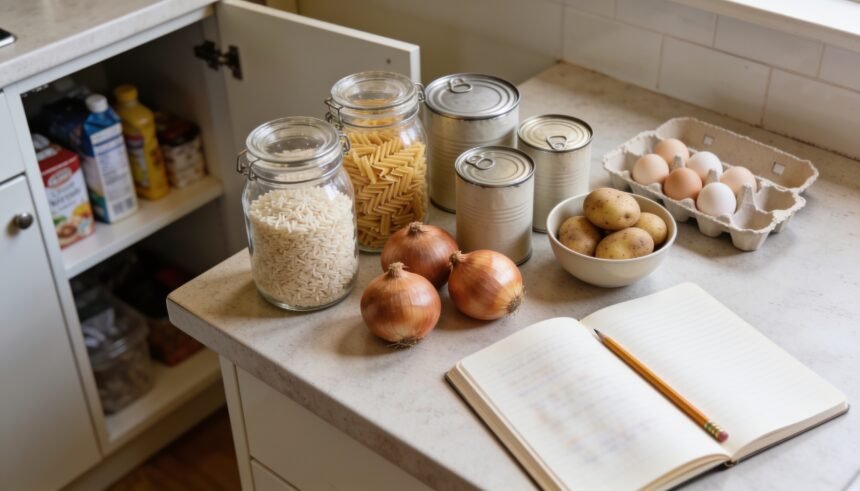
Assume the dinner stock includes 600 g dry rice, 500 g dry pasta, four 400 g tins of tomatoes, two 400 g tins of chickpeas and two 400 g tins of beans. There are also eight eggs, 1 kg potatoes, 900 g frozen mixed vegetables, three onions and some cheese. Breakfast and lunch supplies have already been set aside.
First allocate the ingredients that recur:
| Stock available | First allocation | Second allocation | Third allocation | Balance |
|---|---|---|---|---|
| 600 g dry rice | Tuesday: 200 g | Thursday: 200 g | Saturday: 200 g | 0 g |
| 500 g dry pasta | Monday: 250 g | Friday: 250 g | None | 0 g |
| Four tins tomatoes | Monday: one tin | Tuesday: one tin | Friday: two tins | None |
| 900 g frozen vegetables | Monday: 300 g | Thursday: 300 g | Saturday: 300 g | 0 g |
| Eight eggs | Wednesday: four | Sunday: four | None | None |
The figures balance, but that does not prove the meals are large enough. If your Monday pasta recipe needs 400 g, Friday cannot still use 250 g from the original 500 g. Add 150 g to the purchase requirement, reduce Friday’s requirement through a different complete recipe, or choose another dinner.
Allocate the remaining stock to the proposed week:
| Evening | Proposed familiar dinner | Other stock assigned | Check or top-up before committing |
|---|---|---|---|
| Monday | Tomato and vegetable pasta | Some cheese | Confirm sauce ingredients and cheese quantity |
| Tuesday | Chickpea and tomato rice bowls | Both chickpea tins; one onion | Confirm seasoning and any extra vegetables |
| Wednesday | Potato and egg pan dinner | 500 g potatoes; one onion | Confirm cooking ingredients and side |
| Thursday | Bean and vegetable rice bowls | One bean tin | Confirm sauce or seasoning |
| Friday | Tomato and bean pasta | Second bean tin; third onion | Confirm recipe quantities and finish |
| Saturday | Vegetable rice with a familiar sauce | No unassigned tins or eggs assumed | Choose a complete recipe and list its gaps |
| Sunday | Egg dinner with potatoes | Remaining 500 g potatoes; remaining cheese | Confirm cheese quantity and side |
This is a proposed menu to adapt, not seven complete recipes. In particular, Saturday needs checking against a familiar dish rather than treating rice and vegetables as automatically sufficient. Replace any row that does not suit the diners or needs too many additions.
5. Move whole allocations when the week changes
Put the meals on evenings when their cook has time and equipment available. Follow the preparation requirements of the recipes you choose. Do not place a dish needing substantial preparation on the late-shift evening simply because it was next on the list.
If you swap Tuesday and Thursday, move their ingredients with them. If you replace a meal, release its ingredients before assigning them elsewhere. A crossed-out meal with its quantities still deducted makes the inventory misleading.
Repeated dinners are an option if the household likes them. Count the ingredients twice when cooking twice. This plan does not depend on carrying cooked food from one day to another.
6. Combine the gaps into one shopping list
NSW Love Food Hate Waste advises recording quantities and accounting for ingredients shared across recipes. Add the missing amounts from every dinner, combine matching entries and check what is available once more.
Keep breakfast, lunches and snacks in a separate section, then reconcile anything they share with dinner. Deduct stock once across the whole shop. If milk has already been reserved for breakfast, it cannot also reduce a dinner recipe’s purchase requirement.
Use the meal plan shopping list system if you want a reusable spreadsheet later. Paper is enough for this week. Leave cupboard replenishment off the immediate list unless the item has a job in the plan or is another household essential.
When the pantry cannot cover the week
If the inventory only supports three complete dinners, plan those three and name the remaining gaps. Buying ingredients for four more meals is a valid outcome. Forcing seven dinners out of inadequate quantities produces an unusable plan.
If everything depends on one ingredient, check its quantity early. Cheese intended for two meals needs two recorded allocations. If a fallback is useful, give it separate supplies or identify which planned dinner it replaces; it cannot quietly consume Sunday’s eggs.
Keep the current version accessible to both cooks. A shared meal plan two adults can update can help when plans change during the day. Start now by assigning your first two dinners and subtracting their ingredients. Fill the remaining dates from that revised balance.
The one-page family week
One printable page that holds the whole week: meals, school, activities and who is doing the pickup. Free, and we send one useful email a week.
One email a week. No spam, unsubscribe in a click.