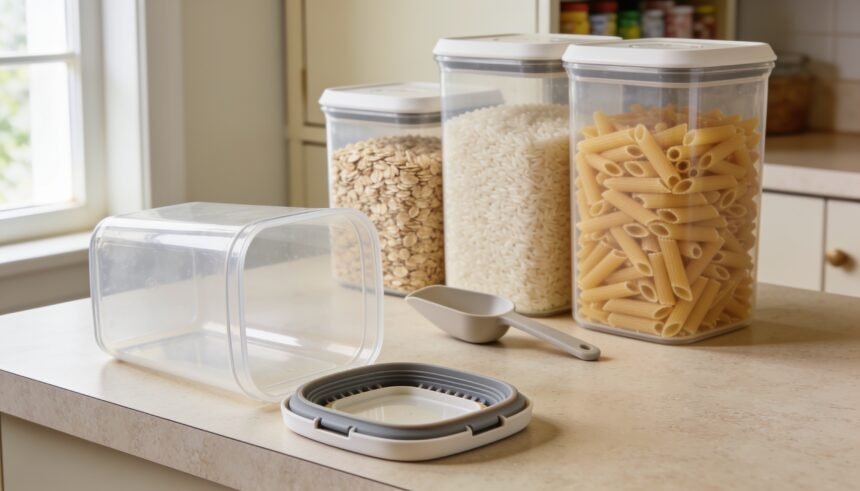
What is in this guide
Use airtight food containers with the correct matching lid, a closure you can operate fully and care instructions you can follow. Start by checking what you already own. An airtight label alone does not tell you how long a particular food will stay fresh, or whether the container suits every kitchen job.
For an everyday pantry, the useful question is whether the container works each time someone opens, refills and closes it. This guide concentrates on that routine. It does not assign extra storage days to food or replace the directions on its packaging.
1. Give each container a specific job
Choose one ingredient and one container to assess first. An oats tub used every morning has a different access requirement from a jar opened occasionally for baking. Write down what needs to happen: pouring, scooping, lifting from a high shelf or opening with one hand.
Check the manufacturer’s intended use before transferring anything. If you cannot identify a container or find its instructions, leave it out of this exercise until you can establish what it is designed to hold. Keep food in its original packaging while you resolve the storage choice.
Avoid buying a complete set before identifying a problem with the containers you have. Start with the staples you actually use; the pantry staples guide can help you decide which ingredients deserve regular space.
2. Identify how the seal engages
Look at the lid instructions rather than relying on how firmly it appears to sit. Find the action that completes the closure: pressing a button, engaging clips or tightening a threaded lid. Follow the sequence specified for that design.
OXO’s POP Round Canister instructions, for example, describe a push-button airtight seal and direct users to operate the button for opening and closing. OXO also explains that the POP mechanism expands a silicone gasket against the container walls. Those are details of that design, not a description of every container sold as airtight.
Practise opening and closing the empty container on the bench. Ask anyone who regularly uses it to do the same. If the mechanism is awkward for someone in the household, choose a different container for their everyday ingredient rather than relying on reminders after every breakfast.
3. Match the lid before checking its condition
Put similar tubs beside their own lids after washing. Compare model markings or the assembly diagram if two pieces look interchangeable. A lid resting neatly on a rim is not enough reason to treat it as a matching part.
Where the instructions show a removable gasket, check that it is present and positioned as shown. Look for an uneven section, an obvious tear or a part that will not stay in its intended position. This is a visual condition check, not proof that the assembled container is airtight.
If a piece is missing or damaged, identify the exact replacement through the manufacturer. Do not stretch a similar seal into place or force an almost-fitting lid. Set the container aside while you resolve the mismatch.
4. Allow room to refill and scoop
Check the opening as well as the advertised capacity. Can your usual scoop pass through it? Can you refill without holding the lid, packet and container at the same time? Try these movements with the empty container before committing it to an ingredient.
Use the following prompts to compare what you already own. They are practical fit questions, not performance ratings.
| Everyday job | Check before choosing |
|---|---|
| Scooping a baking ingredient | The scoop clears the opening and your hand can reach comfortably |
| Pouring breakfast cereal | You can grip the body and operate the closure without juggling parts |
| Keeping an occasional ingredient | The container has an agreed place and is easy to identify |
| Reaching into a deep cupboard | You can retrieve the body without pulling on the lid |
Do not convert a packet’s weight directly into a container volume. Instead, check any manufacturer guidance for the particular ingredient and pack size. If no suitable guidance exists, keep the packet intact until you have established a workable fit.
5. Keep the refill decision visible
Decide what happens when a new packet does not fit. An agreed overflow location is easier to manage than several partly filled packets tucked behind unrelated groceries. Record that location beside the main container or on the shopping list.
Keep the original product information accessible when decanting. A container name alone does not retain the ingredient list, storage directions or other details printed on the packet. Choose a simple way to keep those details with the relevant food rather than creating an elaborate filing task.
For small jars and frequently confused ingredients, organising a spice cupboard covers the wider identification and placement problem. Keep this container check focused on matching parts and operating the closure.
6. Follow the care instructions for every part
Find out which components can be removed and how each should be washed. Check the instructions for the body, lid and gasket separately. Do not assume one care symbol answers every question about a multi-part lid.
During reassembly, use the diagram to check the orientation of removable pieces. Avoid prising apart a mechanism that the manufacturer does not describe as removable. If the instructions are unclear, ask the maker before dismantling it further.
Keep a photograph of the model information or a saved copy of the care sheet where you can find it again. This is particularly useful when several generations of similar containers share a cupboard. It also gives you a reference when ordering a replacement part later.
7. Troubleshoot the closure without inventing a test
If the lid no longer closes as expected, work through matching parts, assembly and the specified closing action in that order. Check for visible material caught where the lid meets the body, and follow the cleaning instructions before trying again.
Do not use lifting by the lid as a seal check. OXO expressly advises against carrying its POP containers that way. Carry the body according to the product instructions, and do not assume an airtight claim authorises transport containing liquids.
When a container remains troublesome, record the symptom precisely: the button does not engage, one clip will not close, or the gasket will not sit as illustrated. That gives the manufacturer something concrete to address. A visual check at home cannot certify airtight performance.
Before replacing anything, separate a closure fault from a purchasing problem. Too much overflow may call for a different pack size or refill rule; building a shopping list from your meal plan helps with that quantity decision. Today, choose one regularly used tub and check its matching lid, closing action and refill space.
How we checked this
Reviewed on 20 October 2026 using OXO’s published product instructions and explanation of its POP seal. These support the named mechanical examples only. The household workflow is editorial advice; no containers were tested and no extension of food storage life is promised.
The one-page family week
One printable page that holds the whole week: meals, school, activities and who is doing the pickup. Free, and we send one useful email a week.
One email a week. No spam, unsubscribe in a click.