What is in this guide
Choose tonight’s dinner before leaving home, using ingredients you already have, then keep the evening cooking to one short sequence. For a busy morning, the useful preparation is a decision and a missing-ingredient list, rather than an extra cooking session squeezed between breakfast and school bags.
The five options below are flexible dinner builds aimed at roughly 30 minutes from starting preparation to serving. Times are editorial planning estimates, not timed kitchen tests. Check packet cooking times and use quantities that suit the people eating; a larger batch or an unfamiliar recipe may need longer.
Make three decisions before leaving home
First, count who needs dinner and when they can eat. A meal for everyone together is a different job from feeding two people before training and another two afterwards. For evenings with separate eating windows, use the guide to planning dinner around sport and activities.
Second, choose one main ingredient already available, then check the rest of the meal. Having pasta does not settle dinner if the sauce needs six things you do not own. Look for a complete combination: pasta, tinned tomatoes, lentils and a vegetable, for example.
Third, write only the missing ingredients, with quantities. NSW Love Food Hate Waste recommends checking existing stock before making a meal-matched shopping list. If another adult is cooking, leave the meal name, diner count and any substitution together in one message or note.
Keep refrigerated ingredients in the fridge. Morning planning can be as simple as confirming where everything is; it does not require laying food out on the bench for the day.
Pick a dinner that fits the equipment you have
Choose according to available ingredients and cooking space. Pasta uses a saucepan and frying pan at once. Bean wraps can use one pan. Couscous needs a heatproof bowl as well as the vegetable pan. In a small kitchen, that difference matters as much as the ingredient list.
Cook lentil and tomato pasta
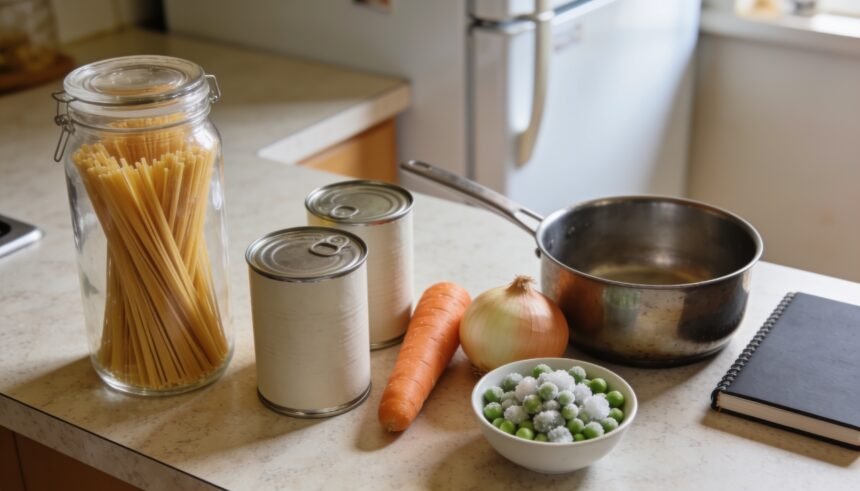
For an illustrative four-person starting batch, consider 350 to 400 g dry pasta, a drained 400 g tin of lentils, a 400 g tin of tomatoes, one grated carrot and a small onion. Add oil and seasonings already in the cupboard. Adjust the pasta and sauce to your household’s usual portions.
Put the pasta water on first. Chop the onion and grate the carrot while it heats, then soften them in a little oil in the other pan. Add the tomatoes and lentils and simmer while the pasta cooks according to its packet. Combine when the pasta is ready, loosening the sauce with a little pasta water if needed.
The budget check is the finishing ingredient. Cheese can be optional if buying a whole block would be solely for this meal. If your household prefers a familiar meat sauce, ways to stretch meat through family meals covers that separate technique.
Fill wraps with beans and vegetables
Start with wraps, two drained tins of beans, an onion or capsicum, and seasonings you already use. Add a familiar vegetable alongside or inside. For four people, count the wraps before choosing this dinner; a half-empty packet may not cover everyone.
Soften the chopped vegetable in a frying pan, add the beans and a splash of water, then mash some beans to bring the filling together. Warm the wraps following their packet directions. Put the filling and any available toppings on the table separately.
Keep the extras short. A dinner needing new salsa, sour cream, avocado and cheese has a different shopping bill from one using beans, wraps and an existing sauce. Pick one preferred topping rather than treating every possible topping as required.
Make a quick chickpea and vegetable curry
Use two drained tins of chickpeas, about three cups of small-cut vegetables, a tin of tomatoes and a familiar curry paste or powder. Serve with rice whose packet cooking time fits the available window. These quantities are a starting combination, not a prescribed family portion.
Start the rice first. Prepare the vegetables, then cook the curry seasoning according to its directions before adding tomatoes, chickpeas and vegetables. Simmer until the vegetables are tender, adding water as needed for the sauce.
The time constraint rules out large chunks of hard vegetables. Cut carrots small or use suitable frozen vegetables. If your usual rice takes most of the half-hour, allow extra time or choose another dinner. There is no saving in planning a meal that cannot be ready when people need to leave.
Toss tuna, peas and lemon through pasta
Choose pasta, a tin of tuna large enough for your household’s usual meal, frozen peas, oil and lemon if already available. An illustrative four-person batch could start with 350 to 400 g pasta and two cups of peas, with tuna adjusted to preference.
Cook the pasta following its packet directions. Prepare the peas according to theirs, drain the tuna and combine everything with a little oil and pasta water. Add lemon or a familiar seasoning to taste.
This option has little chopping but still needs a quantity check. One small lunch-sized tin may be much less tuna than you want across four dinners. Check the actual tin before committing to the meal, rather than discovering the gap after the pasta is cooked.
Build couscous bowls with chickpeas
Use couscous, drained tinned chickpeas and vegetables that cook quickly, such as zucchini and capsicum. Measure the couscous using its packet’s serving guidance, then decide how much chickpea and vegetable topping your household wants.
Cut the vegetables into small pieces and cook them in a frying pan. Prepare the couscous in a heatproof bowl according to the packet. Add chickpeas to the vegetables and finish with seasonings already available, then serve over the couscous.
The trade-off is texture. If your household does not enjoy couscous, this is a poor choice simply because the preparation is short. Choose the pasta option instead, or allow time for a grain everyone already eats.
Check the purchase before calling it a budget dinner
Compare the whole amount you must spend to finish dinner, not just the price of its main ingredient. Check oil, sauce, seasoning and accompaniments before adding a meal to the list. An inexpensive tin can still lead to a substantial shop if everything around it is missing.
For ingredients you need to buy, NSW Love Food Hate Waste recommends comparing unit prices, including fresh and frozen choices. Also check the checkout amount: a larger pack must fit today’s available money, even when its unit price is lower.
These meals carry no fixed Australian dollar total because local prices, pack sizes and existing supplies differ. For the broader weekly decision, use setting a workable family grocery budget. When replacing supplies over time, the guide to pantry and freezer staples worth keeping can help you choose what earns its space.
Leave one workable handover
Write a short instruction before the morning ends: “Tonight: bean wraps for four. Beans and wraps are in the cupboard. Buy one capsicum. Use the sauce already open.”
That gives the next cook a meal, quantities and a clear shopping boundary. Choose one of the five dinners, check every ingredient and leave that note before starting the rest of the day.
The one-page family week
One printable page that holds the whole week: meals, school, activities and who is doing the pickup. Free, and we send one useful email a week.
One email a week. No spam, unsubscribe in a click.