The useful way to sort backyard activities is not by age or theme. It is by how long they last.
A treasure hunt is twenty minutes of setup for eleven minutes of play. A patch of dirt, a bucket of water and a few kitchen spoons is two minutes of setup and can run for two hours. Most lists of backyard ideas are full of the first kind, which is why they are disappointing on day nine of the holidays when you need the second kind.
So these are sorted by duration, using things an ordinary Australian household already owns. Nothing here needs a craft cupboard, a trip to the shops or a printer.
The long ones: an hour or more
These are the ones worth knowing. They are open-ended, which is why they last.
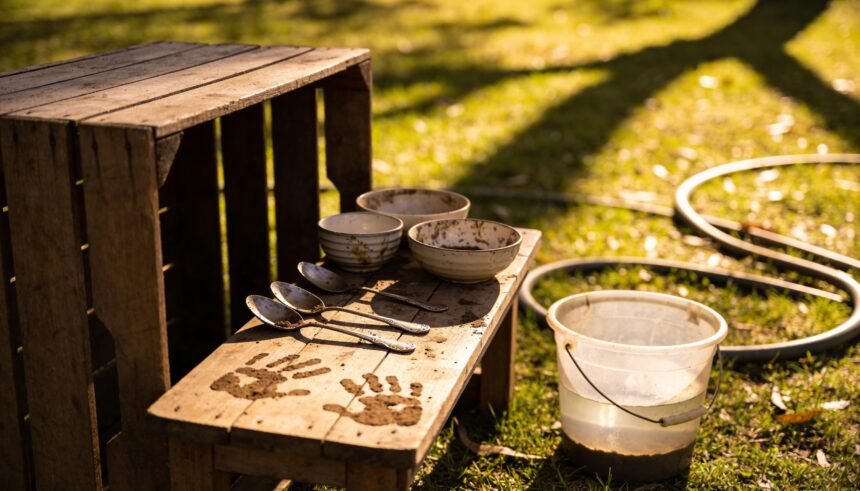
A mud kitchen. A patch of dirt, water, old kitchen spoons, a few containers and a plank or upturned crate as a bench. This is the single highest returning activity on this list for children roughly two to eight and it improves every time it is used, because the equipment accumulates. Site it where the hose reaches and where you do not mind mud.
A cubby out of what is there. A clothes airer with a sheet, chairs and a blanket, a tarp over the trampoline, a corner behind the shed. The building is most of the activity and the occupying is the rest. Older kids will build something genuinely ambitious if you stay out of it.
A dig site. One corner of the garden where digging is permitted, a trowel or two and a bucket. Bury a few things first if the child is young enough to be delighted by that. The reason this works is that the goal never ends.
A water course. Any slope, a hose or a watering can, and whatever channels water: guttering offcuts, planks, plastic bottles cut in half, a tarp. Kids will rebuild it repeatedly. On a hot day this is the whole afternoon.
Car washing, actual car washing. A bucket, a sponge and a hose, and the car genuinely gets cleaner. Children take a job that is real far more seriously than a job invented for them, which is the principle underneath most of the longest-running items on this list.
Painting with water. A bucket of water and any brush, on fences, paving, brick or the side of the shed. It dries and can be repainted forever, which is exactly why it lasts. Costs nothing and uses very little water.
The medium ones: twenty to forty minutes
An obstacle course. Whatever is in the yard, in a sequence, timed. The timing is what extends it, because children will run it repeatedly to beat a number.
Chalk anything. Hopscotch, a road network for toy cars, a target for a ball, an outline of each person lying down. If you have chalk it is the highest value dollar in the house.
Nature colour hunt. Find something green, something rough, something that smells, something smaller than a fingernail. Works from age two to about eight and needs no preparation at all.
Bug hunting with a container. Under pots, under bark, in the compost. Australian caveat: teach the rule of looking rather than reaching, and never putting hands into places you cannot see, which is sensible practice in any Australian backyard. Look, identify, let it go.
Bark, leaf and seed pod collecting. Then sorting, which is often longer than the collecting. Gum nuts, bark strips, seed pods and jacaranda flowers all work.
Frozen treasure. Freeze small toys in a container of water overnight and give it to them with warm water and a spoon. Free, and on a 38 degree day it is the best thing you will do all week.
Sock and pillowcase races. Sack races using pillowcases, a three-legged race with a tea towel, an egg and spoon race with a potato.
Target practice. Buckets or pots at increasing distances, anything soft to throw, a scoring system. The scoring system doubles the duration.
The sheet trampoline. Two or more people holding a sheet, a soft ball, keep it going. Wears out adults faster than children.
The short ones: ten to twenty minutes
Useful for filling a gap or resetting a bad afternoon, not for holding an afternoon on their own.
Treasure hunt with drawn clues. Fast to do, slow to set up, and over quickly. Do it once a holidays, not weekly.
Shadow drawing. Chalk around the shadow of a toy or a person, then come back an hour later and draw it again. The return visit is the good part.
Cloud watching, properly. Lying on a towel, naming things. Genuinely works, particularly with an overtired child who needs to stop.
Blowing bubbles from dish soap. Dish soap, water, a little sugar if you have it, and a bent wire or a straw.
Balloon keepy-uppy. If a balloon exists in the house.
Watering the garden. With a real watering can and a real job.
Feeding scraps to the chooks or the compost. Real jobs again, and the ones with animals attached last longest.
A leaf boat race in any channel of water you have made.
The Australian complications
Heat and UV. For a good part of the year the backyard is not usable in the middle of the day. Shift outdoor play to before about ten and after about four, use shade, and treat the middle of the day as indoor time rather than trying to push through it. Hat, shirt and sunscreen apply to every item on this list.
Water. Several of these use water, and water restrictions vary by state, by region and by season. Check your water authority’s current restrictions before running a hose activity, since what is allowed differs across the country and changes. Bucket-based versions of most of these work under tighter restrictions than hose-based ones, and painting with water uses almost nothing.
Snakes and spiders. The practical rules are the ordinary ones: shoes on outside, look before reaching into dark spaces, do not put hands under things you cannot see, and keep long grass down near where children play.
Mosquitoes. Standing water in the water course and the mud kitchen should be tipped out at the end of the day rather than left.
The principle underneath all of it
The activities that last are the ones with no defined end and no correct outcome. A treasure hunt finishes when the treasure is found. A mud kitchen never finishes. When you are choosing between two ideas, pick the one that cannot be completed.
The second principle is that real jobs beat invented ones. Washing the car, watering the garden and feeding the compost hold attention longer than an equivalent game, because children can tell the difference.
Next: free things to do with kids these school holidays covers getting out of the house, a free week of school holidays puts a week together, and getting the backyard ready for summer covers the shade and safety side.
The one-page family week
One printable page that holds the whole week: meals, school, activities and who is doing the pickup. Free, and we send one useful email a week.
One email a week. No spam, unsubscribe in a click.