What is in this guide
A dog that kicks their bed out of the crate may be rearranging their sleeping spot or making room around bedding that does not suit the space. The useful clue is what happens afterwards: watch whether they settle comfortably, keep moving the bedding, or try to leave the crate.
Finding the bed on the floor each morning gives you an outcome, but misses the sequence. Before buying another bed, watch a normal bedtime while you are nearby. A few observations can help you choose which part of the setup to check first.
Watch how the bed gets outside
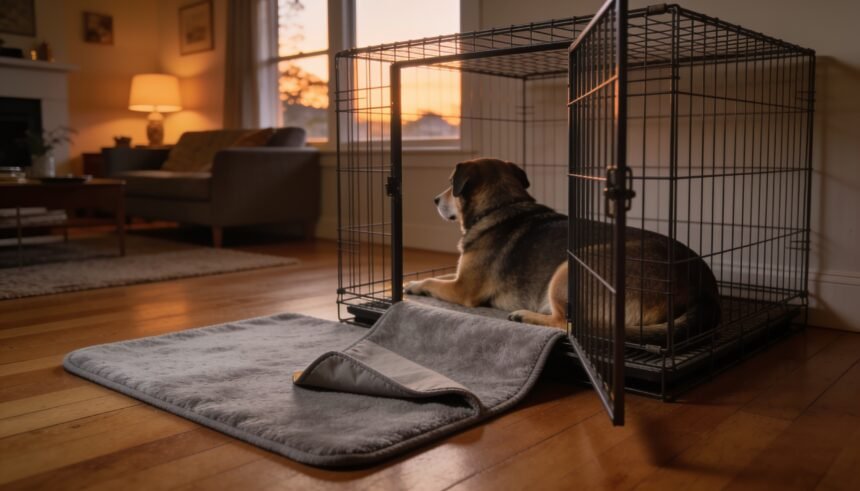
Start with the movement itself. Does the dog paw at a loose corner until it folds over? Push the whole mattress towards the doorway while turning? Pick it up and carry it somewhere else? Those are different things to describe, even if all three leave an empty crate.
Also note whether the door was open. A bed dragged through an open doorway during evening play is a different household problem from bedding repeatedly pushed against a closed door while the dog is trying to settle. If you only see the bed afterwards, avoid filling in the missing action with a story about what the dog intended.
Write down where the dog finally rests and what position they choose. Keep the record simple: bed folded at front, dog lying along back; bed outside, dog sleeping on it beside crate; bedding still being moved, dog not settled. These descriptions are more useful than labelling the dog stubborn.
Is it a short bedding rearrangement?
The American Kennel Club describes dogs digging a sleeping nest and rearranging a blanket before resting. That makes nesting one possible explanation for pawing at bedding. It does not establish why your dog pushes a particular mattress out of a particular crate. [S1]
For a calm dog, ask whether the nightly result actually needs changing. A blanket folded into a heap is less tidy than one spread flat, but tidiness is not the purpose of a dog bed. The observation to record is whether the dog finishes rearranging and rests comfortably.
You can leave an intact, comfortable arrangement alone rather than flattening it every time the dog changes it. If you are unsure about the overall setup, what belongs inside a dog crate covers the broader bedding and cover questions. Here, the narrower task is working out which item is being moved and when.
Check whether the bed fits when the dog is in it
A bed that fits through the door can still sit badly inside. Check the crate with the bedding in place. Does the mattress lie flat, or do its edges curl up against the walls? Is a raised bolster taking up much of the floor? Does the dog push one corner aside before finding a place to lie?
RSPCA Victoria says a crate should allow the dog to stand, turn around and lie down. Use that basic space requirement when looking at the furnished crate, rather than judging the empty crate alone. [S2]
As an editorial fit check, compare the bed’s actual shape with the usable floor. Look at the doorway as well as the back corners. A folded blanket placed over a mattress adds another loose piece to move, so record which layer ends up outside before deciding that the mattress is the problem. [E1]
If you already have a suitable flatter mat, compare it during an ordinary supervised settling period. Keep the crate in the same place. This lets you observe the bedding change without also changing the room, household activity and bedtime routine.
Check the sleeping spot as well as the bed
Room conditions belong on the checklist, especially when the behaviour changes with the season. RSPCA Australia’s puppy guidance calls for soft, dry bedding and a sleeping area that is neither too hot nor too cold. It does not say that ejecting bedding proves a dog is hot. [S3]
Note whether the crate sits beside a heater, under an air-conditioning outlet or in a room that stays warm into the evening. In an Australian household, the same corner can feel quite different between winter and summer. Treat those observations as context, not a diagnosis.
If the dog carries the bed elsewhere and rests on it there, record the destination before replacing the bed. Our guide to where to put a dog bed addresses placement. For this problem, first establish whether the dog keeps choosing another spot or simply moves the bedding out of the way.
Change one thing and judge the settling
Choose the clearest issue you have actually seen. Straighten bedding that is wedged against a wall, compare an existing suitable mat, or remove an unnecessary extra blanket from the comparison. Keep comfortable bedding available; an empty crate is not the automatic solution to a displaced bed.
If the cover needs cleaning, follow its care label and let it dry completely. Washing pet bedding properly covers that separate job. Do not introduce a newly washed cover, different mattress and new crate location together if your aim is to understand which change matters.
Judge the result by how the dog settles, not just whether the bed stays straight. Record whether the bedding still moves, whether the dog rests on it, and whether the final arrangement leaves usable space. One evening is an observation, not proof that you have found the cause or a permanent fix. [E1]
When should you stop the bedding comparison?
Keep this process for a dog that is calm and comfortable. Persistent attempts to escape, an inability to settle, damaged bedding or suspected swallowing of fabric take the situation beyond a simple fit comparison. Seek individual advice rather than adding fasteners to make the bed immovable.
If the difficulty is being in the crate itself, a dog that dislikes the crate is the more relevant starting point. A sudden change accompanied by apparent discomfort belongs with your vet. This article cannot determine a health or behavioural cause from the position of a bed.
Your next step: watch one complete settling session and write down how the bed moves and where the dog rests. Use that record to choose one bedding or placement check before spending money on a replacement.
The one-page family week
One printable page that holds the whole week: meals, school, activities and who is doing the pickup. Free, and we send one useful email a week.
One email a week. No spam, unsubscribe in a click.