What is in this guide
What belongs in a crate depends entirely on what your dog does to things, and getting that assessment right is more important than any product decision.
Watch your dog with a blanket for a week, supervised. A dog that sleeps on it is a different proposition to one that shreds it, and one that shreds and swallows is different again.
Ingestion and intestinal obstruction are life-threatening and require surgery. If a dog swallows fabric, stuffing or squeakers, that is a veterinary matter immediately rather than something to wait out.
Bedding
For a dog that leaves bedding alone: something comfortable and washable. A flat mat, a folded blanket, a vet bed style mat, or a cushion that fits the base. Washable matters more than plush, because a crate bed gets washed often.
For a shredder: a single flat layer that cannot be pulled apart easily, or nothing at all. Many dogs are perfectly comfortable on a bare crate base with a towel, and a towel is cheap to replace.
For a swallower: nothing soft, unsupervised. This is not a comfort question, it is a safety one, and a dog that eats fabric should have an empty crate when unattended.
For a puppy: expect accidents, expect chewing, and use cheap washable layers you will not mind replacing. A puppy’s preferences are not established and neither is its judgement.
For an older dog: more support, and low enough to get in and out of easily, which is the same principle as in making the house easier for an older dog. Joint comfort matters more with age and a thin mat on a hard base may not be enough.
Wash it regularly. A crate is an enclosed space and bedding that is not washed is the reason a crate smells.
Covers
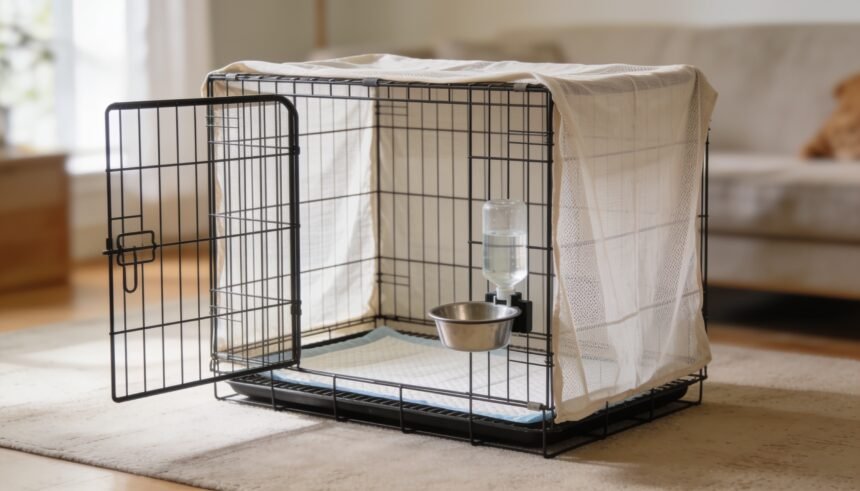
A cover makes a crate den-like and settles many dogs, particularly anxious ones and those in a busy room.
It must not restrict airflow, and in Australian conditions that is a genuine safety matter rather than a comfort one. Cover the back and the sides, leave the front and the top open, or use a breathable fabric rather than a heavy blanket.
Never fully enclose a crate in heat. A covered crate in a hot Australian room becomes considerably hotter than the room, and heat stress in dogs develops quickly and is serious.
A cover the dog can pull in and chew is a swallowing risk. Fasten it outside the bars or use something the dog cannot reach.
Some dogs dislike being covered and settle better with a view. Try it and watch, rather than assuming.
What else goes in
Water, for anything longer than a short period, in a bowl that cannot be tipped or a clip-on bowl fixed to the bars. In warm weather this is not optional.
One safe chew or a stuffed toy, chosen for that dog. What is safe varies and a vet is the right source, since some chews present fracture, choking or obstruction risks.
Something that smells of you, which helps some dogs settle, subject to the swallowing assessment.
Food, if you are using the crate positively. Feeding meals in the crate is the core of building a good association, as covered in a dog that hates the crate: fixing it.
What does not go in
Collars, harnesses and anything with tags. Remove them before crating. Tags and collars catch on bars and cause serious injury, and this risk is genuinely underappreciated.
Rope toys, stuffed toys with squeakers, and anything with small parts, for a dog that destroys them.
Cooked bones. Ever.
Anything you have not watched the dog use. The first time with anything new is supervised, every time.
Anything smaller than the dog’s mouth.
The same assessment applies as in cheap enrichment using things already in the house, and the principle is identical: the safe option depends on the individual dog.
Placement, which affects all of it
Out of direct sun and away from the hottest part of the house. An Australian house has hot corners and a crate in one in February is genuinely dangerous.
Where there is airflow.
Not in a draught in winter.
Where the family is, rather than isolated in a laundry, which is both better for the dog and better for the association.
Off cold hard tile for an older dog.
Size, briefly
The dog should be able to stand up without ducking, turn around comfortably, and lie fully stretched out.
Too small is a welfare problem and a common cause of a dog refusing to use one.
Too large is a real consideration for a puppy being toilet trained, because a dog that can toilet at one end and sleep at the other will. A divider that moves as the puppy grows is the usual approach, and crate sizing for a puppy that will double in size covers it.
Keeping it clean
Wash bedding weekly, more with a puppy.
Wipe the tray and the bars, since both hold odour.
Use an enzyme cleaner for any accident, because ordinary cleaner leaves compounds the dog can still detect, which is the mechanism explained in getting pet smell out of carpet.
Never use ammonia-based cleaners, which smell like urine to a dog.
Next: a dog that hates the crate: fixing it covers building the association, cheap enrichment using things already in the house covers what to put in it safely, and best dog beds in Australia by size and sleeping style covers bedding more broadly.
The one-page family week
One printable page that holds the whole week: meals, school, activities and who is doing the pickup. Free, and we send one useful email a week.
One email a week. No spam, unsubscribe in a click.