What is in this guide
Put your cat’s food in a separate place from the litter tray, with the water bowl in its own spot too. A useful cat feeding station setup starts with choosing those locations before buying a mat, stand or cabinet to hold everything together.
RSPCA Australia recommends separating food, water and toilet areas. That gives you three places to plan, even if all three must fit within a modest home. The aim is an arrangement you can leave in place through dinner preparation, laundry day and the school morning rush.
1. Mark out the places you already use
Start with a rough sketch of the room or rooms available. Mark the litter tray, doors, kitchen appliances and the furniture that moves during the day. Add where people put school bags, washing baskets and shoes. These temporary objects matter when the only spare floor space is beside a doorway.
If the litter tray already has a workable location, use it as the starting point and look elsewhere for food. You do not need to rearrange every cat resource at once to give the bowl a separate home.
Draw a line along your usual route between the fridge, bench and table. Avoid putting dinner directly on that route. For the wider arrangement of resting and activity areas, the guide to keeping a cat happy indoors covers the rest of the room.
2. Give food and litter genuine separation
Cats Protection advises placing litter as far from food and water as possible. The guidance consulted does not supply a universal distance in metres, so there is no supported measurement that makes every floor plan acceptable.
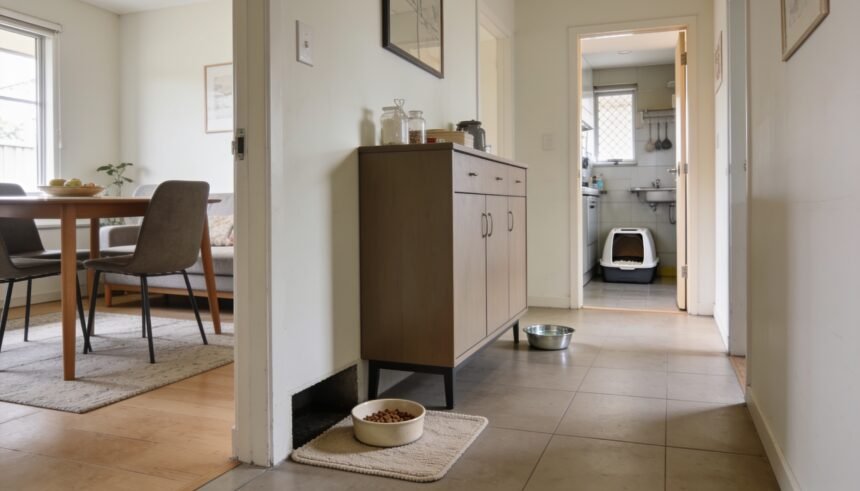
As a practical layout choice, look for another room first. Food might fit in a dining-room recess while the tray stays in an accessible laundry. Check what happens when doors are closed: a location is only usable when the cat can reach it.
Where one room must do both jobs, use the greatest practical separation available. Do not place a bowl beside the tray simply because both fit neatly on one washable surface. Nor does putting the bowl on top of a litter cabinet create a separate feeding area. Look across the available room before choosing storage furniture.
There is a trade-off here. A food bowl in the living area is more visible than one tucked into a utility corner. You may decide that a small, tidy food spot is worth having in view to avoid grouping it with the toilet.
3. Choose a separate water spot
RSPCA Australia’s advice includes providing fresh water in several locations and keeping food separate from water. Leave room for a drinking spot in your plan rather than automatically filling both sides of a double-bowl holder.
A possible arrangement is food beside the dining area, water at the quiet end of the living room and litter in the laundry. Treat this as an example to adapt, not a required room allocation. Walk around with an empty bowl before settling on the water position.
Check whether you can see and reach it easily when refilling. A bowl behind a sofa may fit the floor plan but be awkward to maintain. Keep enough space around it to lift it without dragging furniture out each time.
4. Try the layout with ordinary household activity
Before buying anything, put the existing food bowl in the proposed spot and run through the room’s normal movements. Open the cupboard fully. Pull out the dining chair. Carry a washing basket past. Have another household member walk through while you stand where you would serve the food.
Three example layouts are worth considering:
- Separate kitchen and laundry: keep the food outside the laundry if that is where the litter lives. Check the kitchen location with the dishwasher door open.
- Open-plan apartment: use different ends of the available space and leave a clear route between them. A bowl should not have to move every time someone sits down to eat.
- One available room: identify the furthest usable spots for food and litter, then find a distinct place for water. Avoid filling the gaps with storage until you have checked access.
For a kitchen where the main difficulty is floor space, arranging a feeding station in a small kitchen covers that broader problem. Here, keep separation from litter as the deciding constraint.
5. Plan separate meals for multiple cats
RSPCA Australia’s multi-cat guidance recommends enough resources in physically separate locations to give cats choice and reduce competition. A row of bowls is therefore not the same arrangement as feeding places distributed around the home.
On your sketch, give each cat a feeding location instead of enlarging the shared mat. Separate rooms may be practical at mealtimes; in a shared room, use different areas and check that access to one bowl does not run directly through another cat’s eating spot.
Watch what actually happens when food is served. Can each cat approach its own bowl, or does one take over both? Use that observation to review the arrangement rather than assuming that matching bowls mean equal access. Keep this exercise about placement, without changing food or portions to make the layout work.
6. Make the spot straightforward to clean
Cats Protection recommends washing food bowls daily with soap and warm water, then rinsing thoroughly. Choose a position where lifting the bowl and reaching the floor underneath are ordinary tasks, not a furniture-moving job.
A removable mat is an optional housekeeping choice. If you use one, check that you can lift it easily and clean beneath it. Avoid building a permanent surround before you know the location suits the household.
Keep litter equipment in its own area rather than on the shelf used for bowls. If scattered granules are taking over that side of the room, keeping the litter tray area tidy in a small home addresses the cleaning setup.
Before the next meal, choose one candidate food location and do the door, chair and walking-route checks with an empty bowl. That will tell you whether the spot fits daily life before you spend money furnishing it.
The one-page family week
One printable page that holds the whole week: meals, school, activities and who is doing the pickup. Free, and we send one useful email a week.
One email a week. No spam, unsubscribe in a click.