What is in this guide
A tray corner looks messy for three reasons: litter tracked out on paws, litter flicked over the side, and the scoop, bags and spare litter piling up around it. Each has its own fix, and none of them needs a large enclosure. Set up three small zones and keep a two-minute daily routine, and the corner stays tidy in a home where you cannot shut a door on it.
First, check the tray is where the cat wants it
Tidiness starts with placement, because a cat that is unhappy with the spot will rush, scatter more and sometimes go beside the tray instead of in it. If the tray is beside the food, in a dead end or somewhere the door gets shut, fix that first using the five requirements in where to put the litter tray in a small home. A cat that is actively avoiding the tray is a different problem again, covered in why is my cat not using the litter tray.
Once the location is right, everything below is about containing what an ordinary, settled cat produces.
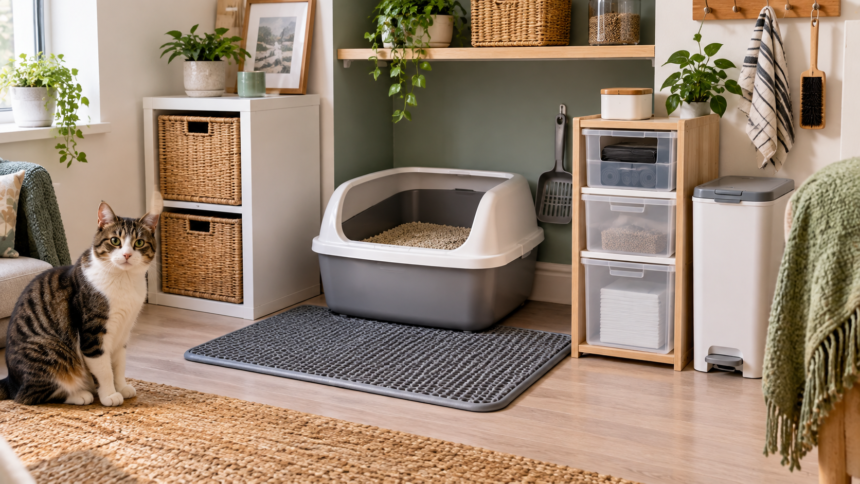
The three-zone setup
Zone one is the tray. Its job is to keep litter inside. A tray with sides tall enough that a digging cat does not flick litter over the edge does most of the work. Many cats dislike hooded trays, so high sides with an open top is usually the better trade in a small home, as the RSPCA’s guidance on litter trays notes that cats generally prefer an uncovered tray they can see out of. Fill to a moderate depth rather than to the brim. Overfilled trays scatter more, and litter that is too shallow gets kicked to the corners and leaves the base exposed.
Zone two is the landing. This is the area the cat steps onto as it leaves, and it is where most tracked litter drops. A mat that is larger than the tray, textured enough to catch granules from paws, and washable, placed under the tray and extending out past the front edge, catches the bulk of it. Position the mat so the cat’s natural exit path crosses it. If the cat leaves sideways rather than forward, turn the tray so the exit crosses the mat.
Zone three is supplies. The scoop, a lined bin or a roll of bags, and the spare litter. In a small home these tend to sit loose on the floor beside the tray and that is what makes the corner look cluttered. A single lidded container or a small caddy that holds all three, kept within arm’s reach of the tray, removes the clutter and makes the daily scoop faster because nothing has to be fetched.
The three zones together take up not much more floor than the tray alone, which is the point. A bathroom corner, the end of a hallway or the space beside a laundry tub can all hold them.
Choosing litter with tracking in mind
Litter type changes how much ends up on the floor. Fine, lightweight litters cling to paws and travel further. Heavier or larger-granule litters, and pellet types such as recycled paper or wood, tend to drop off at the mat rather than in the hallway. There is a trade-off, because some cats prefer the feel of fine litter and will use a coarse one less reliably.
Change litter type gradually if you decide to switch, mixing the new into the old over a week or so, since an abrupt change is one of the common triggers for a cat to start avoiding the tray. Scented litters are best avoided as a tidiness fix. They do not reduce tracking and many cats dislike them.
The daily and weekly routine
Daily, two minutes. Scoop solids and clumps into the bin, shake the mat over the tray or the bin, and return the scoop to the caddy. Do this at the same point in the day so it becomes automatic. Once-daily scooping is the minimum the RSPCA recommends, and in a small home the difference between one scoop a day and none is the difference between a corner nobody notices and one everybody does.
Weekly, ten minutes. Empty the tray fully, wash it with warm water and a mild unscented detergent, dry it, and refill. Wash the mat or hose it off outside if you have a balcony or yard. Wipe the floor and skirting around the tray, since fine dust settles there and builds up into a grey film. Wipe the caddy down and restock bags.
Avoid strong disinfectants and anything ammonia based on the tray itself. The smell is unpleasant to cats and a tray that smells wrong to the cat is one that gets avoided.
Managing dust and smell alongside the mess
Dust is a tidiness problem as much as a smell one. Pour litter slowly and close to the tray rather than from height, and choose a low-dust litter if the corner is in a room you use a lot. In a small apartment with the windows closed for air conditioning, dust settles on nearby surfaces within days.
Smell is a separate topic with its own causes, and placement and scooping only get you part of the way. If the corner is tidy but still smells, litter tray smell: fixing it properly works through the causes, including a tray that has absorbed odour into the plastic and needs replacing rather than cleaning.
Australian summer accelerates both. A routine that holds in winter may need the weekly wash to become twice weekly in the hottest months, especially in humid northern and coastal areas.
Small-home containment without a big enclosure
A furniture enclosure is the usual suggestion and it can work, but it hides mess rather than reducing it, and a small enclosed box concentrates odour and dust. If you use one, it must be large enough for the cat to turn and dig comfortably, with a wide opening and airflow, and it still needs the mat inside at the exit.
Cheaper options that reduce mess rather than hide it:
- A tray inside a slightly larger, shallow storage tub, which catches side scatter and can be lifted out and rinsed.
- A folding screen or the side of a bookcase to break the line of sight from the living area, without enclosing the tray.
- A second, smaller mat at the room’s doorway to catch what the first mat missed.
An automatic tray is sometimes sold as the tidy answer. It changes the scooping, not the tracking or the scatter, and it has its own trade-offs. If you are considering one, read self-cleaning litter box: what to check before you buy first.
Renting
Nothing above needs a fixture. The mat, caddy, tub and screen are all freestanding.
Protect the floor under the whole area, not just the tray, since tracked litter under a mat scratches floorboards and grinds into carpet. A waterproof mat under the landing zone as well as the tray protects a bond.
Deal with any accident immediately with an enzyme cleaner. Urine that has reached carpet underlay is hard to remove and hard to explain at the end of a tenancy. Getting pet smell out of carpet covers the method.
Handling litter safely
Wash hands after scooping. Australian health guidance notes that cat faeces can carry toxoplasma, and recommends that pregnant people avoid handling litter where possible, or wear gloves and wash thoroughly if they cannot. Anyone pregnant or with a weakened immune system should follow their doctor’s advice.
Bag and bin used litter with general waste unless the product and your local council say otherwise. Do not flush litter unless the product states it is flushable and your water authority permits it.
Next: get the placement right with where to put the litter tray in a small home, fix any lingering odour with litter tray smell: fixing it properly, and if the cat is going beside the tray rather than in it, start with why is my cat not using the litter tray.
The one-page family week
One printable page that holds the whole week: meals, school, activities and who is doing the pickup. Free, and we send one useful email a week.
One email a week. No spam, unsubscribe in a click.