
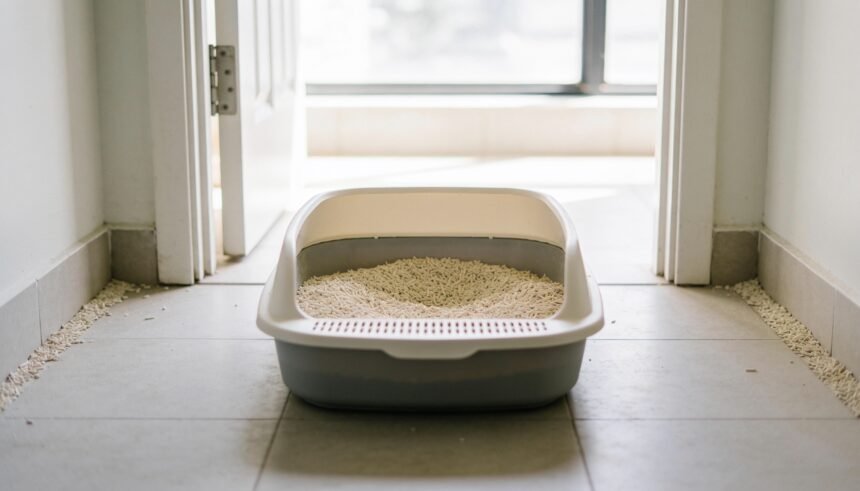
What is in this guide
Start with a vet, not with the litter.
A cat toileting outside the tray is one of the most common reasons cats are seen by vets, and a meaningful proportion of cases have a medical cause: urinary tract problems, bladder inflammation, crystals or stones, kidney disease, diabetes, arthritis making the tray hard to get into, or pain of some other kind.
One of those is a genuine emergency. A cat straining to urinate, going in and out of the tray repeatedly producing little or nothing, crying in the tray, or licking at itself persistently may have a urinary obstruction. In a male cat this can be fatal within a day or two. See a vet immediately, including after hours.
Changing the litter brand while a cat has a urinary obstruction is the single most costly mistake in this entire category.
So: vet first. Once medical causes are ruled out, the setup problems below explain most of the rest.
1. The tray is not clean enough
The most common non-medical cause by a wide margin.
Cats have a much lower tolerance for a dirty tray than people assume, and “clean enough for me” is not the standard.
Scoop at least daily, more with multiple cats. Empty, wash and refill regularly.
Wash with warm water and a mild detergent. Avoid ammonia-based cleaners, because ammonia smells like urine to a cat and can signal that the tray is already soiled or, worse, mark the floor as a toilet.
2. There are not enough trays
The widely used guideline is one tray per cat plus one spare, in different locations.
In different locations is the part people miss. Three trays in a row is one toilet from the cat’s point of view. Spread across the house, they are three.
In a multi-cat house this is frequently the whole answer, because a cat that has been ambushed or blocked at a tray will not return to it. How many litter trays does one cat need covers the numbers properly.
3. The position is wrong
Cats are vulnerable when toileting and will not use a tray where they feel exposed or trapped.
Avoid: beside a noisy appliance, in a high traffic corridor, next to food and water, in a spot with only one way out, or somewhere a dog or another cat can corner them.
Prefer: quiet, accessible at all times, with more than one escape route, and not somewhere a door might be closed.
Not next to the food. Cats do not toilet where they eat, and a tray beside the bowls will be rejected by many cats.
4. The litter is wrong for that cat
Cats have real preferences and a change is a common trigger.
If the problem started when you changed litter, change it back. Obvious and frequently overlooked.
Most cats prefer a fine, sand-like, unscented litter, which is closest to what a cat would choose naturally.
Scented litters and deodorising additives are for humans and are actively disliked by many cats.
Depth matters. Most cats want enough to dig in properly, and too little is a common problem in a tray that is topped up rather than filled.
Change litter gradually if you must, mixing the new into the old over a week or two.
5. The tray itself is wrong
Too small. A tray should be comfortably longer than the cat from nose to base of tail. Many trays sold are too small for an adult cat.
Covered when the cat dislikes covered. Hoods keep smell in for the human and keep smell in for the cat as well, and they remove the ability to see what is approaching. Some cats are fine with them, some are not, and it is worth offering both.
Sides too high for an older or arthritic cat. A cat that used to use the tray and now goes beside it may simply be unable to climb in comfortably. A lower entry can resolve it, and the underlying joint problem is a veterinary matter.
Liners. Many cats dislike the feel of a plastic liner through the litter.
6. Something changed
Cats respond strongly to change and toileting is a common way it shows.
New pet, new baby, new person, a move, renovations, a new cat outside the window, a change in routine, or a piece of furniture moved.
A cat outside the window is a frequently missed cause in Australian suburbs, particularly where a neighbouring cat roams. The indoor cat feels its territory is threatened and marks.
7. It is marking, not toileting
Spraying is different from toileting. A cat that backs up to a vertical surface, treads with its back feet and sprays a small amount on a wall or furniture is marking, not emptying its bladder.
This is territorial or stress-related and the response is different. Desexing substantially reduces spraying and is standard practice in Australia. Beyond that, the cause is usually a perceived threat and addressing the threat is the fix.
Cleaning up properly
The cleaning matters as much as the cause, because a spot that still smells of urine to a cat will be used again.
Use an enzyme cleaner designed for pet urine, which breaks the compounds down rather than covering them.
Never use ammonia-based products.
Clean thoroughly and early, because urine that has soaked into carpet underlay is extremely difficult to remove and is a common reason a cat keeps returning to one spot.
What not to do
Do not punish the cat. It does not connect a punishment with the behaviour, it becomes frightened of you, and stress makes toileting problems worse.
Do not put the cat in the tray forcibly. It creates a negative association with the one place you want it to go.
Do not assume it is behavioural until a vet has said so. This is the single most important line in the article.
Next: keeping a cat happy indoors covers the environment, cat scratching: redirect it rather than stop it covers the other common indoor complaint, and the new kitten checklist covers setting up properly from the start.
The one-page family week
One printable page that holds the whole week: meals, school, activities and who is doing the pickup. Free, and we send one useful email a week.
One email a week. No spam, unsubscribe in a click.