
What is in this guide
Scratching is not misbehaviour and it cannot be trained out of a cat, because it is not a habit. It serves several purposes at once.
It maintains the claws, removing the outer sheath.
It marks territory, both visibly and with scent from glands in the paws. This is why a scratched spot gets scratched again.
It stretches the whole body, which is why a cat scratches after waking.
It releases tension.
A cat with no acceptable surface will use the furniture, because the need does not go away. So the only workable goal is redirection: give the cat somewhere better than the sofa, positioned where it wants to scratch.
Why the post you bought is being ignored
Almost always one of four things.
1. It is too short. A cat wants to scratch at full stretch, which for an adult cat means a vertical surface taller than it can reach standing on its hind legs. Most posts sold are too short, and a cat that cannot stretch on it will go back to the sofa arm, which is the right height.
2. It wobbles. A post that moves under load is useless and slightly alarming. It must be heavy-based or fixed. This is the most common reason a perfectly good post is abandoned after one use.
3. It is in the wrong place. Covered below, and it is the biggest factor.
4. The material is wrong for that cat. Cats have preferences: sisal rope, sisal fabric, carpet, cardboard, bare wood. A cat scratching a woven sofa may want fabric rather than rope, and a cat scratching a door frame may want wood.
Position beats product
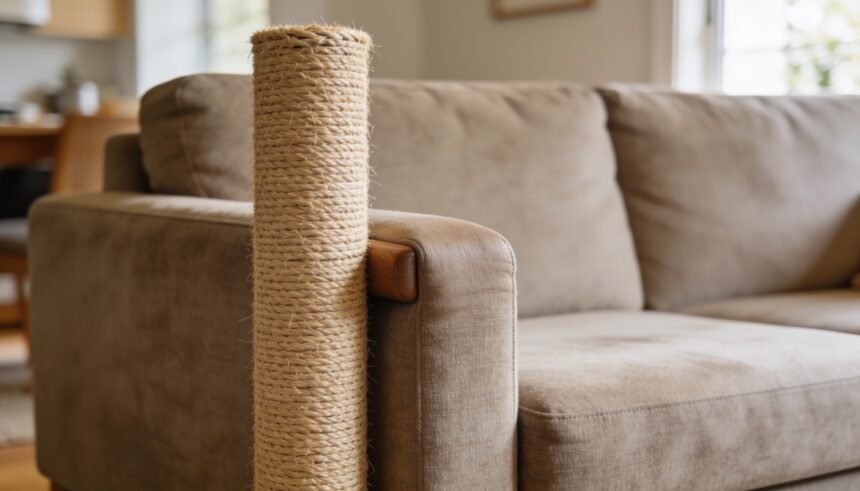
Put the scratching surface where the cat is already scratching. Not where it looks good. Directly next to the damaged spot, or in front of it.
This feels wrong to people and it is the single most effective move available. The cat has chosen that location for a reason: it is usually a doorway, a route, or near where it sleeps, and those are exactly the places a cat wants to mark.
Once it is being used, it can be moved slowly, a few centimetres at a time, if you want it somewhere else. Moving it a metre on day one means it stops being used.
Cats scratch after waking, so a surface near the sleeping spot gets used every day without any training.
Doorways and thresholds are marking points and are worth a surface of their own in a multi-cat house.
The four requirements
A surface that gets used has all four.
Tall enough for a full stretch, or long enough if it is horizontal.
Completely stable under a cat’s full weight pulling on it.
Positioned where the cat wants to scratch.
A material that cat likes, which may take two attempts to establish.
Offer both vertical and horizontal options. Some cats prefer flat, and a cardboard scratcher on the floor is inexpensive and frequently preferred, particularly by older cats and cats with any joint discomfort.
In a multi-cat house, more than one, in different rooms. Resource competition applies to scratching surfaces as it does to litter trays, which is covered in why is my cat not using the litter tray.
Protecting the furniture while you redirect
Make the wrong surface less appealing rather than punishing the cat. Double-sided tape on the spot, a fitted cover, or a blanket over the corner. Cats dislike the texture of tape on their paws and will usually move on if a better option is beside it.
Do not punish, startle or spray the cat. It does not associate the punishment with the scratching, it associates it with you, and a cat that is frightened of a person is a much harder problem than a scratched sofa. RSPCA Australia advises against aversive methods.
Trim the claws if the cat tolerates it, which reduces damage without addressing the behaviour. A vet or a groomer can show you how, and can do it if the cat does not accept it from you.
Nail caps exist and are used by some owners. They are a management option with trade-offs and are worth discussing with a vet rather than adopting on internet advice.
What is not an option in Australia
Declawing is prohibited in Australia except where there is a genuine veterinary medical reason, and it is not a behavioural solution. It is the amputation of the last bone of each toe, and the Australian Veterinary Association and RSPCA Australia oppose it for behavioural purposes.
This matters because a large amount of online advice about cat scratching is written in countries where the practice is more common, and an Australian reader may encounter it presented as a normal choice. It is not one here.
When it is a sign of something else
A sudden increase in scratching, particularly with other changes, can indicate stress: a new pet, a new baby, a house move, a change in the household, or a cat outside the window.
Look for what changed. Stress-driven marking usually appears alongside other signs, and the fix is the underlying change rather than the scratching.
Over-grooming, hiding, changed appetite or changed toileting alongside it warrant a veterinary visit. Cats conceal illness and behaviour change is often the first visible sign.
A cat that seems to be catching claws, limping, or licking a paw repeatedly should see a vet.
Realistic expectations
A cat will not stop scratching. The goal is that it scratches the post instead of the sofa, and most households get most of the way there.
Expect it to take a few weeks, and expect the occasional relapse on the old spot, particularly if the covering or tape comes off.
Existing damage does not attract more scratching once the scent marking is dealt with, so cleaning the marked spot thoroughly helps. Use an enzyme cleaner rather than an ammonia-based product.
Next: keeping a cat happy indoors covers the wider environment, why is my cat not using the litter tray covers the other common indoor problem, and the new kitten checklist covers getting it right from the start.
For choosing the post itself, cat scratching posts a cat will actually use covers the height and stability that decide whether it gets used.
The one-page family week
One printable page that holds the whole week: meals, school, activities and who is doing the pickup. Free, and we send one useful email a week.
One email a week. No spam, unsubscribe in a click.