The difference between craft that stays fun and craft that ends in a scrubbing session is rarely the activity itself. It is usually three things decided before anyone opens a texta: what surface the mess lands on, where the boundary is, and what happens if the material gets squashed into carpet or fabric rather than wiped off a bench.
Decide those three things first, then choose the activity. A contained mess is a five-minute clean-up. An uncontained one is not.
Choose the tray before the activity
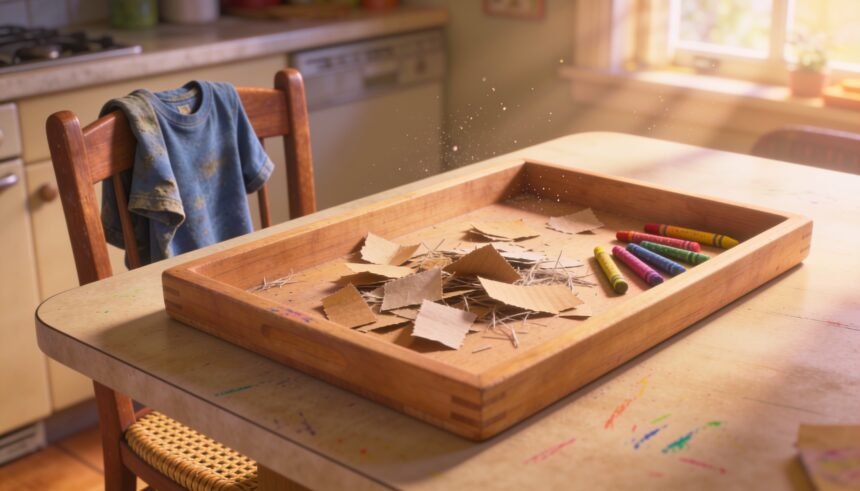
Put a tray, a large sheet or a section of an old vinyl tablecloth down before anything comes out of the craft box. The tray does two jobs: it catches drips and offcuts, and it visually marks the working area, which matters more than it sounds for a child who has not yet learned where a project’s edges are.
For anything wet (paint, glue, anything with water in it), a tray with a raised edge beats a flat sheet, because it catches drips rather than letting them run off the side. For dry craft (paper, stickers, dry collage materials), a flat sheet or an old towel is enough.
Set the tray somewhere with an easy-clean floor underneath it if you have a choice. If the only available space is carpeted, treat the tray as non-negotiable rather than optional.
Pick materials by what they do when they land
This is the single most useful filter, and it has nothing to do with how fun a material is:
| Material | On a hard floor | On carpet or fabric |
|---|---|---|
| Dry paper, cardboard, stickers | Sweeps up in seconds | Brushes off, rarely stains |
| Chalk, dry pastels | Wipes or sweeps easily | Can grind in if stepped on; keep off carpet |
| Washable paint (thin, watery) | Wipes up while wet | Should be treated as wet-only-on-tray, dries stubborn on fabric |
| Glue, especially craft glue | Scrapes off once dry | Genuinely difficult once dry; keep strictly on the tray |
| Glitter | Sweeps up, mostly | Turns up for weeks; avoid on carpet entirely if you can |
| Playdough or clay-based craft | Peels up cleanly once dry | Presses into carpet fibres; tray or hard floor only |
The pattern across the table: dry and paper-based materials tolerate an imperfect boundary. Wet, sticky or fine-particle materials do not. If today’s activity is glue, paint or glitter, put the extra five minutes into the boundary before you start rather than the clean-up after.
Clothing and the boundary, briefly
An old T-shirt or a plastic apron matters more for paint and glue than a fancy smock, because it is the sleeves and the front, not the whole body, that usually make contact. Roll sleeves up rather than relying on a garment to cover them.
For the boundary itself: a chair pushed against a table edge, painter’s tape marking a rug’s edge, or simply “craft happens at this table, nowhere else today” said clearly before starting, works for most primary-aged children. The rule needs to be stated before the activity begins, not partway through when something has already migrated off the tray.
The clean-up sequence that actually works
Clean up in this order, not the reverse:
- Materials away first, while they are still visible and identifiable, before anything gets swept into a general pile.
- Tray last, tipped into the bin or shaken outside, so anything that migrated onto it during the session is caught in one go.
- Spot-check the boundary edge, because this is where stray material tends to collect: the edge of the table, the join between rug and floor, the chair legs.
- Hands before anything else is touched, especially before anyone sits on soft furniture.
Doing the tray last rather than first means it has caught everything by the time you deal with it, instead of being emptied halfway through and needing a second pass.
When it goes wrong anyway
Something will end up on the carpet eventually. Deal with it as soon as it is noticed rather than after the session: a fresh spill of most craft materials is meaningfully easier to lift than one that has dried in. Blot rather than rub for anything wet, and let anything dry (playdough, glue) fully harden before trying to remove it, since half-dried material tends to smear rather than lift.
If a session repeatedly ends with cleanup taking longer than the activity, that is a sign to change the material or the location for next time, not a reason to stop craft altogether. Dry, paper-based activities at the kitchen table are the lowest-risk starting point if today has been a bad week for anything wetter.
Set the tray down, state the boundary, and choose tonight’s material with the landing surface in mind before anyone reaches for the glue.
How we checked this
Reviewed on 27 September 2026. This package is Dovelyne editorial method based on ordinary household experience with common craft materials, not a tested or measured program, and makes no claims about any specific product’s washability or any child’s developmental outcomes.
Related reading: An Indoor Scavenger Hunt Using Only Things Already in the Lounge Room.
Related reading: A Lounge Room Obstacle Course for a Wet Afternoon.
The one-page family week
One printable page that holds the whole week: meals, school, activities and who is doing the pickup. Free, and we send one useful email a week.
One email a week. No spam, unsubscribe in a click.