Free school holiday activities you can do at home include building a cardboard town, making a storybook, setting up a home museum and inventing a game from things you already own. Choose by the space and adult help available today, then skip any idea that requires a shopping trip.
Here, free means no extra spending. Paper, pencils, toys and boxes count only if they are already in the house. A craft that needs glue you have run out of belongs on another day’s list. None of these ideas needs a printer, a booking or a yard.
Choose by what you can manage today
Before offering a choice, decide where the activity can happen and what must be cleared afterwards. A kitchen table needed for lunch calls for something that fits on a tray. A shared lounge room calls for a project that can go into a box, rather than spread across the floor until next week.
Offer two realistic options: drawing at the table or making a museum on one shelf, for example. Keep the rest for another day. Say at the start whether you can join in, help with the setup or simply be nearby. An activity requiring an audience is a poor fit for an afternoon full of work calls.
These are activities to do while children are in your care, not a substitute for holiday care. For days when leaving home is possible, finding free local school holiday programs is a separate option.
Build a cardboard town that fits in one box
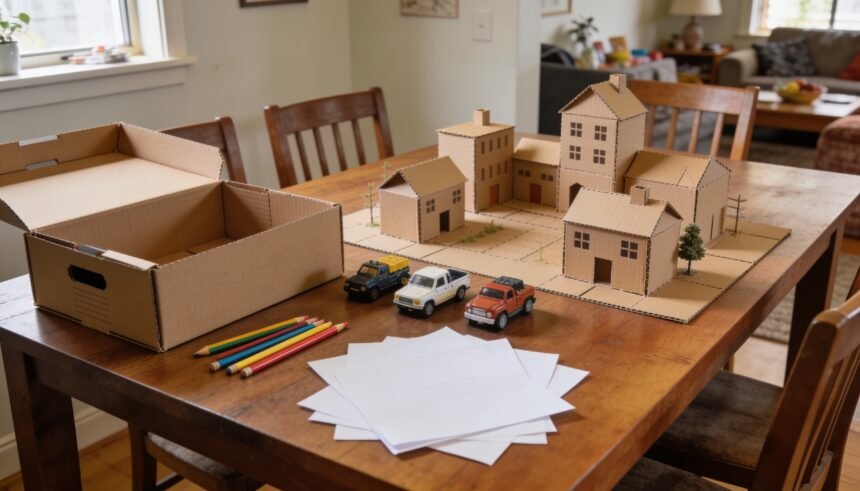
Use clean boxes already available, pencils and existing toy figures or vehicles. A small box can be a house, a shop or a station. Draw roads on scrap paper and arrange the buildings around them. Raising Children Network’s cardboard play guide supports turning boxes into pretend-play settings and letting older children work through construction choices.
Keep this version small enough to store in a single container. There is no need to cut windows or buy decorating materials: drawn doors work. If cutting is needed, make it an adult job before play starts.
Give the town a problem to solve, such as where the library should go or how a toy delivery reaches every house. One child can arrange buildings while another draws a map. At pack-away time, keep the buildings and stack the road sheets underneath. Tomorrow’s activity can be changing the layout rather than starting again.
Make a home museum from familiar objects
Choose a small display space and a theme: favourite toys, interesting household shapes or things in one colour. Children select objects you have agreed they can use, arrange them and explain what belongs in the collection. Keep fragile and sentimental items out of it.
A confident writer can make labels on scrap paper. A child who would rather talk can give a spoken tour. Ask the curator to choose the opening exhibit and explain why it comes first. The point is deciding what to show, not producing a tidy display for a photograph.
This suits a small home because the boundary is visible: one shelf or one end of a table. Agree when the museum closes, then return every object to its usual place. No tape on rental walls or new storage is needed.
Turn a story into an afternoon project
Raising Children Network includes shared storytelling, creative writing and drama in its school-age play ideas. Start with a character and a problem, then choose how to tell the story: spoken aloud, drawn as a comic or acted with familiar toys.
Keep the first version small. One sheet can hold a beginning, a muddle and an ending. A child who dislikes writing can draw while an adult adds a few dictated words, or leave the story entirely spoken.
If children share the project, agree who handles each part before starting. The illustrator need not also be the performer. A quiet ending is to place the finished page beside the books already at home; a social ending is a short performance for whoever is available.
For younger siblings who need a separate activity, rainy day activities for under-fives offers an age-focused starting point.
Redesign a game you already own
Bring out a familiar board game, cards or a set of matching pictures. Ask the children to change one rule and explain the new version before anyone plays. They might reverse the winning condition, work together towards one target or invent a different way to take turns.
Use only the pieces already available. If there is no suitable game, draw a simple track on scrap paper and take turns moving a drawn marker according to a rule you agree together.
Play a short trial round, then discuss what was confusing. Write down the revised rule if that helps. This is a useful choice when you can join in: settling disagreements about a newly invented game may need more adult attention than drawing does. Put every borrowed piece back into its original game afterwards.
Swap unfinished drawings
Each person starts a drawing with a few shapes, then passes the page to someone else to finish. A circle might become a wheel, a planet or a face. Agree beforehand that changing the drawing is part of the game, so nobody hands over artwork they want preserved.
Use the blank side of paper already destined for recycling, after checking it contains no private information. One pencil each is enough. For a child playing alone, make several starting pages together and let them choose which to complete.
This is the simplest option here for a table that needs clearing quickly. Keep favourite pages in an existing folder and recycle the rest. Avoid turning every sketch into something that needs permanent storage.
Let one project continue across the holidays
Leave a note with an unfinished project: add a station, give the museum a new theme or draw the next comic page. That provides a starting point without another round of adult preparation. If there is no storage space, keep a drawing of the project and dismantle it.
For a household with a yard, backyard activities that cost nothing can provide a change of setting. If your problem is arranging several days rather than choosing today’s activity, a free week of school holidays covers the wider plan.
Start with the supplies you can see now. Pick one activity, name its pack-away spot and offer the children a choice about what they will make.
How we checked this
Checked on 9 October 2026 against Raising Children Network’s school-age creative activity and cardboard play guidance. The household constraints, project variations and selection advice are editorial suggestions. No hands-on testing, entertainment duration or developmental result is claimed.
The one-page family week
One printable page that holds the whole week: meals, school, activities and who is doing the pickup. Free, and we send one useful email a week.
One email a week. No spam, unsubscribe in a click.