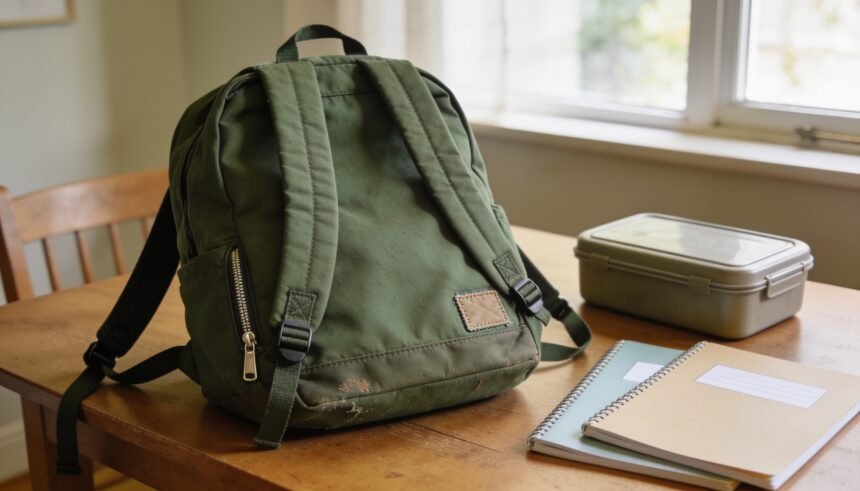
A school bag does not need replacing just because a new school year starts. Keep using it while the straps, base and closures work and it holds the required school gear; the manufacturer guidance checked for this article does not establish a universal number of years a school backpack should last.
How do you decide whether it can do another year?
Use condition as your starting point. Our editorial recommendation is to aim for continued use, then let the bag’s actual problems determine the next step. A faded print and a main zip that will not stay closed deserve different decisions.
Empty the bag and inspect it in good light. Look underneath as well as inside, and check where each shoulder strap joins the body. Then pack the items your child actually needs for an ordinary school day. Open and close the compartments with those items inside.
Use this checklist to sort the result:
- Keep: The fabric contains the contents, the main zip closes properly, the straps stay attached and adjusted, and the required gear fits. Cosmetic marks alone would not trigger replacement under this checklist.
- Investigate a repair: There is one identifiable fault, such as a damaged buckle, a separating seam or a zip problem, while the rest of the bag remains usable. Ask the maker or a bag repairer whether that particular fault can be fixed.
- Replace or repurpose: Essential parts no longer work and a suitable repair is unavailable, or the bag cannot accommodate the school’s required equipment. An intact bag that is too small for school could still have a different household use.
Do not turn this into a strength test. Inspect the joins and normal operation without yanking straps or deliberately overloading the bag.
What should you change during the school week?
Start with a simple unpacking routine: lunchbox out, bottle out, loose papers checked and damp items removed. Keep tomorrow’s essentials together so emptying the bag does not become a second organisation job.
Once a week, review what is going back in. Set aside old notices, completed worksheets and equipment that the timetable does not require. If the main compartment only closes when someone presses hard on the contents, first reconsider the packing arrangement and what needs to travel. Ask the school about uncertain items rather than quietly leaving required equipment at home.
Check the zip before pulling harder on a snag. Look for trapped fabric or visible debris. Deuter’s care guidance specifically advises keeping zips free of dirt. If a zip continues to separate or jam after an obvious obstruction is removed, put it on the repair list instead of repeatedly forcing it.
These are suggested household routines, not a tested promise that they will add a particular number of years.
How much cleaning is useful?
Follow the bag’s own care instructions before choosing a cleaning method. JanSport advises gentle damp cleaning and warns against machine washing and tumble drying its backpacks. A dirty-looking bag is not a reason to put every model through the same wash cycle.
Keep the maintenance goal practical: remove debris, deal with spills using the permitted method and let the bag dry fully. Deuter recommends opening zips for drying and keeping packs away from direct sunlight and heat sources. Do not rush a wet bag onto a heater because school starts tomorrow.
For the summer holidays, empty every compartment before storing the bag dry. Leave enough time for any cleaning and drying before putting it away. This is also a useful moment to photograph faults and arrange a repair enquiry, rather than discovering the same broken closure on the first morning of term.
When is a repair worth pursuing?
Ask for an assessment of the specific problem, the total charge and the turnaround time. Include a photograph of the fault and the whole bag. Ask whether the proposed repair will restore the function you need, particularly for a strap attachment or the main closure.
Compare that answer with the rest of the bag. Repairing one part is a different decision when everything else works than when several essential parts also need attention. Include the practical cost of being without the bag: a family with no spare may need to schedule the work during holidays.
Check the seller’s or maker’s support options before authorising work. Do not assume that a repair is available, free or covered simply because the bag is relatively new.
What should you check before the next school year?
Confirm the next year’s equipment list before declaring the current bag too small. Pack the actual lunchbox, books and any required device case, then check whether your child can use the closures and compartments. A change in requirements is a separate issue from the bag wearing out.
Use the back to school checklist to place that check alongside other preparations. If the bag genuinely needs replacing, the school backpack comparison is a separate starting point for selection, not evidence that any listed bag will last longer.
Before adding a backpack to the shopping list, empty the current one and check its base, strap joins and main zip. Record the specific fault or missing capacity that needs solving.
How we checked this
Checked on 19 September 2026 against JanSport and Deuter manufacturer care guidance. This editorial comparison combines those instructions with a household inspection and decision checklist. No backpack was tested, no average lifespan was established, and each bag’s own care instructions take priority.
The one-page family week
One printable page that holds the whole week: meals, school, activities and who is doing the pickup. Free, and we send one useful email a week.
One email a week. No spam, unsubscribe in a click.