What is in this guide
One decision fixes most of this, and it is not which charging station to buy.
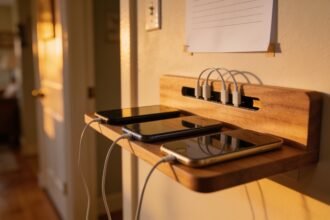
Put every device on charge in one place, outside every bedroom, every night.
That single arrangement solves three separate problems at once: devices stop being in bedrooms overnight, cables stop migrating around the house, and the morning search for a charged device ends.
Where to put it
Outside every bedroom. Kitchen bench, hallway, study, family room. Anywhere that is not somewhere anyone sleeps.
Near a power point you are not otherwise using, because a charging point that requires unplugging the kettle will not survive.
Visible rather than hidden. A drawer charging station looks tidy and nobody uses it, because people plug in where they are standing.
Not in direct sun and not against a heat source. Devices charging in a hot Australian room run warm anyway, and heat is hard on batteries.
Where there is airflow. Not inside a closed cupboard or under a pile of paper, which is both a heat and a fire consideration.
If you already have a drop zone at the entry, the charging point often belongs near it, as in a drop zone or mudroom in a small entry.
Why it is not in the bedroom
Sleep. A device in a bedroom overnight affects settling and provides an option at three in the morning that no child or teenager should have to resist. Removing the device removes the decision, which is why getting kids to bed without the two-hour battle treats it as a structural fix rather than a rule.
The agreement is easier to keep when it applies to everybody including the adults. A household where the parents charge in the kitchen has a rule. A household where only the children do has a restriction, and it is argued about continuously.
Set it before the first device arrives if you can. When should a child get their first phone covers agreeing the terms before handover, and overnight charging location is the single rule most families say they wish they had set from the start.
Stopping cables migrating
One cable per device, kept at the charging point, rather than a communal pile everyone raids.
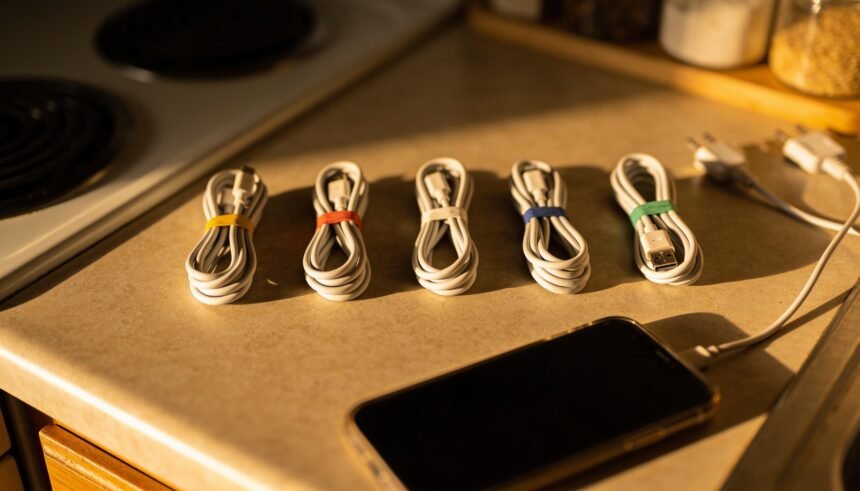
Label the cables. Masking tape and a marker, or coloured tape rings. It takes two minutes and it ends most of the arguing.
Short cables at the charging point. Long cables are what allow a device to be plugged in and taken to a bedroom, and a short cable physically prevents it.
Keep travel cables separate, in the bag or the car, so the household ones stay put.
Have one spare of the most common type in a drawer, not in circulation.
Anchor the cables with clips, a weighted base, or simply threading them through something, so they do not slide behind the bench when unplugged.
Electrical safety, which matters more than the tidiness
Use chargers and power adapters that comply with Australian requirements. Electrical equipment sold for use in Australia must meet Australian electrical safety requirements, and non-compliant chargers, particularly cheap ones bought from overseas sellers, are a recognised risk. Australian electrical safety regulators have published repeatedly on this.
Look for the regulatory compliance mark and buy from reputable Australian retailers.
Do not use a damaged cable or charger. Frayed, cracked, exposed conductors, or one that gets hot. Replace it.
Do not daisy-chain power boards. One board into a wall socket, not a board into a board.
Do not run cables under rugs or through doorways where they get crushed.
Do not cover charging devices with bedding, cushions or paper. Heat needs somewhere to go.
A power board with overload protection, on a single wall socket, is the normal arrangement for a charging point.
Any new outlet, any wiring, any modification is a licensed electrician’s job. In Australia this is not optional and it is not a DIY area. This article describes no wiring or electrical work of any kind.
Check your state’s electrical safety regulator for current guidance, since requirements and advice are published at state level.
Battery and device care
Heat is the main enemy of a battery, and an Australian summer is hard on devices. Charging in a hot room, in a car, or in direct sun shortens battery life.
A device in a case that traps heat while charging runs hotter.
Do not leave devices charging in a car, which reaches extreme temperatures here.
Follow the device manufacturer’s guidance on charging and battery care, which differs between devices and changes.
Making it a household system
Everyone, every night, same place. Including the adults.
Attach it to something that already happens, such as after dinner or as part of the evening tidy.
Devices that are not charged in the morning are not charged. Enforcing this once is more effective than reminding daily.
Review it when a device is added, because a new device without a place ends up on a bedside table by default.
Keep old devices out of circulation. An old phone on wi-fi in a drawer is a device with no rules attached to it, and it is worth deciding deliberately whether it exists or not.
Disposing of old cables and chargers
Not the kerbside bin. Cables, chargers and devices are e-waste and Australia runs recycling arrangements for them, with many councils and retailers accepting drop-off.
Batteries in particular must not go in kerbside bins, where they are a recognised fire risk in collection vehicles and sorting facilities.
What to actually throw out, and what to keep covers the Australian disposal routes for the rest of it.
Next: when should a child get their first phone covers the agreement this rule belongs in, a drop zone or mudroom in a small entry covers where it often sits, and getting kids to bed without the two-hour battle covers why it is out of the bedroom.
If you are buying the charger rather than arranging the cables, charging a family of devices from one spot explains why the port count is the wrong number to compare.
The one-page family week
One printable page that holds the whole week: meals, school, activities and who is doing the pickup. Free, and we send one useful email a week.
One email a week. No spam, unsubscribe in a click.