
What is in this guide
An agreement written by one parent at 9pm and announced at breakfast lasts about four days.
The ones that survive were written with the children in the room, cover behaviour rather than only minutes, and had the consequences agreed before anybody needed them.
Australia’s eSafety Commissioner publishes free family tech agreement templates by age band, and they are the obvious starting point rather than beginning from a blank page. Its framing is useful in itself: an agreement is less about rules or signing a contract, and more about building a foundation for open conversations and habits that keep everyone safer online.
Why a time limit on its own does not work
Almost every household starts here, and it is the weakest possible version.
eSafety is direct about this: there is no magic figure. The right amount depends on the child’s age and maturity, the kind of content, their learning needs and your family routine. It also points out that it is easy to focus only on the clock, when the quality and nature of what they are doing, and your involvement, matter just as much.
Practically, a pure time limit has three problems. It treats homework and a video feed as identical. It turns every day into a negotiation about minutes. And it gives you nothing to say about the thing that actually worries you, which is usually what they are doing rather than for how long.
So the agreement covers where, when, what and who, and time is one part of it rather than the whole thing.
Write it together, which is the part that matters
The single biggest predictor of whether it survives is whether the children helped write it. Creating it together encourages buy-in and makes the expectations feel fair and achievable, which is exactly the difference between an agreement and an announcement.
- Sit down once, with everybody, including the adults
- Ask them what they think is fair before you say what you think. You will usually get something stricter than you expected on at least one point
- Let them win something. An agreement where the child’s position prevailed on one item is an agreement they will defend
- Put the adults in it. No phones at the table applies to parents, and a child will notice within a day if it does not
What to cover
Where
- Which rooms devices are used in
- Whether devices go in bedrooms, and specifically whether they are in bedrooms overnight
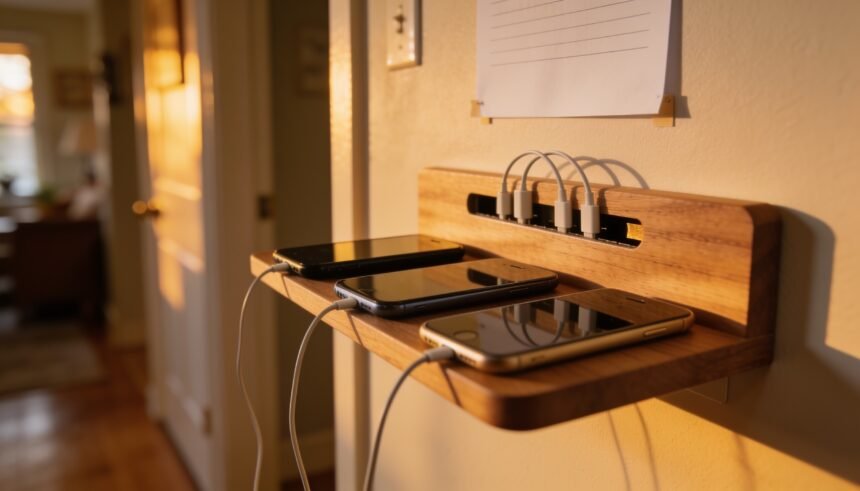
- Where they charge overnight, which for most households is the single most effective rule in the document. A charging station makes it a place rather than an argument
When
- Before school, after school, homework first or not
- Mealtimes
- A cut-off before bed
- Weekends versus school nights, which are genuinely different and should be written differently
What
- Which apps, games and sites are agreed
- The rule for anything new: ask first
- Age ratings, and what the household does about them
- Whether they can spend money, and how that is approved
Who
- Who they can talk to and accept requests from
- The rule about meeting someone in person, which should be explicit
- What to do if something makes them uncomfortable, and the promise that telling you does not cost them the device. That last clause matters more than anything else in the agreement
Consequences, agreed in advance
This is the part households skip and it is the reason agreements collapse.
eSafety’s guidance is plain: there should be clear consequences for not sticking to the agreement, and it is important to follow through with them.
- Agree them when everyone is calm, not during the incident
- Make them proportionate and short. Losing a device for a month is unenforceable and everybody knows it by day three
- Match the consequence to the breach. Going over time is not the same as talking to a stranger, and treating them the same teaches the child the distinction does not matter
- Separate safety from discipline. If a child reports something worrying, the response is not a punishment. Write that down
Put it somewhere real
- Print it and stick it where devices charge, not in a folder
- Everyone signs it, including adults
- Date it
Review it, because it will go out of date
A device agreement written for an eight year old is wrong for the same child at eleven.
- Review it every six months, and at any change: a new device, a new school, a new game everyone is playing. A school moving to bring-your-own-device is the big one, and BYOD school rules in Australia covers what the school will expect of the same device
- Expect to renegotiate. A child who has kept the agreement for six months has earned a change to it, and saying so gives them a reason to keep it
- Loosen as well as tighten. An agreement that only ever gets stricter is one children stop engaging with
What to do when it breaks
It will break. Plan for it rather than treating it as a betrayal.
- Apply the agreed consequence, once, without relitigating the whole document
- Ask what happened rather than leading with the punishment
- If the same clause breaks repeatedly, the clause is probably wrong rather than the child
- If something genuinely worrying has happened online, eSafety is the place to go. It handles reports and has advice for parents on specific harms, and that is beyond what any household agreement covers
The short version
Download the eSafety template for your child’s age. Sit down together, once. Cover where, when, what and who rather than only minutes. Agree the consequences while everyone is calm. Put the adults in it. Stick it where the devices charge. Review it in six months.
If the argument is really about devices in bedrooms overnight, the charging station is the fix, and if it is about the internet dropping out during homework, that is a wi-fi problem rather than a rules problem.
And an agreement holds better when there is something else to do, which is mostly a stocked shelf of indoor activities for primary school kids rather than a lecture.
The one-page family week
One printable page that holds the whole week: meals, school, activities and who is doing the pickup. Free, and we send one useful email a week.
One email a week. No spam, unsubscribe in a click.