What is in this guide
Build the chart from your child’s actual school morning: a short sequence of clear actions, cues they understand and a visible way to see what comes next. Start with a plain-paper draft, walk through it together and revise the confusing steps before spending time on a polished version.
The aim is a chart you can keep using, with adult help where needed. It cannot promise that every morning will go to plan.
1. Decide what belongs on this chart
Write down what happens between getting up and leaving home. Then separate the child’s actions from adult jobs and evening preparation. Finding a clean uniform, checking school messages and signing a note need somewhere to live, but they do not all belong on the child’s morning chart.
Raising Children Network recommends separating night-before preparation from morning tasks. Use that distinction to keep the chart focused. If socks are routinely missing, decide where to put them tonight rather than adding “find socks” as another morning step.
Keep adult departure planning separate too. Work out your leaving time and what realistically fits before it using the school morning routine planning guide. The chart then shows the child their part in that plan.
Ask your child to describe the sequence with you. Include the jobs they need help with, rather than quietly leaving those out and expecting them to know when to ask.
2. Choose a format you can change
Compare these options before making anything permanent:
| Format | Consider it when | Trade-off to allow for |
|---|---|---|
| Plain paper with a movable marker | You are still changing the order | It may need replacing after repeated handling |
| Wipe-clean checklist | Your child understands ticking off completed jobs | Someone must clear yesterday’s marks |
| Separate picture cards | You need to swap individual steps or their order | Loose cards need a consistent home |
A handwritten page is enough for the first draft. Choose the format you can maintain with what you already have. If you want a starting layout, adapt the existing printable morning chart rather than designing a second checklist alongside it.
Pick one way to show progress: a tick, a marker beside the current step or moving a completed card. Practise resetting it as part of preparing for tomorrow. Otherwise, a fully ticked chart can sit there while a new morning starts.
3. Give each row a clear finish point
Write instructions that describe something you can see. “Get ready” leaves several decisions hidden. “Put on your uniform” is clearer; “put on socks and shoes” can be a separate row if those are often forgotten.
For each draft row, ask three questions:
- What exactly does the child do?
- What shows that this step is finished?
- What help or equipment must be available?
For example, “bag ready” might mean the lunchbox is inside, today’s library bag has been checked and the schoolbag is in the agreed place. If that bundles too much into one instruction, split the final check from carrying the bag.
Keep the order realistic for your home. A child sharing a bathroom may get dressed before brushing their teeth because a sibling is using the basin. Do not copy an order that creates a queue you already know about.
Raising Children Network advises considering how long activities take and when they need to happen. Use your own morning to check whether the sequence fits. Adding clock times to every row will not create more time for breakfast or adult assistance.
4. Use cues your child recognises
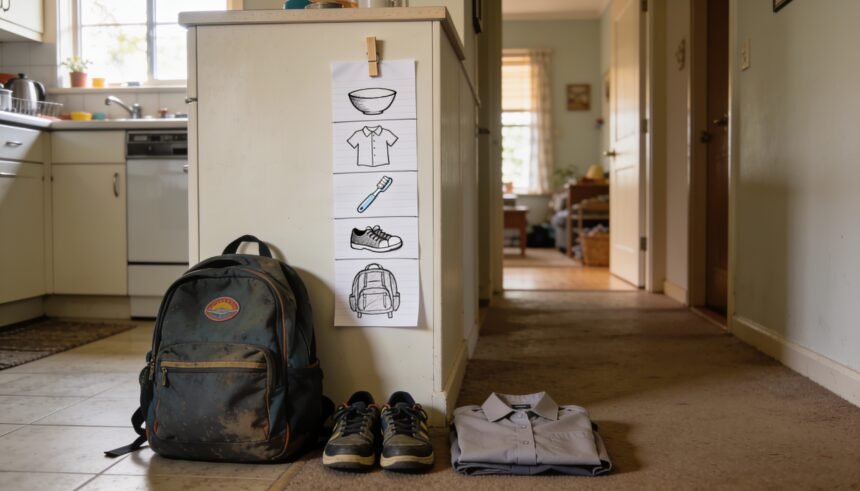
Raising Children Network suggests displaying the routine and including pictures if useful. Choose pictures that mean something to your child: their own shoes, their schoolbag or a simple drawing of the breakfast bowl you use.
Put a short action beside each picture. A toothbrush picture might mean “brush teeth” to one child and “fetch toothbrush” to another. Ask what they think the cue means before relying on it.
Start with a page that is easy to scan. Keep the order consistent, leave space between rows and remove decoration that competes with the instructions. Check it from the spot where the child will actually stand, rather than judging it only while holding it close.
If your child prefers written instructions, use them. Pictures are an option, not a requirement for every chart.
5. Make adult help visible
Add a simple “help” note beside jobs that need you. That might be fastening shoes, reaching something or checking the bag together. Marking the support makes the plan honest about what can happen independently.
Agree on the adult’s role too. If two adults alternate mornings, both need to know what “finished” means and when to help. For changing rosters or care across homes, use a separate plan for shift-work and split households to clarify who is available. Keep each home’s chart matched to its own rooms, equipment and departure arrangements.
For siblings, consider separate child checklists with a shared adult plan. One child’s completion marks should not leave another trying to work out which jobs are still theirs.
6. Rehearse using the chart at a quiet time
Walk through the draft before asking it to carry a rushed school morning. Let your child find the first step, explain it and show how they will mark it complete. You can practise pointing and moving the marker without repeating every care task.
Notice where the instructions break down. Can they find the uniform? Does “bag check” need explaining? Is the chart in the kitchen while the next action happens down the hall?
Place the chart where it can be consulted without an awkward detour. If you need another reminder near the shoes, make it a cue for that step rather than a second, conflicting sequence.
On the next school morning, refer to it together: “Breakfast is finished. Which step is next?” Stay available to explain or help. Reading a checklist and carrying out its instructions are separate jobs.
7. Revise the point that keeps failing
After a few ordinary school mornings, look at the specific row that needed repeated explanation. This is a suggested review point, not a deadline by which the chart should work.
If the cue is missed, check its size and position. If the action starts but never finishes, check the finish point. If the child is waiting for help, check whether the adult is available at that stage. If everything is running late, return to the timing plan rather than adding more boxes.
Ask a concrete question: “Which bit was hard to follow today?” Change one confusing part, then try that version. Keep the draft flexible until the order and wording suit your household.
Put library days, sports uniform changes and other weekly exceptions beside the daily sequence. Show who checks those extras. For a disrupted morning, decide which optional tidying can wait; keep essential care and school requirements in the plan.
Before the next school morning: draft the sequence on paper, agree what completion means for each row and walk through the first two steps together. Leave room to edit it.
How we checked this
Reviewed on 9 October 2026 against Raising Children Network guidance on separating preparation, allowing for timing and displaying routines with optional pictures. The construction method and troubleshooting choices are Dovelyne editorial suggestions, not a tested programme or a guarantee of adherence.
The one-page family week
One printable page that holds the whole week: meals, school, activities and who is doing the pickup. Free, and we send one useful email a week.
One email a week. No spam, unsubscribe in a click.