What is in this guide
- Decide which kind of day you are preparing for
- Separate what your child attempts from what you check
- Put the finding and choosing jobs into the evening
- Follow a sequence with room for help
- Confirm afternoon pickup before you leave
- Allow for an older sibling’s school run
- Use a shorter version when the morning slips
Build a four-year-old’s morning around a short, familiar order, with an adult available for the jobs that need help. Before leaving, confirm who is collecting each child and where, whether your four-year-old attends a service that day or comes along for an older sibling’s school run.
Decide which kind of day you are preparing for
Start with today’s actual destination. Is your child going to preschool or kindergarten, staying with a carer, or returning home with you after school drop-off? Use the name your child knows for the place they attend. Keep the adult plan specific about locations and times.
On an attendance day, check that service’s start and collection arrangements. On a sibling-run day, decide what your four-year-old needs for the trip and what happens once you return. A child accompanying you does not need a schoolbag packed as though they are staying all day.
Write the leaving time from your own journey, including walking, parking or a second stop. If departure timing itself needs work, use the general school morning planning guide. Here, the extra question is when your four-year-old needs you beside them and whether that help fits before departure.
Separate what your child attempts from what you check
Avoid making the routine depend on a four-year-old completing everything alone. Choose small actions your child can attempt today, and state where you will help. Collecting shoes and fastening shoes can be two different responsibilities.
Try this division as a starting point:
| Part of the morning | Child’s possible job | Adult’s job |
|---|---|---|
| Clothes | Choose between two suitable outfits or fetch the clothes | Check suitability and help with dressing |
| Breakfast | Come to the table and choose from what is offered | Prepare food and remain available |
| Bathroom | Follow the familiar care sequence with support | Provide the help your child needs |
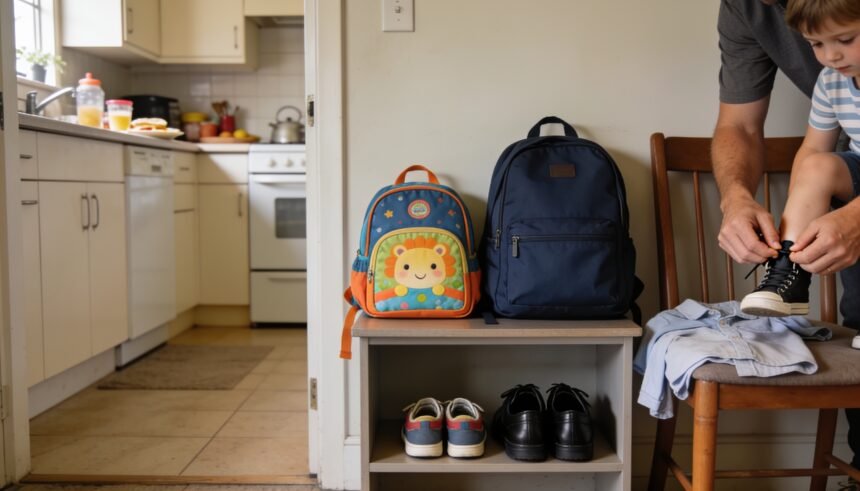
| Shoes and bag | Bring shoes and the relevant bag to the agreed spot | Help with fastenings and check the contents |
| Departure | Come with the adult when called | Manage timing, travel and collection arrangements |
These are options, not milestones. Remove any job that does not suit your child, and leave enough adult time for the support you already provide. Raising Children Network recommends clear instructions and notes that younger children may need more reminders.
Put the finding and choosing jobs into the evening
Raising Children Network separates preparation for the night before from tasks that must happen in the morning. For this routine, use the evening to find clothes, pair shoes and check which bag is needed tomorrow.
Offer a limited clothing choice if that suits your household, then leave the chosen items together. Make any day-specific requirement visible to the adult: spare clothes for the service, something requested by staff, or an older sibling’s library bag.
Keep tomorrow’s belongings somewhere you can use without blocking the entrance. In a small home, a cleared section of a shelf is enough. Leave a short reminder for anything still to be added, rather than treating a bag by the door as proof that packing is finished.
Follow a sequence with room for help
A sequence is useful when the same jobs happen daily but their duration varies. A detailed timetable can suit a household with fixed transport, but it also creates more clock points for an adult to supervise. Start with the order below and add times only where they help.
- Get up and reconnect. Tell your child what kind of day it is: “Preschool today. I will collect you after your session.”
- Have breakfast. Keep the available choices clear before preparing it.
- Do bathroom care and get dressed. Stay available for assistance. Swap the order if your bathroom is shared.
- Put on shoes and check the right bag. Give one instruction at a time if a longer request gets lost.
- Leave together. The adult checks the essentials and manages the trip.
This is an editorial example, not a prescribed schedule. Raising Children Network advises allowing for how long activities take and when they need to happen. Use your own mornings to decide where more room is needed.
If a visible cue would help, adapt the picture-based morning checklist. You can point to the next action together; displaying a chart does not remove the need to help.
Confirm afternoon pickup before you leave
Keep collection planning on the adult’s list. Before departure, establish who is collecting, which location they are going to, the collection time and how they will be told if arrangements change.
For example, an adult note might read: “Tuesday: Alex collects the older child from school at the agreed gate. Jo collects the younger child from preschool at session end.” This is an illustrative format, not a suggested timetable. Use actual names and arrangements, and ask the named adults to confirm.
Check the relevant school or service’s process if someone different will collect. A household note does not replace its requirements. Give the collecting adult the necessary details directly instead of expecting a four-year-old to relay them.
Tell your child the confirmed plan in simple terms: “Grandad is collecting you today.” If the arrangement is still unsettled, resolve it between adults rather than offering a promise you cannot yet make.
Allow for an older sibling’s school run
If your four-year-old is coming home after drop-off, say so before you leave: “We are taking your brother to school, then coming home together.” Keep their trip belongings distinct from the older child’s school equipment.
Consider the afternoon journey while organising the morning. Will the four-year-old be with you for collection, or with another carer? What needs to be ready before you leave home again? Put that preparation on the adult list, rather than sending everything out on the morning trip unnecessarily.
For several destinations, a shared plan for different children's schedules can hold the adult responsibilities. Keep your four-year-old’s spoken instructions focused on what they are doing next.
Use a shorter version when the morning slips
When time runs short, drop optional tidying or a non-urgent household job. Keep care, food, necessary belongings and travel arrangements in the plan. Offer direct help with the immediate obstacle: “Bring your shoes here and I will help you put them on.”
If you miss the planned departure, update anyone affected once it is practical to do so. Do not make your child responsible for explaining an adult scheduling problem.
Later, identify the specific delay. Were clothes missing, was the adult unavailable during dressing, or did two destinations require the same departure time? Change that detail before adding more instructions. Keep afternoon expectations separate; the after-school routine guide covers the stretch after collection.
Tonight: put tomorrow’s clothes and shoes together, name the adult who will help in the morning, and confirm collection for every child leaving home.
How we checked this
Reviewed on 18 October 2026 against Raising Children Network guidance on morning preparation, timing, visible routines and clear instructions. The age-specific examples and pickup planning are Dovelyne editorial suggestions, not a tested programme or a guarantee of cooperation.
The one-page family week
One printable page that holds the whole week: meals, school, activities and who is doing the pickup. Free, and we send one useful email a week.
One email a week. No spam, unsubscribe in a click.