What is in this guide
- 1. Check what the school expects before choosing a size
- 2. Check the bag against your child’s body
- 3. Pack the actual lunchbox, bottle and school items
- 4. Let your child operate every compartment they need
- 5. Compare the compromises instead of chasing one size label
- 6. Try the existing bag before replacing it
- 7. Repeat the check with your child doing the packing
Choose a five-year-old’s backpack by checking it on the child with the things their school actually requires inside. The bag needs to fit their body, close around the day’s belongings and let them reach and use its compartments; an age label or attractive print cannot answer those questions for you.
1. Check what the school expects before choosing a size
Ask whether the school requires a particular bag and what needs to travel in it each day. Check whether a take-home folder, library bag or spare clothes must fit inside, and whether some supplies stay in the classroom. Write down the answers rather than buying space for equipment your child will never carry.
CHOICE notes that some schools include a prescribed backpack in their uniform requirements. If that applies, ask to try the available sizes before ordering. If the required model seems unsuitable when tried on, take the specific problem to the school: for example, the straps cannot shorten enough or the required folder cannot fit.
Use the prep and kindergarten packing guide to organise the contents, then confirm the list with your own school. Another family’s list is a starting point, not a requirement for your child.
2. Check the bag against your child’s body
Put both shoulder straps on and adjust them before judging the size. Developmental Occupational Therapy WA, known as DOT (WA), recommends that the backpack sits close to the child’s back, with its bottom just above the waist. Check this from the side as well as from behind.
Use these physical checks:
- The straps can shorten enough to position the bag as intended.
- The bag rests close to the back rather than hanging well away from it.
- Its bottom sits just above the waist, following DOT (WA)’s guidance.
- Its width does not exceed the child’s chest width, following CHOICE’s size guidance.
- When the child sits with it on for the fitting check, it does not extend past their shoulders, as CHOICE advises.
If a bag fails these checks after adjustment, compare another size or shape. Leaving it oversized in the hope that your child will grow into it does not solve the current fit problem. The guide to school bag fit features covers the broader feature questions; this checklist is for deciding whether the particular bag works on your child today.
3. Pack the actual lunchbox, bottle and school items
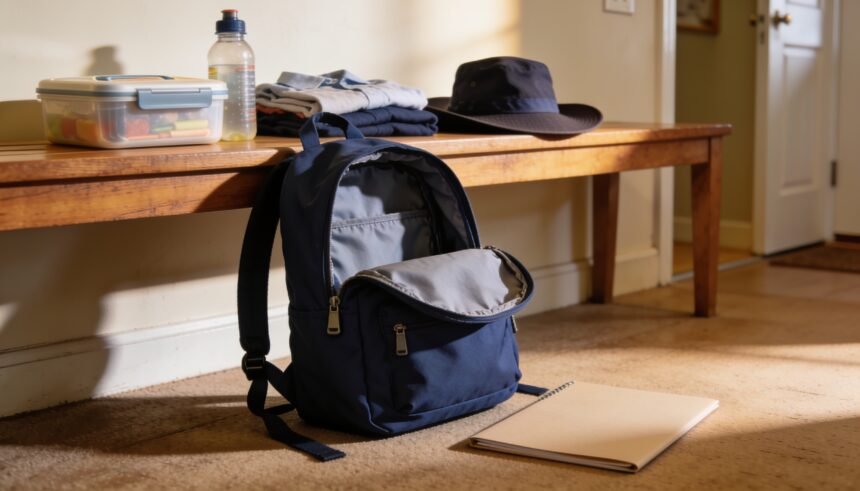
Bring the items you already own when trying a bag, or check them at home before removing labels. Start with the lunchbox and drink bottle, then add the school-required folder, hat and spare clothing. Include the library items if they must travel inside on library day.
This is an editorial capacity check: you are comparing your belongings with the usable opening and compartments. A stated capacity in litres does not tell you whether your particular lunchbox can pass through the zip opening or whether the folder can lie flat.
Close the main compartment normally. If you have to press hard on the contents while an adult pulls the zip, try a different arrangement or bag. Leave enough room for your child to put things back without reproducing a precise adult packing pattern.
For book days, use the school library bag packing guide to decide what belongs together before repeating the capacity check. Avoid choosing the everyday backpack around a special-event load until you have asked how the school wants that equipment brought in.
4. Let your child operate every compartment they need
DOT (WA) recommends choosing a backpack the child can open and close, with compartments they can access. Bourke Street Public School also encourages practising bag zips and packing before starting school. Give your child the packed bag and watch the sequence rather than demonstrating every movement as they go.
Ask them to:
- Set the bag down and open the main compartment.
- Find and remove the lunchbox.
- Take the bottle out of its pocket and put it back.
- Return the lunchbox and close the bag.
- Open and close any buckle needed to put the bag on or take it off.
Notice exactly where help is needed. A stiff zip, awkward opening or tightly stretched bottle pocket gives you something concrete to compare with another bag. Allow a calm practice attempt before deciding; unfamiliarity and an unsuitable fastening are different problems.
5. Compare the compromises instead of chasing one size label
Use a short comparison sheet if two bags remain in contention. Record body fit, required contents and independent access separately. A bag should pass all three before colour or extra pockets settle the choice.
| What happens during the check | What to compare next |
|---|---|
| The body is too long after adjustment | A shorter bag with a usable opening for the same school items. |
| The body fits but the lunchbox jams | A different compartment shape or opening, before automatically going larger. |
| Everything fits only with careful adult packing | A simpler layout your child can repack themselves. |
| An extra compartment is difficult to reach | Whether it is actually needed for the daily routine. |
| The school bag model is compulsory | Available sizes and the school’s advice about the specific fit problem. |
These are comparison prompts, not measured rules about a brand or bag style. Keep the decision tied to the child and contents in front of you.
6. Try the existing bag before replacing it
A hand-me-down or preschool backpack is worth putting through the same checks. Empty it, adjust the straps for its new user and pack the current school list. Its previous owner’s age tells you less than this fitting attempt.
If it fits the child and passes the contents and access checks, there is no need to replace it simply because school is starting. If it fails, record why before shopping so the replacement addresses that problem. This is particularly useful when money is tight: you can compare the feature you need rather than paying for extra compartments without a purpose.
7. Repeat the check with your child doing the packing
Before the first school day, practise the same unpacking and repacking sequence with the bag in its usual place at home. Agree where the lunchbox, bottle and folder belong. DOT (WA) recommends a packing routine and organising the contents with the child.
Build on that with getting children to pack their own school bag, while keeping adult help available. Repeat the fit and capacity checks when the contents change or the bag no longer sits as it did. Start today by laying out the school’s required items and asking your child to pack, close and put on the bag you already have.
How we checked this
Checked on 17 October 2026 against CHOICE, DOT (WA) and Bourke Street Public School guidance. The household comparison steps are editorial recommendations. No backpack was handled or tested, and no single bag dimension, capacity or load limit is prescribed for every five-year-old.
The one-page family week
One printable page that holds the whole week: meals, school, activities and who is doing the pickup. Free, and we send one useful email a week.
One email a week. No spam, unsubscribe in a click.