What is in this guide
Hand it over one job at a time, not all at once. Pick a single item your child owns completely, give them a checklist they can read without you, and let a missed item be a small, recoverable problem rather than a reason to take the job back.
Start with one job, not the whole bag
Packing a school bag is several small tasks stacked together: finding things, deciding what is needed today, fitting them in, and remembering the bag exists at all. Handing over all of it in one go usually fails, not because the child cannot manage any of it, but because they cannot manage all of it together yet.
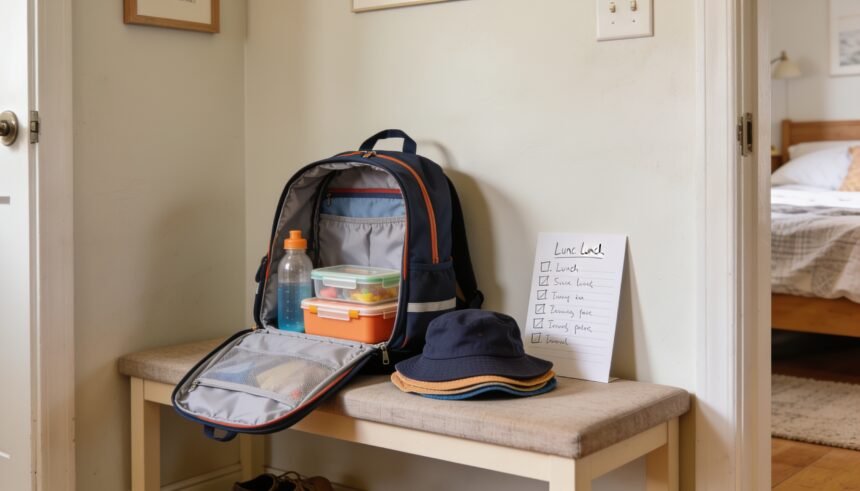
Pick the easiest piece first. Putting the lunch box in the bag is a common starting job, because it is concrete and happens at a predictable moment. Once that is reliable, add the next piece: the drink bottle, then the hat, then checking for a reading folder or a note from school. Add a job when the current one has stopped needing a reminder, not on a fixed schedule.
Give them a checklist they can actually read
A checklist only works as a handover tool if your child can use it without you standing next to them. For a child who is not yet reading fluently, that means pictures or symbols rather than a list of words. For an older child, a short written list taped inside a cupboard door works fine.
Keep it to what genuinely changes day to day: library bag on Thursdays, sport uniform on Wednesdays, a reading folder once home readers start. A checklist with every possible item on it every day teaches a child to ignore the checklist. Build it from what your own week actually looks like rather than copying a generic version, and keep it short enough that your child checks it rather than skims past it.
Decide what “packed” means before the argument happens
Agree, outside of a rushed morning, on what counts as done: bag by the door, lunch box and drink bottle inside, hat on top. Your role at that point is to check, not to repack. If you quietly redo a job your child believes they finished, they learn that it was never really theirs.
When something is missing, say what is missing rather than redoing the whole bag: “the drink bottle isn’t in yet” gives a child something specific to act on. Fixing it yourself without naming the gap looks faster this morning and slower every morning after.
When something gets left at home
It will happen, and it is not evidence the handover failed. A forgotten hat or lunch box is usually a short-term inconvenience that the school day absorbs, not an emergency. Treat it as information about the system rather than the child: was the item in its usual spot, was the checklist followed, was the morning simply too rushed for a new job to get the attention it needed.
If the same item goes missing repeatedly, the item’s spot is the first thing to check, not the instruction. A drink bottle that lives in a different place each night is harder to remember than one with a single fixed spot it always returns to. Age-appropriate chores has a broader way to think about which tasks suit which stage, if the bag job turns out to be one of several responsibilities worth reviewing together.
Fit it around the rest of the morning, not against it
A handover that only works when the morning is calm will fail on the mornings it matters least. If your household already runs on a set morning sequence, slot the bag job into wherever packing naturally sits, rather than adding it as a separate task competing for the same five minutes as shoes and breakfast.
On a morning that has already gone sideways, it is reasonable to do the job yourself and reset the handover the next day. One rushed morning does not undo the practice that came before it.
Next step: choose one item for your child to own from tonight, and one spot in the house where the checklist for it will actually get read.
How we checked this
Reviewed on 2 October 2026 against Raising Children Network material on household chores and family routines. The staged handover, checklist format and troubleshooting steps are Dovelyne editorial suggestions, not a tested programme or a guarantee against forgotten items.
The one-page family week
One printable page that holds the whole week: meals, school, activities and who is doing the pickup. Free, and we send one useful email a week.
One email a week. No spam, unsubscribe in a click.