What is in this guide
Build an after school routine for kids around a short sequence your household can repeat, with clear starting cues, agreed adult help and a shorter version for late days. Walk through it together, then revise the steps that keep getting missed rather than adding more instructions.
A routine that sticks still needs reminders and occasional changes. The useful question is whether the plan fits the afternoon you actually have.
1. Choose the problem you want the routine to solve
Start with one recurring difficulty. Perhaps lunchboxes stay in bags overnight, nobody knows when free time ends, or the adult coming home later cannot tell what has already happened. Write down what a better afternoon would look like in observable terms.
For example, choose “lunchbox on the kitchen bench before the bag is put away” rather than “be more organised”. You can see whether the first instruction has happened and work out what prevented it.
Raising Children Network recommends agreeing on goals with a partner where applicable and involving children in planning. Ask your child which part of arriving home feels awkward and what they would like time for. Leave space for play, talking or doing very little, rather than filling every gap with another job.
If you need to decide the overall order of food, a break and schoolwork, use the existing afternoon plan for the 4pm slump. Build this routine around that choice instead of creating a competing timetable.
2. Plan from your real arrival time
Write down the different kinds of school afternoon you have: straight home, outside school hours care, sport, or pickup by another adult. Include travel and the time someone is actually available to help.
A plan starting at 3.30 pm cannot apply unchanged to a child arriving home at 6 pm. Mark the fixed commitments first, then decide which household jobs fit around them. Keep departure times for activities visible to the adult responsible for getting everyone there.
Raising Children Network advises putting steps in order, allowing for their timing and identifying where children need assistance. For your draft, give each action a starting cue and a finish point:
| Action | Starting cue | What counts as finished | Help to arrange |
|---|---|---|---|
| Unpack school items | Arriving home | Lunchbox and bottle are in the agreed kitchen spot | Adult checks any notes that need attention |
| Take a break | Unpacking is done | The agreed next cue occurs | Adult confirms what comes next |
| Check school tasks | The break ends | Today’s required work has been identified | Help reading instructions if needed |
These are suggested rows, not a complete schedule. Keep only the actions relevant to your goal, and write your own definitions where the example does not fit.
3. Choose cues you can keep using
Compare a clock time with an event cue. “Unpack when we get home” fits changing arrivals. “Leave for swimming at 4.20 pm” needs a clock because there is a fixed commitment. Both can belong in the same plan.
For a break, decide what signals its end before it begins. That could be an agreed timer or an adult returning from a particular household job. Avoid “later” if nobody knows what later means.
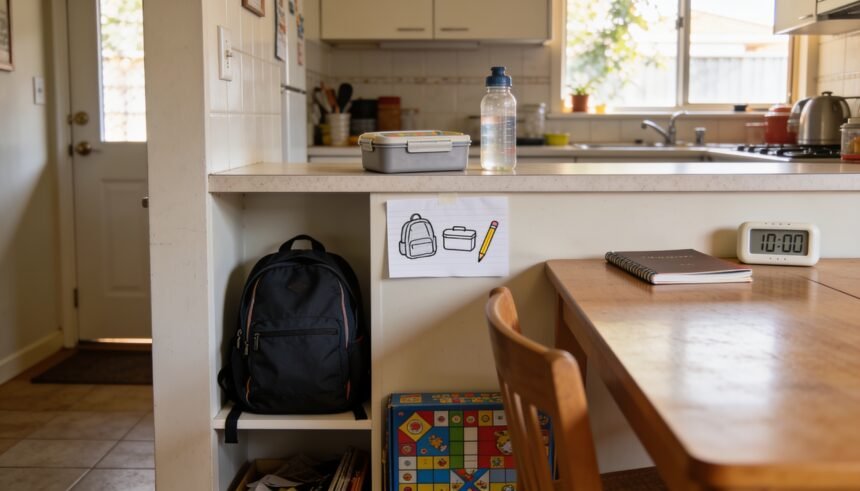
Raising Children Network suggests visible lists, pictures and prompts as reminders. Choose a short written list, simple drawings or a combination your child understands. Put the reminder where the first action happens. A beautiful chart inside a cupboard is awkward if the bag is dropped at the front door.
Show how to use it, including how yesterday’s ticks are cleared. Keep a draft easy to alter; plain paper is enough while you are working out the wording.
4. Give the adults a clear part
Separate the child’s actions from adult responsibilities. A child can bring out a school note, while an adult still needs to read it and arrange any response. Naming both jobs prevents “check the bag” from quietly meaning different things to different people.
If adults alternate pickups, agree on what needs handing over: whether school tasks have been checked, whether equipment is missing and who will follow up. Keep the handover short and factual. The next adult needs the current position, not a replay of the afternoon.
For changing rosters or care across homes, use the routine planning guide for shift-work and split households. Match each home’s instructions to its own arrangements rather than expecting identical rooms, equipment or arrival times.
For siblings, mark whose jobs are whose and when shared help is available. Do not schedule two children to need the same adult at once if that adult is also taking a work call.
5. Write the shorter version before you need it
Decide what happens on a late-care or activity day while you are making the ordinary plan. Keep required care, meals and school commitments accounted for, and identify optional jobs that can move.
For example, unpacking the bag might stay, while sorting artwork moves to the weekend. Free time might be shorter because travel has used the afternoon. Show the difference openly so a late arrival does not trigger an attempt to squeeze in the whole ordinary schedule.
Keep homework planning within the school’s expectations. The simple homework routine guide covers arranging that block; contact the teacher if the available time repeatedly cannot accommodate assigned work. Avoid making a blanket rule that unfinished work always disappears or must always continue until bedtime.
Leave tomorrow’s preparation in its own place. The five-minute evening reset before a school day provides a separate check for the next morning, so this afternoon list need not carry every household task.
6. Walk through it and revise the sticking point
Explain the draft before a busy afternoon and ask your child to show what each instruction means. Can they find the bag’s home? Is the bottle spot within reach? Does the next step depend on an adult who will be unavailable?
Raising Children Network recommends explaining routines and adapting them as family circumstances change. Use the first few ordinary afternoons to look for specific problems. This is a suggested review period, not a deadline for learning a habit.
If a step is missed, check its cue and location. If it starts but remains unfinished, clarify what completion means. If the child waits for help, move the action to a time when help is available. If everything runs late, remove or relocate an optional task before adding another reminder.
Change one part at a time so you can judge whether the new arrangement is easier to use. After a disrupted day, return to the relevant version of the plan without demanding that every missed optional job be caught up immediately.
Before the next pickup, choose one recurring problem, write a clear action with a starting cue and agree who will help. Leave room on the page for the late-day version and the first revision.
How we checked this
Reviewed on 9 October 2026 against Raising Children Network guidance on planning and explaining family routines. The afternoon examples and revision method are Dovelyne editorial suggestions. They have not been tested with families and do not promise adherence within a set period.
The one-page family week
One printable page that holds the whole week: meals, school, activities and who is doing the pickup. Free, and we send one useful email a week.
One email a week. No spam, unsubscribe in a click.