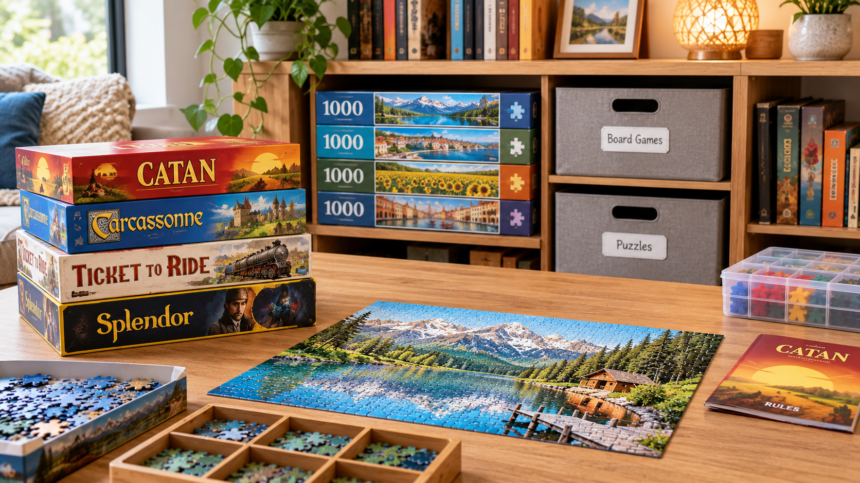
What is in this guide
Keep each game or puzzle in one container with its instructions, a contents note and smaller containers for loose pieces. Make checking the playing area part of every pack-up, and record anything missing before the box goes away. Start with the set your household uses most, rather than emptying the whole cupboard.
Check what belongs in the box
For keeping board games and puzzles complete, start with a reference you can check again. Open one set on a clear table and compare its contents with the rulebook or supplied parts list. Count cards, counters, dice and player pieces separately, including any pieces tucked under the box insert.
Write a short contents note using the actual quantities for that edition. Add the date and any gaps. If there is no reliable list, mark the set as unchecked rather than calling it complete because the box looks full.
For a jigsaw, use the next completed assembly as your check. Photograph it before taking it apart and note whether every space is filled. A loose-piece count alone does not show that every piece belongs to that puzzle. If there is a gap, photograph its position and record it on a note inside the box.
Keep the picture reference, instructions and identifying details with the set, even if you replace the original packaging. Choosing a different puzzle is a separate decision: the guide to choosing jigsaws by age and difficulty covers that before-buying question.
Give loose pieces their own place inside the box
Use the original compartments where they still work. Otherwise, group components in small containers that fit inside the main box without forcing the lid shut. Try containers you already have before buying an organiser.
Choose groups that match how the game is set up: one group per player, one for shared counters and one for dice, for example. Keep cards in their intended decks, with enough room to lift them out without bending them. Put the contents note and rulebook on top.
Keep similar-looking pieces from different games separate. If several sets share an outer tub, give each set its own inner container and identifying label. For construction kits and other multi-piece toys, extend the system using storage for educational toy sets.
Finish each session with the same pack-up sequence
Agree on a short sequence that everyone using the game can follow:
- Return pieces from each player’s area to their assigned group.
- Check the board, box insert, table edge, chairs and nearby floor.
- Compare the grouped contents with the note, checking quantities where practical.
- Put the instructions back and record any missing item.
- Close the box without pressure and return it to its shelf.
Do the floor check before sweeping or vacuuming. For a large jigsaw, use the completed-puzzle check rather than counting hundreds of loose pieces after every session. Collect the pieces into the same inner container each time, then check the work area before closing it.
Give an unidentified piece a temporary holding place with a note saying where it was found. Check that holding place during the next pack-up; avoid tipping unidentified pieces into whichever box has room.
Decide where an unfinished puzzle will go
Before starting a jigsaw on the dining table, decide what will happen when the table is needed for dinner. Choose a flat, rigid surface large enough for the puzzle’s stated finished dimensions, with room for handling. Check that the whole surface fits its planned storage spot.
Keep sorted loose pieces in containers belonging to that puzzle. If moving the work, support the entire base and clear the route first. Do not assume a thin sheet will support an assembled section when lifted.
If you cannot store the unfinished puzzle flat, choose between leaving the table occupied and packing it away. A photograph can serve as a reference for restarting, but it does not preserve the assembly. Make that choice before opening another puzzle alongside it.
Check condition without improvising a cleaning treatment
Make the play area clean and dry before opening the box, and keep drinks outside the playing space. Follow the manufacturer’s care instructions for the actual materials. Do not apply a cleaning method intended for plastic pieces to printed cards or cardboard puzzles unless the instructions allow it.
| What you notice | Practical next step |
|---|---|
| Lid only closes when pushed down | Rearrange the contents or use a roomier container |
| Split box corner or unreliable lid | Move the set into a sound container and retain its picture and product details |
| Cards bent under other components | Give the deck a separate compartment with room to lift it out |
| Damp pieces after a spill | Leave them out of storage and consult the maker’s care guidance before further treatment |
| Missing or unreadable instructions | Look for the publisher’s rules for the exact game and edition |
Choose a dry indoor shelf where boxes fit without being wedged in. Keep heavy objects off game boxes and leave enough room to remove a set without pulling down the pile above it.
Record missing pieces before deciding what to keep
Check the playing area, nearby boxes and the temporary holding place first. If a piece remains missing, record exactly what it is. Ask the manufacturer or publisher whether a replacement is available for that edition, without assuming individual parts are supplied.
Keep incomplete sets clearly marked while you decide their future. If offering one to another household, describe the missing pieces and let the recipient decide whether it is useful. For a wider cupboard clear-out, use a manageable approach to decluttering kids' toys.
Your next step: open one frequently used game, check its contents and put a dated contents note inside the lid before returning it to the shelf.
The one-page family week
One printable page that holds the whole week: meals, school, activities and who is doing the pickup. Free, and we send one useful email a week.
One email a week. No spam, unsubscribe in a click.