What is in this guide
Judge a toy on how open-ended the play actually is, whether it suits your child’s current stage rather than an aspirational one, and whether it carries an appropriate safety marking for its age group. “Educational” printed on a box is a marketing description, not a standard any toy has to meet.
Ask what the toy actually asks the child to do
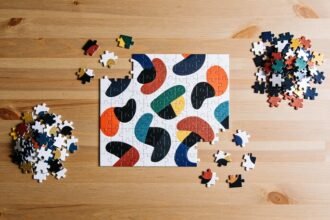
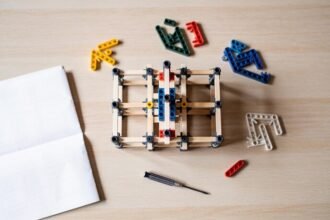
Some toys have one correct outcome, like a puzzle with a single solution. Others are genuinely open-ended, like building blocks or loose parts, where a child sets their own goal. Both have a place, but an open-ended toy generally holds a child’s interest longer and stretches with them as they grow, while a single-outcome toy is often finished once solved.
Read past the box description to the actual mechanic: does the child press a button and watch, choose from a fixed set of outcomes, or genuinely construct or problem-solve something themselves? The more the child does, the more the “educational” claim tends to hold up in practice.
Match age range honestly, not aspirationally
It is tempting to buy slightly ahead of a child’s current age, expecting them to grow into a toy. For most educational toys, this backfires: a toy genuinely beyond a child’s current stage is frustrating rather than stretching, and often gets abandoned before the child is ready for it.
Use the stated age range as a starting point, then weigh it against what you already know about your specific child’s current skills, not their age on paper. Toy rotation: how to make the same toys last covers how to keep a toy relevant for longer once you have made this match.
Check whether skill actually transfers
A toy that teaches a skill only usable within that toy is less valuable than one where the skill applies elsewhere. Sorting by shape, basic counting, or fine motor control learned through a well-designed toy tends to show up in other parts of a child’s play and daily life. A toy with a very narrow, toy-specific skill is not wrong to buy, but it should not carry the same weight in your decision as one with broader transfer.
Check the safety marking and small-parts warning
Toys sold in Australia intended for young children are generally required to meet mandatory Australian safety standards covering choking hazards and other risks, and should carry appropriate age and small-parts warnings on the packaging. Always check the specific product’s current packaging and any recall notices rather than assuming an older toy or one bought overseas meets current Australian requirements.
Weigh durability against how long interest will last
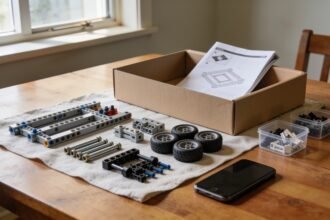
A toy that will only interest your child for a few months does not need to be the most durable option on the shelf. Conversely, a toy intended to be used daily for years, such as an open-ended building set, is worth spending more on construction quality for. Free STEM activities using household items is worth trying first if you are not yet sure a purchased set is needed at all.
Your next step: before your next toy purchase, check the age range against your child’s actual current skills and confirm the safety marking on the packaging.
The one-page family week
One printable page that holds the whole week: meals, school, activities and who is doing the pickup. Free, and we send one useful email a week.
One email a week. No spam, unsubscribe in a click.