What is in this guide
Store educational toys by complete activity: keep the pieces, instructions and reference picture together, then give each set a defined home. For rotation, swap a packed, ready-to-use activity into the available space while leaving any project still in progress alone.
If you are working out how to store kids toys, start with one shelf or cupboard section and the containers you already own. The aim is to be able to take out an activity and put it away without searching several boxes.
1. Decide what belongs together
Choose one group to sort first, such as puzzles or learning games. Lay out each set beside its instructions, board, cards or picture. Check the contents against a supplied list where there is one.
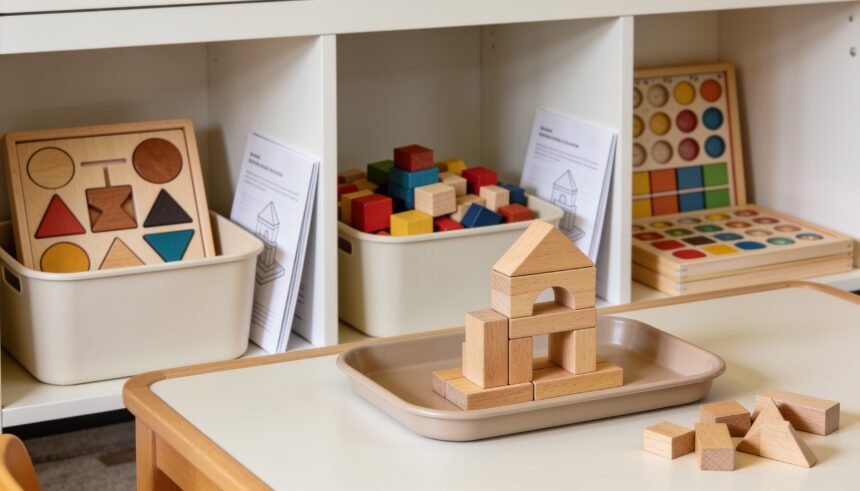
Use the activity as the unit of storage. A matching game belongs with its cards and rules. A puzzle belongs with its own pieces and completed-picture reference. Loose construction pieces can share a container when you deliberately use them as a mixed building collection.
Keep model-specific pieces together if the child wants to rebuild that model. Otherwise, ask whether those pieces should join the general building collection. Neither approach needs to become a rule for every set in the house.
Put an incomplete activity aside with a note naming what is missing. Distinguish between a missing optional piece and something needed to play the game as written. Do not mark the set ready for rotation until you have decided how it will be used.
2. Match the container to the activity
Try the original packaging before transferring everything. Keep it when the insert, picture or compartments are useful. If you change containers, retain the instructions, identifying details and any supplied warnings.
| Activity | Suggested storage | Trade-off to check |
|---|---|---|
| Jigsaw puzzle | Original box, or a separate container with its reference picture | A smaller container saves room only if the pieces and picture still fit comfortably |
| Learning game | Keep board, cards, counters and rules together | Several small compartments mean more sorting at pack-up |
| General building collection | One broad container, with a separate section only for pieces you regularly search for | Detailed colour sorting adds work; one mixed container means more searching |
| Model-building set | Its own container with the booklet and required pieces | Keeping every model separate takes more cupboard space |
| Pattern or matching activity | A shallow tray or original box holding both pieces and activity cards | An open tray needs a place where it can remain together between uses |
Before choosing a permanent home, practise taking the container out and returning it. Check that there is room for the lid, booklet and any awkwardly shaped board. A container that fits only when carefully repacked may be more effort than you want at the end of the day.
3. Give each set a recognisable home
Use a short label naming the actual activity, such as “shape puzzle”, rather than a broad heading such as “educational”. Add a photograph of the set if that suits your household better than written labels.
Match the label on the container to its storage position. You do not need a full inventory: start with enough information for another adult to return the set without asking where it belongs.
Keep the organising categories broad unless a specific search problem warrants more detail. If nobody looks for building pieces by colour, there is little reason to make colour sorting part of every tidy-up.
4. Reserve a place for unfinished work
Agree on one temporary project space, such as a tray that can move off the dining table. Keep the remaining pieces and instructions with the project where practical.
Before packing it away, ask whether the child intends to continue. For a model they want to remember but dismantle, offer to take a photograph. Treat that as a choice, not a requirement to break up work on a schedule.
In a small home, define the limit by available space: one project tray may be all the room you can spare. If a project will not fit, agree on when the shared table needs to be clear before starting it.
5. Rotate complete activities into the available space
Choose an activity that is ready to use and put it where the outgoing set lived. Return the outgoing set with its pieces and instructions together. Leave a frequently used set or active project in place if it still earns its space.
Use a household checkpoint, such as the start of school holidays or an ordinary cupboard tidy, to ask what should come out next. This is a suggested reminder, not a recommended interval based on research.
For the wider system of choosing what stays out and what rotates, see toy rotation. Here, the useful check is simpler: can this particular activity come out complete?
What if there is only one cupboard?
Give the current selection one section and the packed selection another. Avoid creating more rotation groups than you have room to store. If an activity needs several containers, label them as belonging together and keep them in the same section.
You can also skip rotation and keep a smaller permanent selection. The storage method still applies. For activities without another boxed set, free STEM activities using household items provides a separate starting point.
Start with one activity today: reunite its pieces and instructions, choose its container, and give it a home. Use the next pack-up to decide whether the arrangement is simple enough to repeat.
How we checked this
Last checked on 19 September 2026. This is an editorial organisation guide. The container choices and workflow are suggestions, not results from household testing. No claim is made that rotation improves learning or that a particular number of toys or swap interval is best.
The one-page family week
One printable page that holds the whole week: meals, school, activities and who is doing the pickup. Free, and we send one useful email a week.
One email a week. No spam, unsubscribe in a click.