What is in this guide
Start passing on outgrown STEM toys by checking each set against its contents list, keeping the instructions with it and describing anything missing. Sell a set if you can explain exactly what the buyer gets and the listing effort suits you; otherwise, offer it to someone who wants those particular pieces.
Decide whether the set is ready to leave
Ask your child which sets they have finished with before opening every box. Separate toys they want to keep from those ready to pass on, and put uncertain choices aside for another conversation. You do not need to settle the whole cupboard in one afternoon.
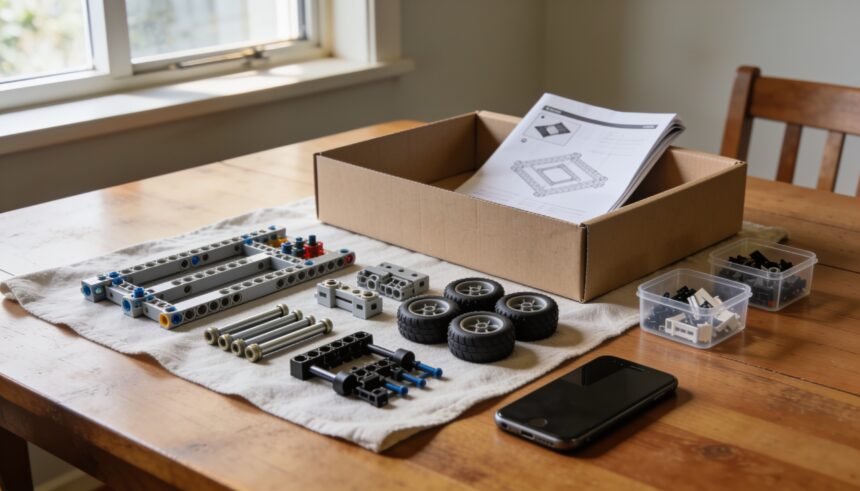
Choose one set to prepare first. Put its box, loose pieces, instructions and accessories on a clear table. Keep unrelated pieces outside this working area so they do not accidentally become part of the listing.
For toys staying in your household, use storing and rotating educational toys to keep their pieces together. The job here is different: give the next household an accurate picture of what they will receive.
Check what is actually in the box
Use the original contents page or parts list where you have it. Count by type rather than making one total pile: wheels with wheels, connectors with connectors, puzzle cards with puzzle cards. Tick off what you find and write down gaps immediately.
If there is no reliable reference, describe the contents you can identify and say that completeness has not been verified. A full-looking box is not a reason to call a set complete.
Adapt the check to the toy:
- Construction sets: Separate a named model kit from a mixed collection of building pieces. Describe a mixed collection as a bundle, rather than attaching a set name you cannot confirm.
- Puzzles and logic games: Check challenge cards, answer booklets, boards and playing pieces separately. Mention a missing booklet even when all the physical pieces are present.
- Science activity kits: Record which supplied materials have been used up and which activities have already been completed. Do not describe a partly used kit as ready for every original experiment.
- Electronic or coding toys: Identify the controller, leads, instructions and any stated app requirement. Keep observations narrow: switching on is not evidence that every function works. Say what remains unchecked.
Set aside damaged equipment or items needing repair rather than including them in a ready-to-use bundle. Follow the manufacturer’s guidance for questions about condition or suitability; a contents check cannot answer those questions.
Choose a route that fits your time
Use the condition record to decide what to do next. These are practical options, not predictions about what will sell.
| What you have | A sensible next step | The trade-off |
|---|---|---|
| An identifiable set with checked contents | Prepare an individual listing | More photographs and messages for one item |
| Mixed building pieces with no confirmed original set | Offer a clearly described bundle | Less sorting, but no claim of completeness |
| A set another family has specifically requested | Arrange a direct handover | No sale proceeds, but no public listing to manage |
| A kit with missing essentials or unresolved faults | Pause and clarify what remains usable | Avoid promising a finished activity you cannot supply |
Before offering toys to a school, toy library or charity, ask whether it wants that exact type of set and condition. Send a photograph and contents summary first. Do not make an unconfirmed donation trip part of an already busy school run.
If selling, compare like-for-like sets in similar condition before choosing your asking price. Treat asking prices as sellers’ requests, not proof of completed sales. Decide how long you want to handle enquiries and what you will do if the set remains unsold. A collection-only listing may suit a bulky box, provided collection is practical for your household.
Write a description someone can act on
Photograph the whole set laid out, then the identifying details, accessories and visible wear. Show the actual contents rather than relying on the picture on the original box.
Build the description from your notes:
Set name or type: [identify it]. Included: [list contents]. Missing or used up: [list gaps]. Instructions: [included or absent]. Condition and functions checked: [specific observations]. Collection or postage: [arrangement].
Delete any field that does not apply. Avoid vague labels such as “everything included” unless you checked against a reliable list. If the toy specifies an app, report that requirement and any compatibility you have actually confirmed; do not promise it will work on the recipient’s device.
For a gift, share the same information privately. The next family still needs to know whether it is receiving a complete activity or spare pieces for something it already owns.
Pack for the next person to open
Clean the toy according to its care instructions and pack only once it is dry. Keep each set separate, put its instructions alongside it and include the missing-parts note. Retain original age guidance and product information where available.
Use smaller containers within the box to keep different components together during transport. Keep identifying details visible rather than covering them with a new label. Before closing the box, compare its contents with your photographs and description one last time.
Your next step: choose one outgrown set, write its contents and gaps on a single sheet, and decide whether to list it or offer it to a specific recipient.
The one-page family week
One printable page that holds the whole week: meals, school, activities and who is doing the pickup. Free, and we send one useful email a week.
One email a week. No spam, unsubscribe in a click.