Do something physical first.
A child confined indoors has unspent energy, and starting with a quiet activity fails because the energy is still there. Twenty minutes of movement first makes everything afterwards work.
Then sort by how long things last, because on a wet day the useful question is not what to do but what will still be going in forty minutes.
Everything below uses what is already in an ordinary house.
Start here: the physical ones
Obstacle course. Cushions, chairs, a broom between two seats, masking tape lines on the floor. Time it, because the timing is what makes them run it eleven times instead of once.
Balloon keepy-uppy, if a balloon exists. Cannot touch the floor.
Sock basketball into a washing basket, with a scoring system and increasing distances.
Dance competition, judged by whoever is cooking.
Indoor bowling with plastic bottles and a soft ball.
Hide and seek, which still works at nine and ten more than people expect.
Animal races down the hallway: crab walk, hop, bear crawl.
Supervise anything involving climbing or height, and clear the hard edges first.
The long ones: an hour or more
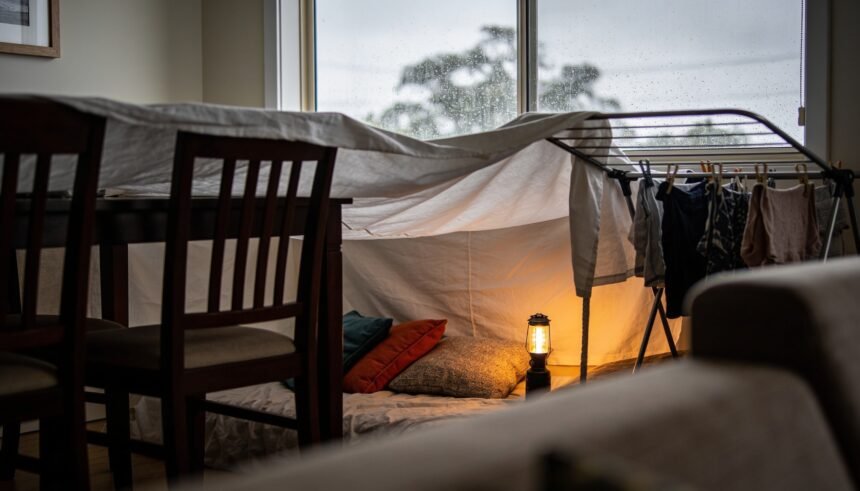
Fort building. Sheets, clothes airers, dining chairs, the sofa. The building is most of the activity and the occupying is the rest. This is the single highest value wet day activity for primary-aged children and it improves with ambition.
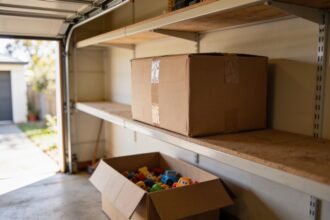
Cardboard construction. A large box becomes anything. Tape, scissors and time.
A long Lego or block build with a stated goal, which lasts far longer than free building.
Cooking something. Measuring, mixing and waiting, and it produces food. Biscuits, pizza dough, scones, bread.
A stop-motion film made on a phone with toys. Genuinely absorbing for eight to twelve year olds and it takes hours.
Setting up a shop, a restaurant or a museum and making everyone visit it. Signs, tickets, prices, the lot.
A treasure hunt they design for you, which reverses the usual effort and is far better for the adult.
The medium ones: twenty to forty minutes
Board games and card games, which need no explanation and are underused because they are in a cupboard rather than out.
Drawing challenges. Draw with your eyes shut, draw with your other hand, draw what the person next to you describes.
Paper aeroplane competition, three designs, measured distances, recorded. This is also the STEM activity in free STEM activities using household items with the effort removed.
Origami from a phone tutorial.
A jigsaw, on a tray so it can be moved.
Making a comic, folded paper stapled into a book.
A room in the house redesigned on paper, measured and drawn to scale, which is applied maths that children do voluntarily.
Sorting and organising something. A shelf, a toy box, a collection. Some children find this genuinely satisfying.
Letter or card writing to a grandparent, which is an actual event when it arrives.
The short ones: filling a gap
Simon says, charades, twenty questions, memory tray. All zero preparation and useful for resetting a bad twenty minutes.
Reading aloud to them, above their reading level, which works far past the age people assume, as in getting a reluctant reader reading.
A ten minute tidy with a timer, competitive, which is not an activity but it does count.
Using a screen deliberately
A defined block, agreed in advance, with a clear end is a legitimate tool on a long indoor day and is completely different from a screen that expands because nobody decided anything.
A film as an event rather than background: blinds down, something to eat, everyone watching.
Something made rather than watched: the stop-motion film above, a photo project, a slideshow, learning something specific.
The difference between a good screen block and a bad one is whether it was decided or surrendered to, which is the same point made in beating the 4pm to 6pm witching hour.
When it is heat rather than rain
In much of Australia the indoor day is caused by temperature rather than weather, and that changes things.
Water becomes available again. An early or late paddling session, a bath in the middle of the day, water play on a towel-covered floor for younger children, or an outing to an air-conditioned library or pool.
Move outdoor play to the edges of the day, before about ten and after about four, and treat the middle as indoor time rather than a lost day.
Ice is an activity. Frozen toys in a container, ice cubes with food colouring, an ice cube race.
When it is a whole wet week
One long project that continues across days does more than a different activity every afternoon. The fort stays up. The cardboard build continues. The stop-motion film gets finished.
Rotate through the categories rather than repeating the most successful one until it dies.
Get outside anyway, in gumboots. A wet walk is frequently the best thing in a wet week, and Australian rain is generally warm.
Lower the standard. A wet week is not the week to be strict about screens, tidiness or routine, and a household that tries to hold everything together across five indoor days ends worse off than one that let some of it go.
Next: beating the 4pm to 6pm witching hour covers the hardest part of an indoor day, backyard activities that cost nothing covers the moment it clears, and free STEM activities using household items covers the ones that are also educational.
The one-page family week
One printable page that holds the whole week: meals, school, activities and who is doing the pickup. Free, and we send one useful email a week.
One email a week. No spam, unsubscribe in a click.