What is in this guide
This is general household organisation guidance, not legal, tax or financial advice. Retention periods vary by situation, and anything specific to your circumstances belongs with the ATO, your accountant or your solicitor. What follows is a sorting framework for an ordinary household.
Most of the paper in a family home can go. A small amount must never be thrown out. A middle group has a sensible keeping period. The reason paperwork accumulates is that these three are stored together, so the whole pile feels risky to touch.
Sort them apart and the problem mostly disappears.
Category 1: Never destroy
These are originals that are painful or expensive to replace, and a scan is not a substitute.
- Birth certificates
- Marriage and divorce documents
- Death certificates
- Citizenship and naturalisation documents
- Passports, current and the immediately previous one if it contains a valid visa
- Wills, powers of attorney and advance care directives
- Property titles and conveyancing documents
- Vehicle ownership documents
- Original academic certificates and qualifications
- Adoption and guardianship documents
- Superannuation fund records and any binding nomination
- Insurance policy documents for anything current
Store these together, in one container, and know where it is. Details on that below, because it matters more in Australia than in most countries.
Category 2: Keep for a defined period
This is the group people agonise over, and most of it is straightforward.
Tax-related records. The ATO sets record keeping periods for individuals and businesses and publishes them clearly. Check the ATO’s current guidance rather than a rule of thumb, because the period differs depending on what the record relates to and whether a return is amended. Anything supporting a deduction sits in this group: receipts, statements, logbooks, work-related expense records.
Receipts for anything under warranty. Keep for the warranty period plus a margin. Australian Consumer Law also provides remedies independent of a manufacturer’s warranty, and a proof of purchase is what makes any claim straightforward, so a receipt for an expensive item is worth keeping well past the stated warranty.
Receipts for major purchases and home improvements. Useful for insurance claims, and relevant if a property is ever sold in circumstances where cost base matters.
Bank and credit card statements. Available online from most institutions for a period, and worth downloading the ones you might need rather than relying on them remaining available.
Medical records, test results and specialist letters. Worth keeping indefinitely in practice, because a history is genuinely useful and nobody else keeps a complete one for you.
School reports. No obligation, and most families keep them.
Rental records: the lease, the condition report, the bond receipt. Keep for the tenancy and a period after it. The entry condition report is the single most valuable document in a rental and is routinely lost.
Employment records: contracts, payslips, superannuation statements. Payslips matter more than people assume, particularly for checking that superannuation was actually paid.
Category 3: Keep while current, then bin
- Utility bills once paid and out of any relevant record keeping period
- Insurance policies once superseded by the renewal
- Manuals for appliances you still own, though almost all are online
- Product warranties that have expired
- Bank statements beyond what you need
Category 4: Bin now
- School newsletters
- Junk mail and catalogues
- Expired vouchers
- ATM receipts
- Anything from an account that is closed
- Duplicates of anything digital
- The photocopy you made just in case
Digital or paper
Scan Categories 2 and 3. Keep Category 1 as physical originals.
A scanned copy is fine for tax records, receipts and statements, and the ATO accepts electronic records provided they are true and clear reproductions and remain accessible for the required period. That last part is the catch: a scan on a laptop that dies is not a record.
Three rules for the digital half:
Back it up in two places, one of them not in the house. Cloud storage or an external drive kept elsewhere. A single copy is not a backup.
Name files so they are findable. Date first, in year-month-day order, then what it is. A folder of files named “scan001” is not a filing system.
Check annually that you can still open them. File formats and services change.
Storing the originals in an Australian house
This is the part that most filing advice skips and it matters here more than almost anywhere.
Australian households face bushfire and flood risk, and the documents in Category 1 are exactly what is hardest to replace after either. State emergency services and fire services publish household emergency planning guidance and it consistently includes preparing important documents.
Practical version:
One grab bag or container holding the Category 1 originals, kept somewhere you can reach quickly on the way out.
A complete scan of every Category 1 document, stored somewhere not in the house. This does not replace the originals and it makes replacing them enormously easier.
A list of what is in the container, which is what you will need when you are trying to remember what was lost.
Consider a safe deposit facility or a fireproof container for the most critical originals, and follow your state emergency service’s guidance on what to include in an emergency kit.
If you are moving house, the Category 1 container travels with you rather than in the truck. The first-night box covers what else belongs in that category during a move.
Doing the sort
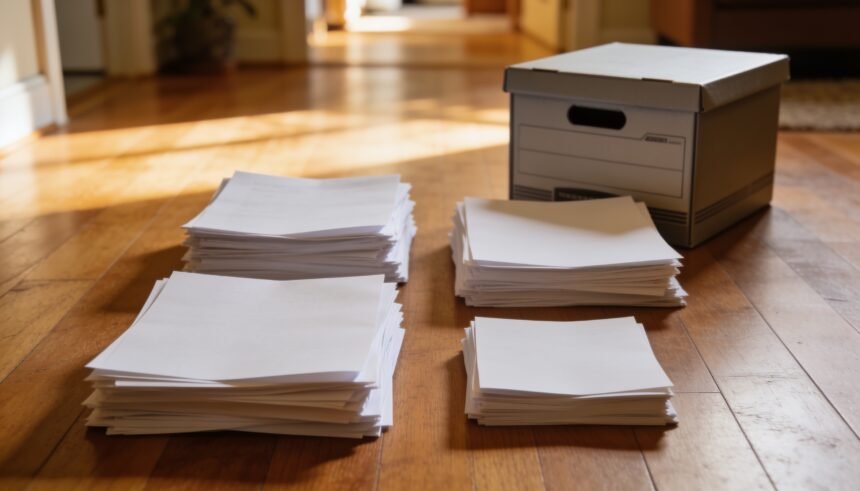
One afternoon, four piles on the floor, matching the four categories above. Do not read things. Sort them.
Then, in order: bin Category 4 immediately. Put Category 1 in its container. Scan Category 2. Decide on Category 3 last, because it is the one that generates indecision.
Anything you genuinely cannot categorise goes in a box labelled with the date. Look at it in two years. If you have not opened it, it can go.
Keeping it from rebuilding
The weekly ten-minute admin slot from the school-year calendar setup is what stops it. Paper that is triaged weekly never becomes a pile.
Go paperless on everything that offers it, which removes most of Category 3 at the source.
One in, one decision. Every piece of paper that enters the house gets categorised at the moment it enters, not put on the bench.
Next: setting up the family year in January covers the dates, the school-year calendar setup covers the weekly flow, and the first-night box covers moving with the originals.
The one-page family week
One printable page that holds the whole week: meals, school, activities and who is doing the pickup. Free, and we send one useful email a week.
One email a week. No spam, unsubscribe in a click.