What is in this guide
Nail trimming fails for a behavioural reason, not a technical one.
The usual pattern: the nails get long, someone attempts all of them in one sitting, the dog objects, someone cuts too far, it bleeds, and the dog now has a permanent association between clippers and pain. The next attempt is harder, and so is every attempt after that.
The fix is to do less, far more often. One nail a day, for a calm dog, is more effective and less stressful than sixteen nails once a month.
Why it matters
Nails that are too long change how a dog stands. They push the toes back and alter weight distribution, which over time affects comfort and gait.
Very long nails can curl into the pad, which is painful and needs veterinary attention.
Dewclaws are the ones people forget. They do not touch the ground, so they never wear, and they are the ones that most often curl. Check them every time.
If you can hear clicking on hard floors, the nails are longer than ideal. That is the simplest test there is.
Dogs walked mostly on grass wear nails less than dogs walked on footpaths, which is why an urban dog walked daily on concrete may need very little trimming and a suburban dog on lawn may need a lot.
Finding the quick
The quick is the blood vessel and nerve inside the nail. Cutting it hurts and bleeds, and it is what creates the bad association.
On pale nails it is visible as a pink triangle. Cut well outside it.
On dark nails you cannot see it, which is where most people go wrong. Two approaches:
Look at the cut end. Take a very small amount off, then look at the exposed surface. It will be chalky and white. As you get closer to the quick a small dark dot appears in the centre. Stop at the dot.
Cut small slices repeatedly rather than one big cut. Each slice is a chance to check.
Cut at roughly a forty-five degree angle, following the natural curve, rather than straight across.
The quick grows out with the nail. A dog with long-neglected nails has long quicks, which means you cannot get to a short nail in one session. Trimming small amounts frequently causes the quick to recede over weeks, and that is the only way there.
The two-week rebuild for a dog that objects
If your dog already hates this, do not attempt a trim. Rebuild first.
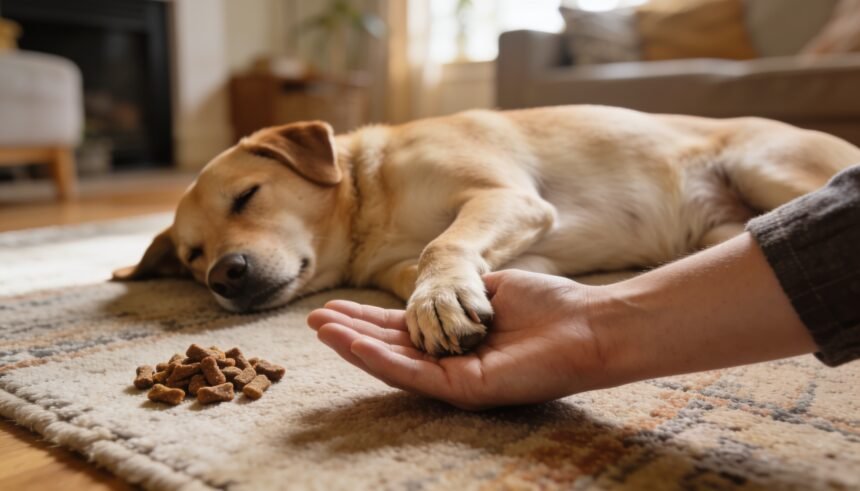
Days 1 to 3: touch only. Pick up a paw, one second, treat, release. Several times a day. Nothing else happens.
Days 4 to 6: hold and separate. Hold the paw, touch individual toes, treat, release. Still no clippers in sight.
Days 7 to 8: introduce the tool. Clippers on the floor near the dog. Treat for looking at them, treat for sniffing them. Do not touch the dog with them.
Days 9 to 10: tool touches paw. Clippers touch the nail without cutting. Treat, release.
Day 11: one nail. One, a tiny amount, treat, and stop for the day even if the dog seems fine. Especially if the dog seems fine. Ending early is what builds the association.
Days 12 to 14: one nail a day.
This is marker training and it works considerably better with a marker, as in clicker training in ten minutes a day.
Watch the body language throughout. Pulling the paw away, lip licking, head turning, freezing and whale eye all mean go back a step. Dog body language every family should recognise covers reading it.
Practical details
Position matters. Most dogs hate being loomed over. Sit beside or behind the dog rather than in front, or have a large dog lie on its side.
Support the paw firmly but gently. A wobbling paw makes a bad cut more likely.
A grinder is an alternative to clippers and some dogs tolerate it better, though the noise and vibration suit others less. Introduce it with the same gradual process.
Two people helps, one feeding continuously while the other trims.
Do it when the dog is tired, after a walk rather than before one. And not in the heat of the day, when tolerance for handling is lowest.
No product is named in this article, because the technique and the behaviour matter far more than the tool, and none has been verified here.
If you cut the quick
It will bleed and it can bleed more than you expect. Stay calm, because the dog is reading you.
Apply firm pressure with a clean cloth. Styptic powder or a styptic pencil, if you have one, stops it faster, and cornflour is a common household alternative.
Keep the dog still and quiet until it stops.
Contact your vet if bleeding does not stop, if the dog is in ongoing pain, or if the nail looks damaged rather than just cut short.
Then stop for that day. Do not finish the other nails. And expect to need to rebuild some trust afterwards.
When to use a professional
There is no failure in this. A vet nurse or a groomer does this constantly, quickly and calmly, and for many dogs it is the better outcome.
Use a professional if: your dog is genuinely frightened, the nails are badly overgrown, a nail has curled into the pad, your dog is large and strong and you cannot safely restrain it, or you simply do not want to.
A vet visit is the right call for a curled or embedded nail, any infection, limping, or bleeding that does not stop.
Some dogs need sedation for grooming, which is a veterinary decision and not something to arrange informally.
Next: clicker training in ten minutes a day covers the marker work the rebuild depends on, dog body language covers knowing when to stop, and dog barking at everything covers the wider stress picture.
The one-page family week
One printable page that holds the whole week: meals, school, activities and who is doing the pickup. Free, and we send one useful email a week.
One email a week. No spam, unsubscribe in a click.