What is in this guide
Do this on the floor. Genuinely, on your hands and knees, in each room the puppy will be allowed into.
Almost everything a puppy gets into is invisible from standing height: the cable behind the couch, the gap under the bookshelf, the corner of the rug, the thing that rolled under the fridge in 2023. Twenty minutes at puppy height finds more than an hour of thinking about it.
Do it before the puppy arrives, because the first week is not when you will have time.
The four things that actually matter
Everything below is a version of one of these.
- Things that can be swallowed. The largest category by far, and the one that ends in surgery
- Things that can be chewed while live or under tension. Cords, cables, blind cords
- Gaps. Anywhere a puppy can get into and not out of, or out of and not back
- Chemicals and plants
Room by room
Everywhere
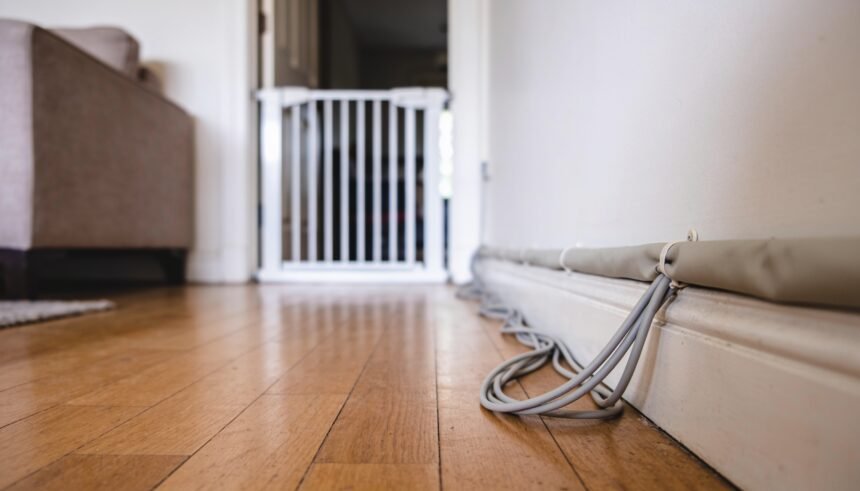
- Power cords and phone chargers. Route them behind furniture, into cable sleeves, or unplug and put away. A chewed live cable is the one indoor hazard that can kill quickly
- Blind and curtain cords. Secured high and out of reach. These are already a legal requirement in Australian homes because of the risk to children, and a puppy is the same problem at the same height
- Rugs with fringing or loose threads. Fringe is a chew toy that unravels into something swallowable
- Anything small at floor level. Hair ties, socks, kids’ toys, coins, batteries, bread tags, corks, bottle caps. Socks and hair ties are the classics
- Handbags and school bags on the floor. They contain medication, gum and food, and they sit at exactly puppy height
Kitchen and laundry
- Bin with a lid that latches, or a bin behind a door. The kitchen bin is the single most attractive object in the house
- Cleaning products up high or behind a childproof catch, not under the sink
- Dishwasher closed. An open dishwasher door is a platform and the contents are coated in food residue
- Washing machine and dryer doors closed. Puppies climb into them
- Know what is toxic in the pantry. Chocolate, grapes and sultanas, onion and garlic, macadamias, and anything containing xylitol, which is in sugar-free gum, some peanut butters and some baking products
Lounge and bedrooms
- Under and behind the couch, which collects exactly the objects on the swallowable list
- Remote controls and their batteries. A swallowed button battery is a genuine emergency
- Shoes away, which is less about safety and more about your shoes
- Block the gap under and behind low furniture where a puppy can wedge and panic
Bathroom
- Toilet lid down, particularly if you use an in-cistern or in-bowl cleaning block
- Medication in a cupboard, never in a bedside drawer that opens
Confine rather than supervise
The most useful thing in this whole article is not a hazard, it is a strategy.
A puppy that has run of the house has to be watched continuously, which nobody manages. A puppy that has a small, proofed area is safe without being watched, and everyone sleeps.
- Baby gates on doorways, or an exercise pen in the main living area
- One or two rooms to start, expanding as the puppy earns it
- Hard floors are easier than carpet in the first months, for reasons that will become obvious during toilet training
- Somewhere to be alone that is not a punishment, which is also what makes a crate work rather than being a fight
The garden, which is the other half
Two separate problems: getting out, and eating something.
Getting out
- Walk the fence line and look at the bottom. Puppies go under, not over. Gaps between palings, worn ground under a colourbond fence, the space beside a gate post
- Gate latches. A latch a person can nudge open is a latch a dog can nudge open. Add a second catch, and a spring closer if children use the gate
- Check under the house and block access to the subfloor
- Pool fencing is a legal requirement for children and it is not a dog barrier. Pool gates have a gap at the bottom on purpose, and a small puppy fits through it. If the yard includes a pool, that is a separate conversation and a real drowning risk, because a puppy that falls in cannot climb out at the corners
Eating something
- Snail and slug baits, rat baits and insecticides. These are the most common serious poisonings in Australian dogs, and the baits are designed to be palatable. If you have a puppy, they do not go down at all, including in the shed
- Fertiliser, and particularly anything containing blood and bone, which dogs find extremely attractive and which can cause serious illness
- Compost. Decomposing food waste is a genuine hazard. Make the bin dog-proof or close it off
- The dog’s own food bag, which a puppy will get into and then gorge on. It belongs in a sealed container off the floor, and storing pet food so it does not go off covers where
- Mulch. Cocoa bean mulch is toxic to dogs and is sold in Australia. Use a different mulch
- Plants. Several very common Australian garden plants are toxic to dogs, including oleander, brunfelsia (yesterday-today-and-tomorrow), cycads and sago palms, lilies, azalea, and the bulbs of daffodils and similar. Cycad and brunfelsia poisonings in particular are well known to Australian vets
- Mushrooms, which appear overnight after rain and cannot be identified by a household
Identifying every plant in a new garden is a real job and worth doing once. A local nursery will identify a cutting, and if you are redesigning anyway, a pet-friendly garden is easier than auditing one you inherited.
If you think your dog has eaten something, the Animal Poisons Helpline is a free Australian service and your vet is the other call. Make the call early rather than waiting to see what happens, and take the packet or a photo of the plant with you. This article does not cover what to do next, because that is a veterinary decision and not a household one.
Before day one, the short list
- Floor-level sweep of every room the puppy will use, done on the floor
- Cords routed or removed, blind cords secured high
- Bins closed, chemicals up, medication away
- Gate or pen set up and the confined area decided
- Collar and harness bought and adjusted, which is its own small job and is covered in fitting a collar and harness properly
- Fence line walked, bottom checked, latches tested
- Baits removed from the property entirely
- Toxic plants identified, and a plan for the ones staying
- Vet’s after-hours number and the Animal Poisons Helpline saved in your phone before you need them
The one-page family week
One printable page that holds the whole week: meals, school, activities and who is doing the pickup. Free, and we send one useful email a week.
One email a week. No spam, unsubscribe in a click.