What is in this guide
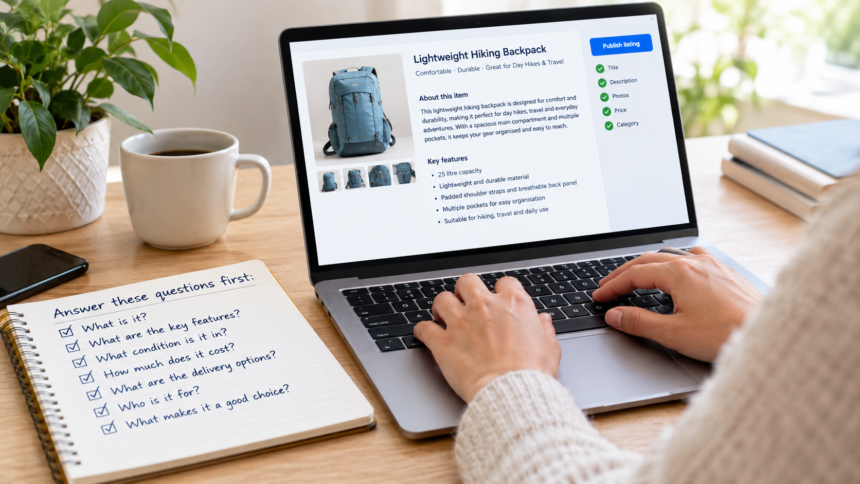
When writing a marketplace listing, put the answers to the five questions buyers ask most at the top: what exactly it is, what condition it is in, what is included, how big it is and how they can collect it. Write those in plain sentences before anything else, then check every line against the item and the photographs.
A well-written listing cannot guarantee a sale. Its job is to remove the reasons a buyer has to message you, and the reasons a sale falls over at pickup because something was not mentioned. If you are still deciding what to list, start with the guide to selling secondhand kids gear as income.
1. Write the title as the answer to “what is it?”
Use the words a buyer would type. Name the item type, the brand or maker if it has one, the size or model, and one distinguishing fact, in that order. “Kids bike 16 inch blue with training wheels” tells a searcher more than “Great little bike, must go”.
Leave out filler such as “look”, “bargain” or a row of exclamation marks. They take up space the size or model could use, and they do not answer anything.
Keep private details out. A street name, a school name on a uniform or a child’s name on a label do not belong in a public title or description.
2. State the condition, including the flaws
eBay Australia’s selling practices policy asks sellers to specify the condition of the item and to describe any defects or flaws, and it notes that this helps avoid problems or buyer dissatisfaction. That is sound guidance for any marketplace, not just eBay.
Write condition as a short factual sentence followed by the specific wear. “Used, working. Scratch on the left side about the length of a finger. Zip pull replaced with a key ring.” A buyer who reads that and still asks to collect is unlikely to walk away at the door.
Avoid condition words you cannot back up. “As new” means nothing was used and nothing is marked. If that is not true, say “used, light wear” and describe the wear. Do not describe a set as complete unless you have counted it.
Match the wording to the photographs. If a photo shows a mark, the description names the same mark in the same place. The guide to photographing secondhand items so they actually sell covers how to take those pictures.
3. List exactly what is included, and what is not
Write the contents as a list, one line per item. For a cot, that might be the frame, the mattress base and the instructions, with the mattress excluded. For a board game, the pieces counted against the box list.
Name the exclusions plainly. If the photo shows a chair beside the desk you are selling, say the chair is not included. If a charger or remote is missing, say so instead of hoping nobody asks.
For a bundle, say whether you will split it. A single sentence, “sold as a bundle, not splitting”, saves a run of messages asking for one piece.
4. Give the measurements a buyer cannot see
Write the dimensions in centimetres for anything that has to fit a space, a car boot or a child. Height, width and depth for furniture. Age or size label and the actual measured length for clothing. Wheel size and seat height for a bike. Weight if the buyer will need to carry it.
Measure the item rather than copying a number from a retailer page. The retailer figure may describe a different version, and the buyer is fitting your item, not the catalogue one.
5. Say how the sale works
Finish with the practical terms, each in its own sentence:
- Price and whether it is firm or open to offers.
- Pickup suburb or area, not your street address, and the times you can do.
- Whether you will post, and if so who pays and roughly what packaging it needs.
- Payment you will accept at pickup.
- Whether you will hold an item, and for how long.
Deciding these before you publish means you answer once, in the listing, instead of separately to every message.
A plain template you can reuse
Copy this into a note on your phone and fill it for each item. It is a suggested order, not a platform rule.
| Section | What to write |
|---|---|
| Title | Item type, brand or maker, size or model, one distinguishing fact |
| Condition | One factual line, then each flaw and where it is |
| Included | One line per part; name any exclusions |
| Measurements | Measured dimensions in centimetres; weight if relevant |
| Sale terms | Price, pickup area and times, postage, payment, holds |
| Anything else | Age of the item if known, reason for sale if useful, pet or smoke-free home if true |
Keep the “anything else” section short and only include what is true. Do not add a line about a smoke-free home or original receipt unless it is accurate.
Read it back as the buyer before publishing
Open the draft and read it as someone who has never seen the item.
- Can you tell what it is from the title alone?
- Does every flaw in the photos appear in the text, and the other way round?
- Is anything pictured that is not included, and is that stated?
- Could a buyer work out whether it fits, without messaging?
- Do they know where, when and how to collect it?
- Is there any private information, name label or house detail visible?
If you keep a home inventory list with photos, your own record of the item’s age and original purchase can supply the “anything else” line without guessing.
Some items should not be listed at all, or need extra care. Recalled products, car seats past their date and anything with a safety standard attached are covered in what to buy secondhand for kids, and what not to; read the same guidance from the seller’s side before writing a listing for them.
How we checked this: Reviewed eBay Australia’s selling practices policy on 27 September 2026 for its condition and flaw-description requirements. The question order, template and read-through are editorial guidance; no listing, message count or sale outcome was tested.
Next step: Take one listing you already have live, rewrite it in the five-question order, and remove any line you cannot verify against the item in front of you.
The one-page family week
One printable page that holds the whole week: meals, school, activities and who is doing the pickup. Free, and we send one useful email a week.
One email a week. No spam, unsubscribe in a click.